July 27, 2026 | By Lisa Scagliotti 
Gov. Phil Scott speaks at his weekly press conference in his ceremonial office at the State House. Behind him (left to right) are Lisa Loomis, editor of the Valley Reporter and board member of the Vermont Journalism Coalition; Kristen Fountain, interim coordinator of the Vermont Journalism Coalition; Wendy Mays, executive director of the Vermont Broadcasters Association; and Rebecca Kelley and Erin Robinson, the governor’s chief and deputy chief communications officers, respectively.
In a move that can help support Vermont's print, broadcast, and digital newsgathering organizations, Gov. Phil Scott took a key step on Thursday to prioritize Vermont media outlets in state government’s advertising policy.
At his weekly press conference held in his ceremonial office at the State House, the governor signed an executive order that directs state agencies, departments and contracted marketing vendors to give preference to Vermont media outlets when deciding where to spend state advertising dollars. The order also outlines steps toward greater transparency around state advertising spending, calling for annual reporting on how much the state spends and where those ads are placed.
Gov. Scott noted in his remarks that the concept is a familiar one. “I’ve always been a supporter of ‘buying local,’ and that’s just as important for local newspapers and [broadcast] stations, as it is for our local hardware stores or farms,” he said. “We’re fortunate in Vermont to have regional newspapers and broadcasters who still serve their communities and play a vital role in reaching Vermonters – especially in our rural towns. It’s important that we don’t forget these channels as we’re trying to reach all Vermonters.”
Each year, the state of Vermont invests in advertising and paid media campaigns to put out messaging on a wide variety of topics, such as public health and safety news, promotions of state parks and lotteries, announcements of state regulations and policies, and more. The executive order directs state entities “to ensure these paid media purchases include local media and broadcast outlets whenever feasible and in the best interest of the state.”
According to the governor’s Chief Communications Officer Rebecca Kelley, the new order would apply to approximately $4 million to $5 million in annual state spending. State advertising spending to date has not been uniformly tracked across state government, making it difficult to say how much is currently being spent with in-state media outlets. The order’s annual reporting directive aims to clarify that going forward.
Advertising funds local news
Although Vermont has a strong local news media sector, the past several decades have seen a shift in traditional sources of advertising revenue as the internet has expanded and fragmented the array of options available to advertisers to reach consumers, jobseekers, and more. While international companies, including social media, attract advertising at all levels, local media organizations that generate local news coverage in Vermont—newspapers, radio and TV broadcasters, and online news sites—all still rely on and compete for advertising income.
The executive order acknowledges that local journalism strengthens state and local government and keeps communities connected. Recognizing the economic challenges facing both national and local news media, it emphasizes spending state advertising dollars in-state to, in turn, provide essential revenue for in-state news operations.
A recent study by Northwestern University’s Medill School of Journalism found that the number of journalists working in Vermont dropped by more than half (53%) between 2013 and 2023, a loss of more than 400 jobs. So far, however, Vermont communities have retained more of their local media organizations and journalists than elsewhere. The number of journalists over the same time period nationally dropped by 75%, according to the Northwestern University report.
Muck Rack and Rebuild Local News produce the Local Journalist Index, which has calculated a ratio of 7.8 local journalists per 100,000 people nationally in 2026. That’s fewer than one-quarter of the approximate 40 per 100,000 in 2002. Vermont’s 2026 ratio was more than 19 local journalists per 100,000 people, according to the index.
“We are lucky to still have around 50 active local news organizations in our state. Advertising with them is a smart way to reach Vermonters, but it also helps sustain these essential community resources,” said Kristen Fountain, interim coordinator for the Vermont Journalism Coalition.
Addressing the governor and the state officials gathered for the announcement, Fountain expanded on the governor’s “buy local” point. She noted that she lives in the Northeast Kingdom and regularly buys vegetables from the Pete’s Greens CSA, founded by vegetable farmer Pete Johnson. “His business has a motto that resonates with me a lot. It’s ‘Vermont can feed itself.’ Well, sharing accurate information is just as important as healthy food. I think Vermont communities can and must keep reporting on themselves, and I believe we can with your continued support.”
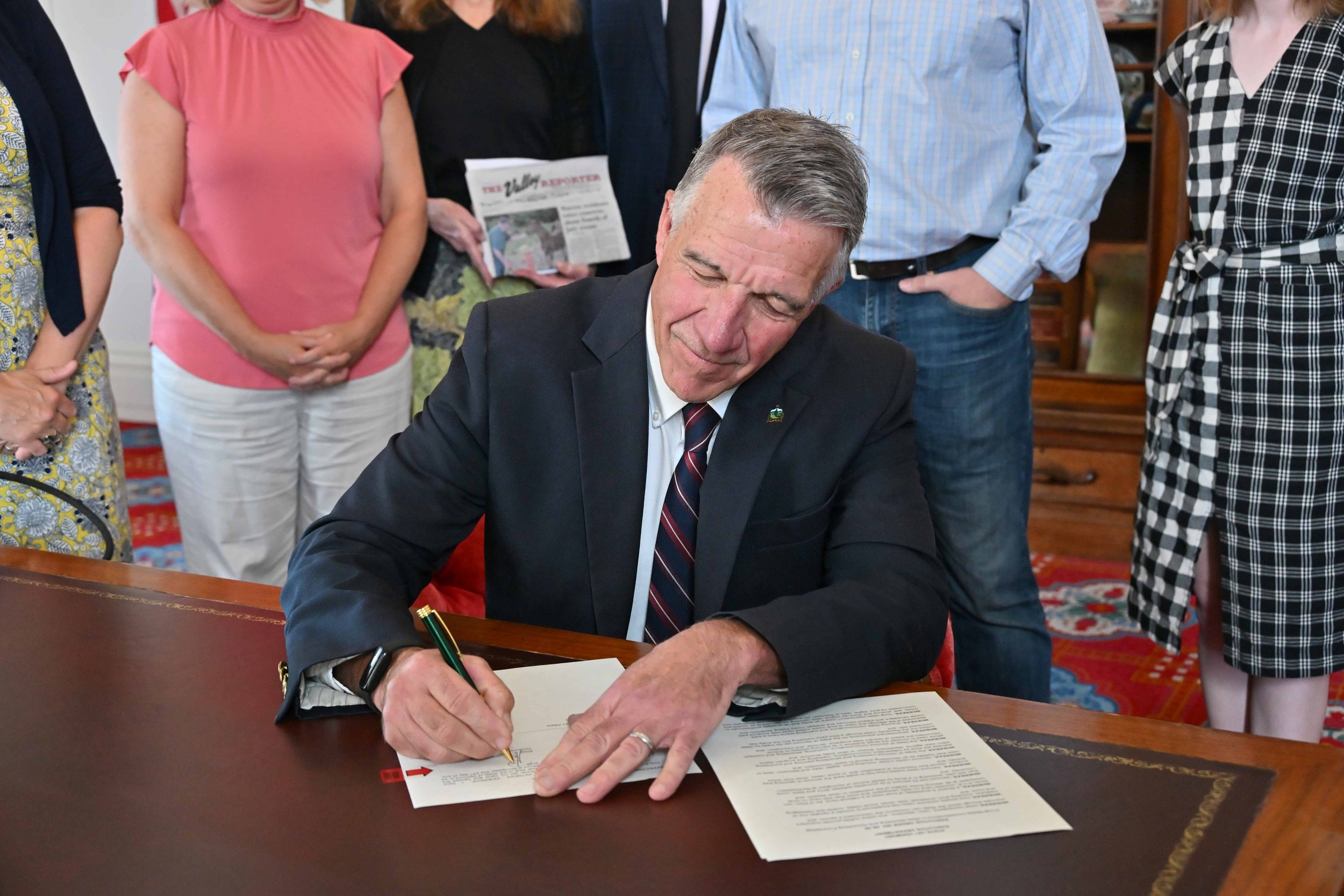
Gov. Phil Scott signs an executive order directing state departments and agencies to prioritize in-state media outlets when deciding where to spend state advertising dollars. Photo by Gordon Miller
Policy breaks new ground
Gov. Scott’s order is believed to be the first executive action of its kind nationwide. In May, the governor of Colorado signed a state budget in which lawmakers included a statement of intent that state agencies prioritize advertising and public outreach spending with local media organizations.
“Gov. Scott and the Vermont local news community have made history,” said Steven Waldman, president of Rebuild Local News. “This unique executive order encourages spending with Vermont-based media while giving agencies the flexibility they need. The extra support for community media will help Vermonters have better coverage of schools, health care, local businesses and their fellow residents – to make for more vibrant communities. This wouldn’t have happened without the dedicated work by local media leaders, key advocates in the legislature, and Gov. Scott and his staff. We are grateful.”
The governor was joined by members of the Vermont Journalism Coalition and the Vermont Association of Broadcasters who worked along with administration officials to create the executive order. They stressed the impact that directed state spending could have on the civic ecosystem in the state.
Lisa Loomis, owner, editor and publisher of The Valley Reporter, which covers the Mad River Valley region, thanked the governor and his team for taking this step to prioritize what will be support for local journalism in Vermont. “Directing state advertising dollars to local news media such as The Valley Reporter that connect Vermonters to their neighbors, and also their government, will help this critical part of local and state infrastructure survive and thrive,” Loomis said.
Wendy Mays, executive director of the Vermont Association of Broadcasters, agreed and said she was pleased to see all Vermont broadcast stations included in the executive order. “Vermont’s local radio and television stations are the voices and faces of the regions they serve,” Mays said.
In his remarks, the governor emphasized the importance of local news reporting as it connects citizens with their government. He pointed to one very recent example of how a new state law was changed once it became widely known to the public after it was passed. He pointed to Act 181, the land-use law from 2024 that was passed by the Legislature over his veto. Public opposition to the law, particularly from residents in rural Vermont communities, grew this year as it was being put into practice, ultimately resulting in parts of the act being repealed.
“I believe a big contributor to the harmful policies that come out of this building is the fact that rural Vermont is under-represented and far too often gets completely ignored,” Scott said, recounting that he made numerous objections to the law before it was passed.
“If we had had more local news outlets in those rural communities with the resources and staff to regularly cover what happens in Montpelier, maybe we could have saved ourselves two years, and the worst parts of the bill would never have passed in the first place,” Scott suggested. “That’s how important good, straightforward local news coverage is for our small communities.”
The governor said he would like to see Vermont’s news ecosystem thrive so that multiple news outlets could be covering state government. “The legislative work done in Montpelier every session has a significant impact on the lives of Vermonters. So I truly believe that a responsible, impartial press corps making sure people in all corners of the state know what’s happening is essential.”
Scott acknowledged that the new state directive is not likely to be transformational to local news coverage, but that it represents a value important for government to promote. “While I know this is a drop in the bucket, it’s an important gesture, and I appreciate the partnership as we share the goal to inform Vermonters of the things that impact their lives,” he said.
The order considers a local news organization to be one that engages professionals to create and distribute original news reporting on Vermont or its regions and communities, has at least one 20-hour per week employee, and has a physical presence in Vermont or an adjacent state. Local broadcast organizations are defined as operating in Vermont and licensed to broadcast by the Federal Communications Commission.
The executive order does not prevent the state from advertising with out-of-state media outlets. It also does not apply to paid media purchases focused on tourism by out-of-state visitors or employment advertising geared toward recruiting out-of-state candidates for state jobs.
The concept for the measure had its start in the 2025 legislative session when it was introduced as a bill, H.244, which passed the Vermont House. In the 2026 session, it failed to move forward in the Vermont Senate, leaving open the option to advance the initiative as an executive order from the governor.
Formed in 2025, the Vermont Journalism Coalition is a professional and support organization with 42 members producing news around the state via radio, television, print and digital media. Startup support has come from the University of Vermont Center for Community News and the Vermont Community Foundation. The Vermont Association of Broadcasters has represented broadcasters in the state since 1995.
Links to more information
See the governor’s announcement of the executive order, Local Media Considerations in State Marketing and Advertising Purchasing, online here. Find the full text of Executive Order 06-26 on the governor’s website. The order became effective upon signature, and the state’s Communications and Marketing Office is responsible for implementation. The press conference was recorded and may be viewed online at ORCA media.
Note: The Waterbury Roundabout is a member of the Vermont Journalism Coalition. Editor Lisa Scagliotti served on its initial board of directors from June 2025 to June 2026 and is a current member of the board’s legal and business subcommittee.