
Laid off, midwives organize, plan local birthing center for Waterbury
October 6, 2026 | By Lee Kahrs | CorrespondentCorrection 10/7: This story was updated to correct details in Lindsay Lachant’s work history.
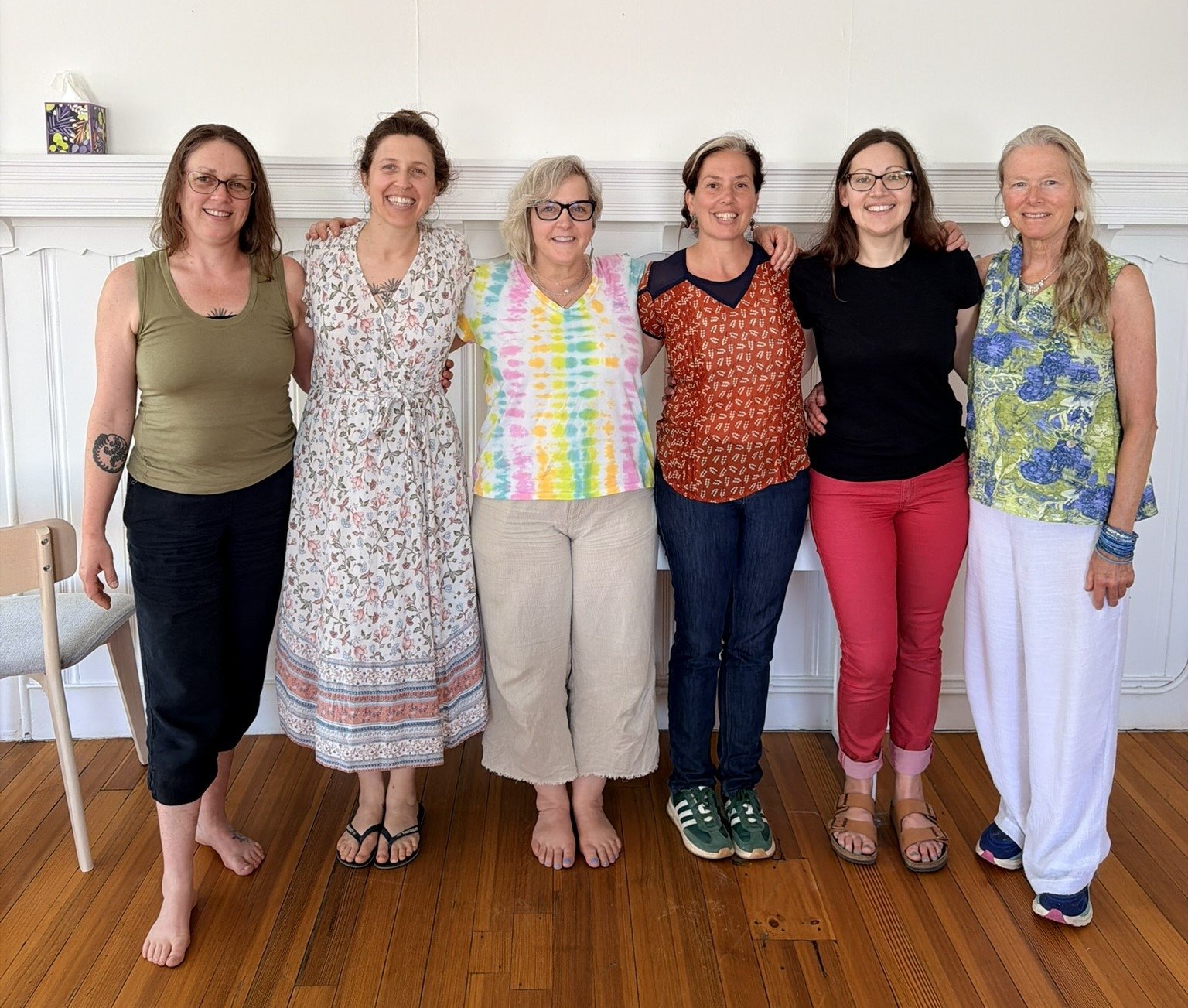
The founding midwives and board members of Green Mountain Birth & Wellness Center in Morrisville. From left: Heidi Riendeau, Alison Fischman, Mary Lou Kopas, Erinn Mandeville, Lindsay Lachant and Laurie Foster. Photo by Sarah McGowen Audet/Hedgehog & Fox Collaborative
Sometimes things just fall into place.
Lindsay Lachant has been wanting to open a freestanding birthing center in Central Vermont for a long time. She just didn’t think it would be happening so fast.
When midwives Erinn Mandeville and Mary Lou Kopas were laid off from Copley Hospital after it closed its birthing center on Nov. 1, 2025, they teamed up with Lachant and three other midwives and opened Green Mountain Birth & Wellness in Morrisville. It is a midwifery and lactation center offering clinical care both on-site and via telehealth.
Judging from its growing patient list, Lachant says it is filling part of the need left by Copley’s birthing center closing. “People wanted to see midwives at Copley,” Lachant said. “So, they came with us.”
Copley is not alone in its decision to close its birthing center. Other hospitals around Vermont are also struggling with the economic pressures that come with the labor-intensive branch of healthcare. Springfield Hospital ended its labor and delivery functions in 2019. Under strong public pressure, Brattleboro Memorial Hospital just this month reversed its plans to close its birthing center.
An in-depth report published Sept. 9, Seven Days newspaper focused on the challenges Vermont hospitals face in keeping birth centers open and the impacts on communities and families when they close. “Hospitals are contending with the combined pressures of declining birth rates, hiring challenges, limits on what insurers will pay them and the unforgiving economics of keeping an obstetrics unit ready around the clock,” the report states.
The former Copley midwives say they are working to do their part by offering prenatal and postpartum care. Still, the need for labor and delivery services in the region persists.
Looking to Waterbury
Their next step will be to open a freestanding birthing center in Waterbury in 2028. The goal is to maintain access to birthing and midwifery care for women in Central Vermont, which has become a “birthing desert” since the Copley closure.
Waterbury is an ideal location for a new facility, Lachant said, being within roughly 30 minutes of both Central Vermont Medical Center in Berlin and UVM Medical Center in Burlington.
Lachant said the board has met with architects Scott and Partners in Essex and has compiled a list of what is needed in a building that would house the birthing center. She said they are exploring options for the right property. It’s likely that the group would buy a building and renovate it to their needs, but leasing a space is also an option.
Roger Clapp is the executive director of the nonprofit economic and community development organization Discover Waterbury. He said his office is looking forward to helping the midwives find the right building and location when the time comes.
“Discover Waterbury welcomes the interest of Green Mountain Birth & Wellness in locating to Waterbury,” he said. “Our central location has attracted several health and wellness service providers over the past several years, and we look forward to supporting their search for a suitable location in Waterbury.”
New law opens new opportunities
From a regulatory perspective, the providers at Green Mountain Birth & Wellness couldn’t have chosen a better time. Copley’s birth center closing came six months after the passage of Act 19 (S.18 before adoption) in 2025, an act relating to the licensure of freestanding birth centers. The new law pertains to birthing centers not attached or associated with a hospital.
Two key requirements in the new law are that it explicitly exempts birthing centers from Vermont’s Certificate of Need review process for health facilities, and it requires health insurance plans that cover maternity services in Vermont to cover care provided at licensed birth centers.
Prior to the bill’s passage, there was no regulatory or licensing path available to establish a birthing center in Vermont. The bill’s main sponsor, Sen. Martine Gulick, D-Burlington, has served on the Senate Health and Welfare Committee for four years and is vice chair. She said the timing of the bill’s passage and this first potential center was pure chance.
“I had no idea there would be birthing center issues with the hospitals when I introduced the bill,” Gulick said in a recent interview. “This all started for me in the late 1990s when I had my first child. I had to navigate on my own, deciding on midwifery care.”
She said she had her first child at UVM’s birthing center in 1997.
“But it was gone by 1999 when I had my second child,” Gulick said. “I didn’t feel comfortable doing a home birth, and I didn’t want to give birth in a hospital. I introduced the bill because I had personal experience. I think it’s super-exciting.”
A freestanding birthing center offers pregnancy, labor, and postpartum care outside of a hospital setting. It is the only place where midwifery is the model of care, Lachant said, meaning it prioritizes and supports the natural process of birth in a more home-like setting. Birthing centers focus care on patients having healthy, low-risk pregnancies, and the use of pain-blocking drugs like an epidural is not allowed.
However, proximity to hospitals is important in the event of unforeseen complications, in which case the mother must be transported to a hospital for care.
According to the American Association of Birthing Centers, research has shown that birthing centers “offer safe outcomes for low-risk pregnancies, fewer medical interventions, more support for natural birth, high family satisfaction with personalized, relationship-based care, a comfortable, home-like setting that promotes calm and confidence, and cost-effective maternity care.”
Lachant spent six years as a certified nurse midwife in Connecticut before returning to her home state of Vermont, and it was in Connecticut where she began to formulate plans for opening a birthing center.
“I think it’s just perfect timing,” she said. “I’ve just been waiting to bring something like this to Vermont. When Erinn (Mandeville) opened the door, I was in. It’s like we’ve been waiting for our moment.
Mandeville, also a former midwife at Copley, is the founder, president, and co-executive director of the Green Mountain Birth & Wellness nonprofit. Lachant is vice president and co-executive director. The other members are Treasurer Mary Lou Kopas, Secretary Alison Fischman, board members Heidi Riendeau and Laurie Foster.
Lachant holds a Doctor of Nursing Practice degree and is a certified nurse midwife. All of the board members are either Advanced Practice Registered Nurses, certified midwives, certified nurse midwives, licensed midwives, or have a master’s degree in midwifery.
“We knew Vermont needed a birthing center, but Copley closing just made it like, ‘Let’s just do this now,’” Lachant said. “We have the vision we’re working towards. What we didn’t want was to wait two years and start a birthing center.”
Open in Morrisville
The first step toward that vision was opening the clinic in Morrisville in July, which Lachant said became possible thanks to fundraising that included a $15,000 grant from the Vermont Women’s Fund, $7,000 from the Lucy Downing Nisbet Charitable Fund, Bank of America, N.A., Co-Trustee, and $5,000 from the Vermont Community Fund.
The organization began operating with a nonprofit fiscal sponsor, the American Association of Birthing Centers Foundation. “That allowed us to get everything teed up so we could provide the care,” Lachant said.
The birth and wellness clinic’s website notes that it is seeking nonprofit status of its own with the IRS. The clinic now is open two to three days a week, four to five hours per day. It offers preconception/fertility counseling, contraception, prenatal care, postpartum care, perinatal mental health support, reproductive and wellness visits, annual exams and cancer screenings, peri/menopause support, gynecologic care, lactation consultation services and telehealth.
There still are more regulatory hurdles to clear. The group has been added as a network provider with Vermont Blue Cross/Blue Shield, and it’s in the process of securing relationships with other insurers. They also accept Vermont Medicaid.
The new law, Act 19 from the 2025 legislation, made the Vermont Department of Health responsible for writing the rules and licensing procedures for birthing centers. Lachant said the department has until Jan. 1 to finalize the draft rules. The process so far has involved gathering public comments, after which draft rules will be adopted.
Meanwhile, Gulick said she is impressed with the midwives and the progress they have made. She said she’s pleased that Act 19 helped pave the way for a birthing center plan to move ahead so quickly.
“They are amazing and they have a watertight plan,” she said. “It was really me learning from them.”
Lachant said it all comes down to one simple goal: “Basically, we want midwifery available to all Vermonters, particularly in rural areas. We keep saying it’s a labor of love.”
Open House Oct. 18
Looking to share their mission and new practice with the community, Green Mountain Birth & Wellness will host an Open House on Oct. 18, from 4 to 6 p.m., at the Morrisville clinic, located at the Wing Center, 24 Upper Main St. The organization also is actively fundraising and seeking additional board members. Find more information online at greenmountainbc.org.