
November 23, 2026 | By Jim Lowe | The Times Argus
Soprano Lillian Broderick sings the title role when Green Mountain Bel Canto Initiative presents Vincenzo Bellini’s “Norma,” Act I in a concert reading with piano, at 3 p.m. Saturday, Nov. 28, at the Waterbury Congregational Church. Courtesy photo
When soprano Lillian Broderick saw Vincenzo Bellini’s bel canto opera “Norma” for the first time, it was a game changer for the 10th generation Vermonter.
“Last year, when I was auditioning for things in Germany, I went to Das Bayerische Staatsoper (Bavarian State Opera in Munich) to see ‘Norma.’ I lucked out and got much better seats than I bought because someone was just getting rid of them outside the entrance. That was exciting!
“And then they made an announcement at the beginning that they had to delay the performance because the tympanist was stuck in traffic!
“I didn’t completely understand the German, but a woman sitting next to me was telling me what was happening. I told her that I was in town for an audition because we were waiting awhile.
“And then the staff of the theater came out and announced that Sonya Yoncheva (Norma), the soprano, asked them to tell the audience that she was under the weather but would persevere through the performance. The woman next to me told me, ‘You’re a soprano, you should do it.’
“Things kept happening during the performance. The Adalgisa was also sick, and she lost her voice in Act I. Then, in Act II, they had to have the mezzo who was singing Clotilde sing Adalgisa from the side of the stage.
“So it was a pretty chaotic performance! But just getting to hear it live for the first time, it’s so different from what I was expecting.
“Getting to hear ‘Norma’ live in that space, and the performance being, like, on the edge of your seat, not knowing what was going to happen,” Broderick said. “The whole time I was just thinking, ‘Oh my God! This would be perfect for people we have at home.”
So Broderick did something about it — she began creating her own performance of “Norma.”
The newly formed Green Mountain Bel Canto Initiative will present Bellini’s “Norma,” Act I in a concert reading with piano, at 3 p.m. Saturday, Nov. 28, at the Waterbury Congregational Church.
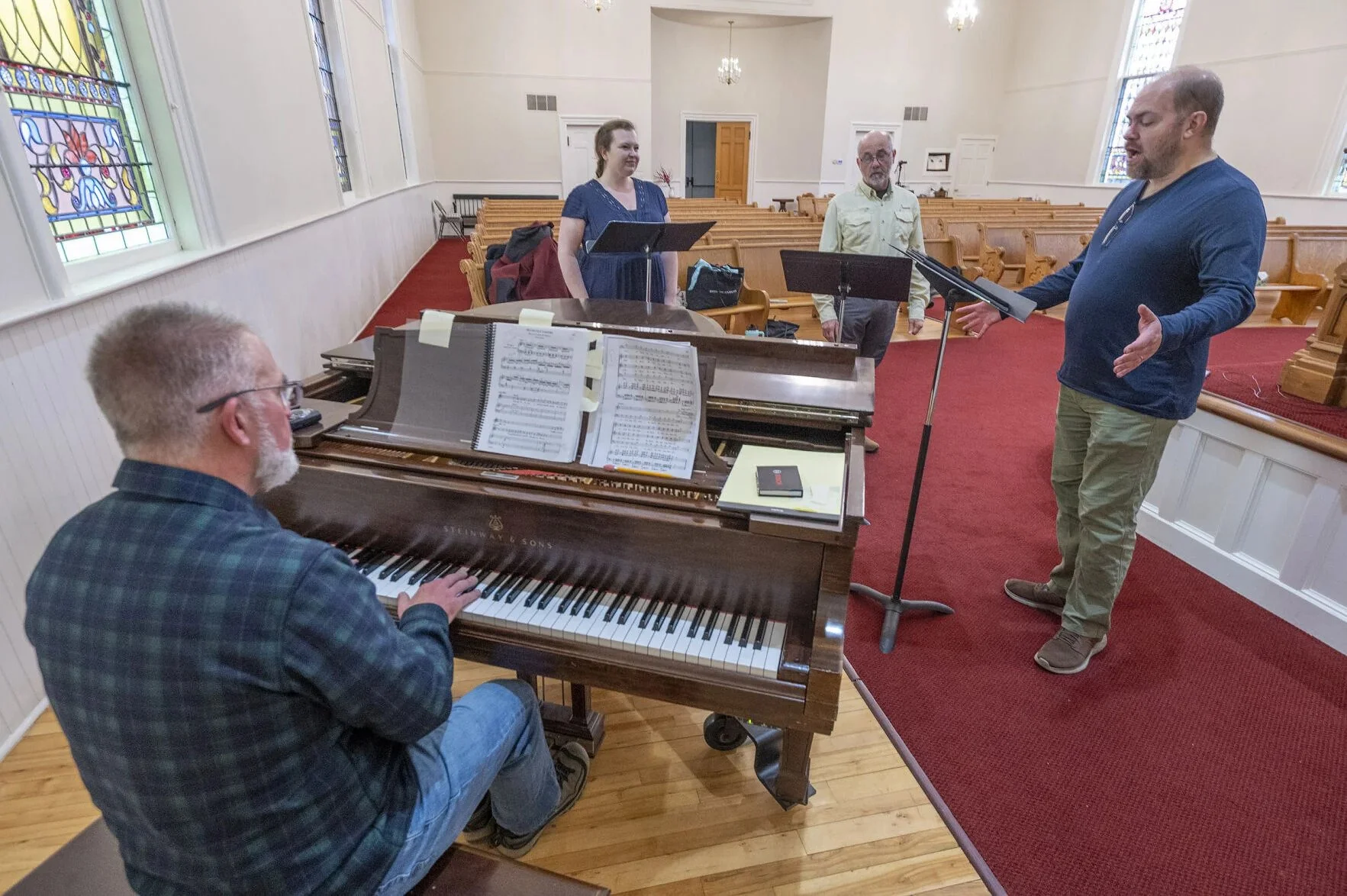
A rehearsal of Green Mountain Bel Canto Initiative’s “Norma” with, from left, pianist Michael Sitton, Lillian Broderick (Norma), Ted Marcy (Flavio) and Adam Hall (Pollione). Photo by Jeb Wallace-Brodeur
Broderick was ready: “Proving her bel canto mettle, soprano Lillian Broderick delivered the virtuosic ‘O rendetemi la speme … Qui la voce’ managing the florid lines and high notes with beauty and flair,” reported a recent review.
Joining Broderick as Norma will be tenor Adam Hall as Pollione, soprano Molly Flynn-Stack as Adalgisa, mezzo-soprano Nessa Rabin as Clotilde, Ted Marcy as Flavio, and Michael Sitton as “the orchestra.”
“We’re trying to do some very minimal staging,” Broderick said. “The next part I want to do is in March and do both acts. The aim is eventually a full production with orchestra.”
“Norma” is a tragedia lirica or opera in two acts with an Italian libretto by Felice Romani after the play “Norma, ou L’infanticide (Norma, or The Infanticide)” by Alexandre Soumet. The opera premiered at La Scala in Milan on Dec. 26, 1831.
“Norma” is regarded as a leading example of the bel canto genre, and the soprano prayer “Casta diva” in Act 1 is a justly famous aria. Among the greatest Normas of the 20th century was the Greek-American superstar Maria Callas.
Composer Richard Wagner conducted “Norma” at Riga, Latvia in 1837.
“Norma” was “indisputably Bellini’s most successful composition,” Wagner wrote at the time.
“In this opera, Bellini has undoubtedly risen to the greatest heights of his talent. In these days of romantic extravaganzas and the hyper-excitement of the so-called musical attractions he presents a phenomenon which can hardly be overrated. The action, free from all theatrical coups and dazzling effects, reminds one instinctively of a Greek tragedy. Perhaps the views expressed by Schiller in his ‘Bride of Messina’ to the effect that he had hopes for the full revival of the tragedy of the ancients upon our stage, in the form of the opera, will receive new justification in this Norma! Let anyone name me a spiritual painting of its kind, more fully carried out, than that of this wild Gaelic prophetess ... Every emotional moment stands out plastically; nothing has been vaguely swept together.”
Wagner also praised Romani’s libretto:
“Here, where the poem rises to the tragic height of the ancient Greeks, this kind of form, which Bellini has certainly ennobled, serves only to increase the solemn and imposing character of the whole; all the phases of passion, which are rendered in so peculiarly clear a light by his art of song, are thereby made to rest upon a majestic soil and ground, above which they do not vaguely flutter about, but resolve themselves into a grand and manifest picture, which involuntarily calls to mind the creations of (composers) Gluck and Spontini.”
The action takes place in Gaul c. 100-50 B.C. under the Roman occupation, and is centered on the love triangle between Pollione, the Roman proconsul of Gaul, Norma, his former companion, and the young Adalgisa. The background is the uprising of the Gallic people against the Roman occupiers, led by the Druid Oroveso.
Norma, the high priestess of the Druid temple, who had two children by Pollione, breaking her Druid chastity vows, discovers that her lover is now in love with her friend, the young Druid priestess Adalgisa. Norma tries to convince Pollione to give up Adalgisa and return to her, but he refuses. Norma publicly confesses her fault and is sentenced to death by fire.
Moved by Norma’s self-sacrifice, Pollione joins her at the stake.
Broderick is building an opera career from her home in Vermont.
She has performed throughout the United States, as well as in Italy and Germany, most recently as Susanna in “Le Nozze di Figaro” in Scharbeutz, Germany. Other recent performances include J.S. Bach’s “Coffee” Cantata, Rossini’s Petite Messe Solennelle, and a last-minute replacement for Despina in “Mozart’s Così fan tutte.”
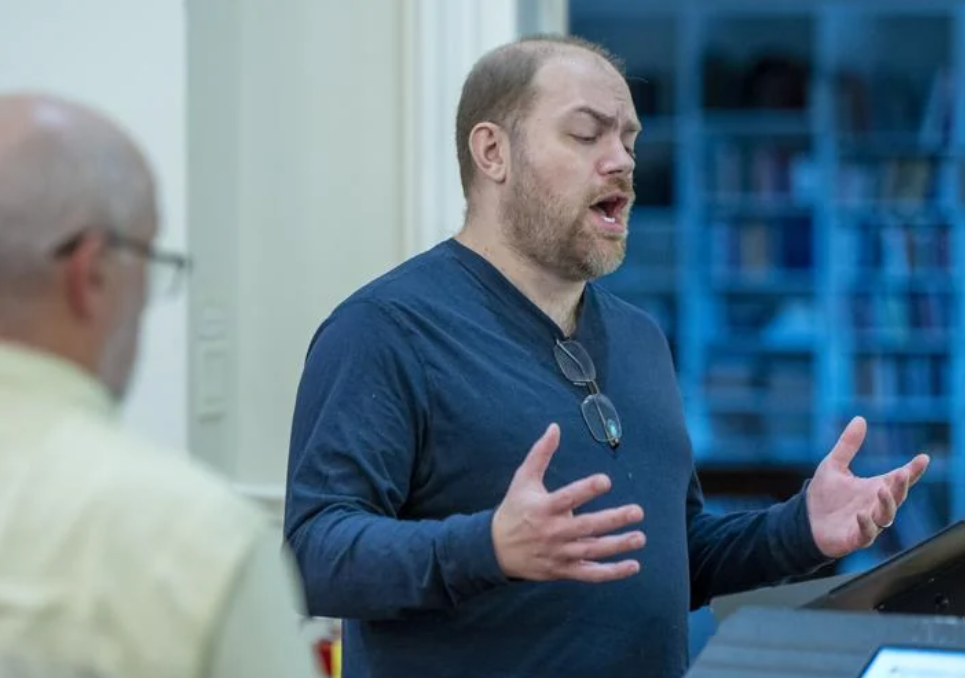
Tenor Adam Hall is Pollione. Photo by Jeb Wallace Brodeur
Broderick earned a master of music degree in opera performance from the University of Kentucky Opera Theatre (UKOT). There, she performed “The Rose” in Rachel Portman’s “The Little Prince” as part of the Graduate Opera Workshop and La Prima Cercatrice in the mainstage production of “Suor Angelica.” As a cover, she prepared the role of Abigail Williams in Robert Ward’s “The Crucible,” which was canceled due to COVID-19.
At UKOT, Lillian was a proud Getchell Scholar and the 2019 recipient of the UK School of Music Phyllis Jenness Vocal Scholarship.
Broderick is also an alumna of the Ezio Pinza Council for American Singers of Opera (EPCASO). Attending for two years, she prepared Italian bel canto repertoire including Adina in “L’elisir d’amore,” Ilia in “Idomeneo” and Amina in “La Sonnambula” with Maurizio Arena and the late soprano Claudia Pinza. She has been a longtime student of bass Erik Kroncke.
Local audiences may recognize Broderick from her many performances of Gilbert and Sullivan heroines at Marshfield’s Unadilla Theatre, including Mabel (“The Pirates of Penzance”), the title role in “Princess Ida,” and Josephine (“H.M.S. Pinafore”).
Green Mountain Bel Canto Initiative presents Vincenzo Bellini’s “Norma,” Act I in a concert reading with piano, at 3 p.m. Saturday, Nov. 28, at the Waterbury Congregational Church, 8 N. Main St. in Waterbury. Tickets are sliding scale ($15-$100); go online to sevendaystickets.com For information, visit greenmountainbelcanto.weebly.com