
Northeastern crayfish: Tiny predators with big impact
June 2, 2026 | By Tiffany Soukup | The Outside Story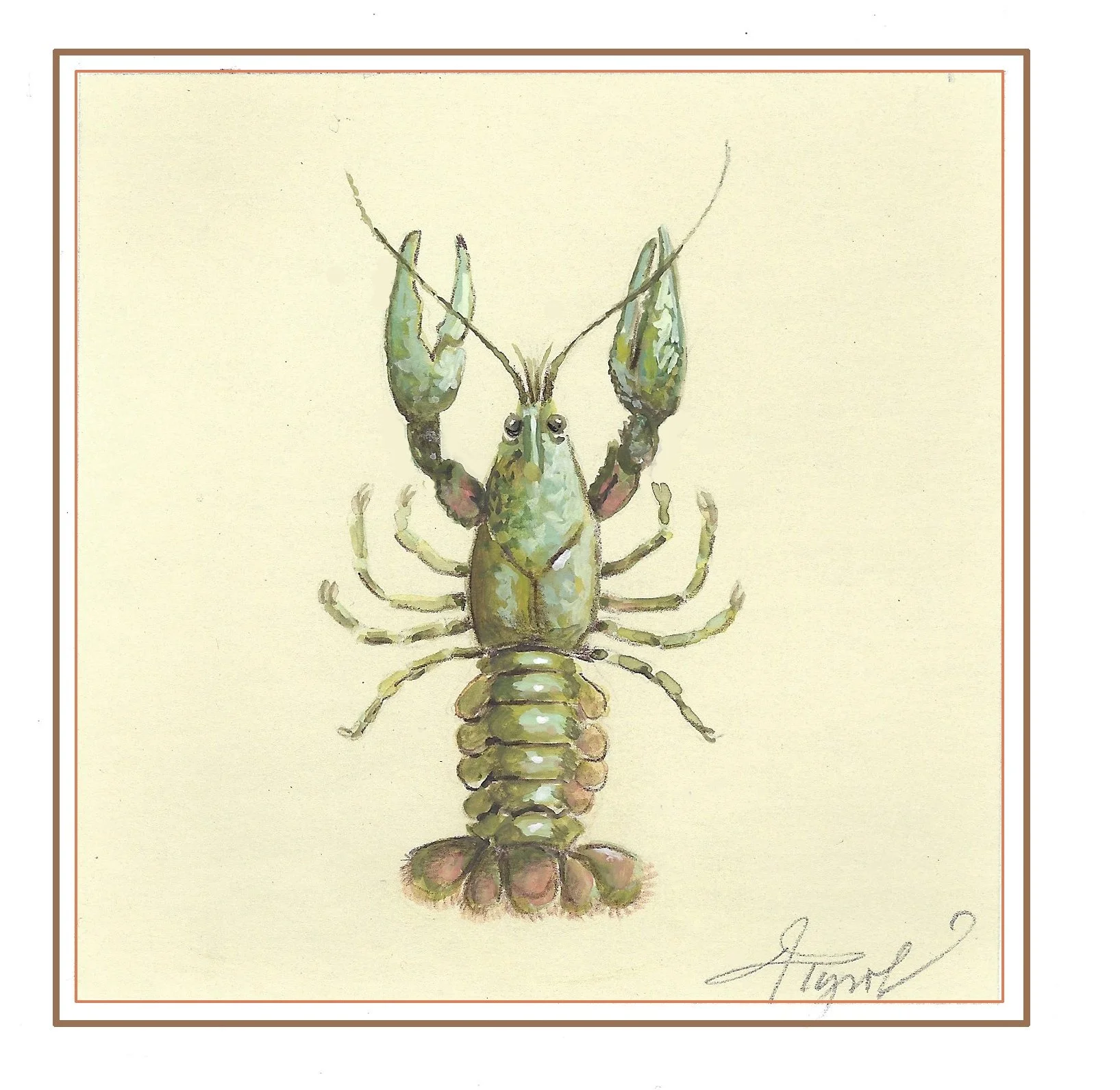
Illustration by Adelaide Murphy Tyrol
Crayfish fill my childhood memories. I spent summers playing in streams, flipping over rocks, and, if I was lucky, catching glimpses of these mysterious little creatures.
Most crayfish are nocturnal and dart backwards to escape danger. An early summer morning last year at Crystal Lake State Park, near Barton, Vermont, brought me back to these moments when I saw a crayfish along the shore in the gently lapping waves. As I knelt for a closer look, I realized I knew so little about crayfish in my backyard.
In the Northern Hemisphere, crayfish are in the family Cambaridae. Globally, there are around 500 species. North America is home to about 400 species. The unglaciated South is the epicenter of crayfish biodiversity – Georgia has approximately 70 species, while Vermont has only eight. Though there is some debate, it is generally agreed upon that there are two to three native species and five non-native species in Vermont.
Our most commonly seen species is the virile crayfish, a generalist that thrives in a variety of habitats, from lakes to rivers large and small.
The rusty crayfish, originally from the Ohio River Basin, is our most abundant invasive crayfish species. An aggressive generalist, it is now the dominant crayfish species in the White River watershed, and also lives in the Connecticut River and Hudson River Basins, and in a number of Vermont lakes, including Morey and Carmi.
The least studied crayfish is the Appalachian brook crayfish. These dwell in small cold-water streams in the mountains and in some valleys, making them more concentrated in the interior of the state. They are listed in the state’s Wildlife Action Plan as a species of greatest conservation need due to threats to their habitat, including introduced species, sedimentation, acid rain, and climate change.
Crayfish are not true hibernators, though they do burrow down into softer sediment as freezing temperatures approach. They enter a low metabolic state for the winter and are rarely seen.
Mating typically occurs in the fall, and females overwinter with sperm before activating the sperm in the spring. This reproductive strategy is advantageous because it allows females to choose the optimal time to have young, when aquatic plants, small invertebrates, and fish resources become abundant again. Researchers call pregnant, or gravid, female crayfish “in berry,” because the egg sac, carried under the tail, looks like a blackberry.
As crustaceans, crayfish must molt their shells, or exoskeletons, to grow bigger. Molting happens throughout the summer and fall. It is a vulnerable time for crayfish because their new shells need time to harden. Juveniles molt more frequently, and breeding males have two distinct molt forms. Form one has chelae, or hooks, on one pair of legs, and form two has no hooks. The hooks are essential when mating to transfer sperm to the female.
I talked with Dan “Rudi” Ruddell, a watershed scientist who works closely with the White River Partnership. Fourth- through sixth-grade students have gone to the same river spots for years to monitor crayfish, collecting data on species, number of individuals, and their sex.
The data reflects the impacts of recent major flooding events, which displace ideal crayfish habitat; in locations where students previously found around 100 crayfish an hour, after flooding they found around 30 crayfish an hour. All the nooks, crannies, boulder overhangs, and woody debris create great habitat for these tiny solitary predators; this habitat can be swept away in floods or removed through dredging.
“One of the things that is so exciting is that it’s these kids who see these patterns. One of these kids might become our next expert,” Rudi said.
Crayfish are an essential part of the food web in river ecosystems. Julia Pupko noted in a Vermont Center for Ecostudies article that crayfish are connected to more than 240 other animals through the food web. Fish species like smallmouth bass rely almost exclusively on crayfish for their diet. Crayfish are also opportunistic omnivores and help keep waterways clean by eating dead and decaying animal and plant matter. They have even been known to eat each other!
With my renewed appreciation of crayfish, I am ready to embrace childlike wonder and flip some rocks. I have a new addition to the life goals list: observe a female crayfish in berry.
Tiffany Soukup is a writer, photographer, world traveler, park manager with Vermont State Parks, and winter backcountry logistics manager with the Appalachian Mountain Club in Maine. The Outside Story is assigned and edited by Northern Woodlands magazine and sponsored by the Wellborn Ecology Fund of New Hampshire Charitable Foundation.