
November 20, 2026 | By Loren Merrill | The Outside Story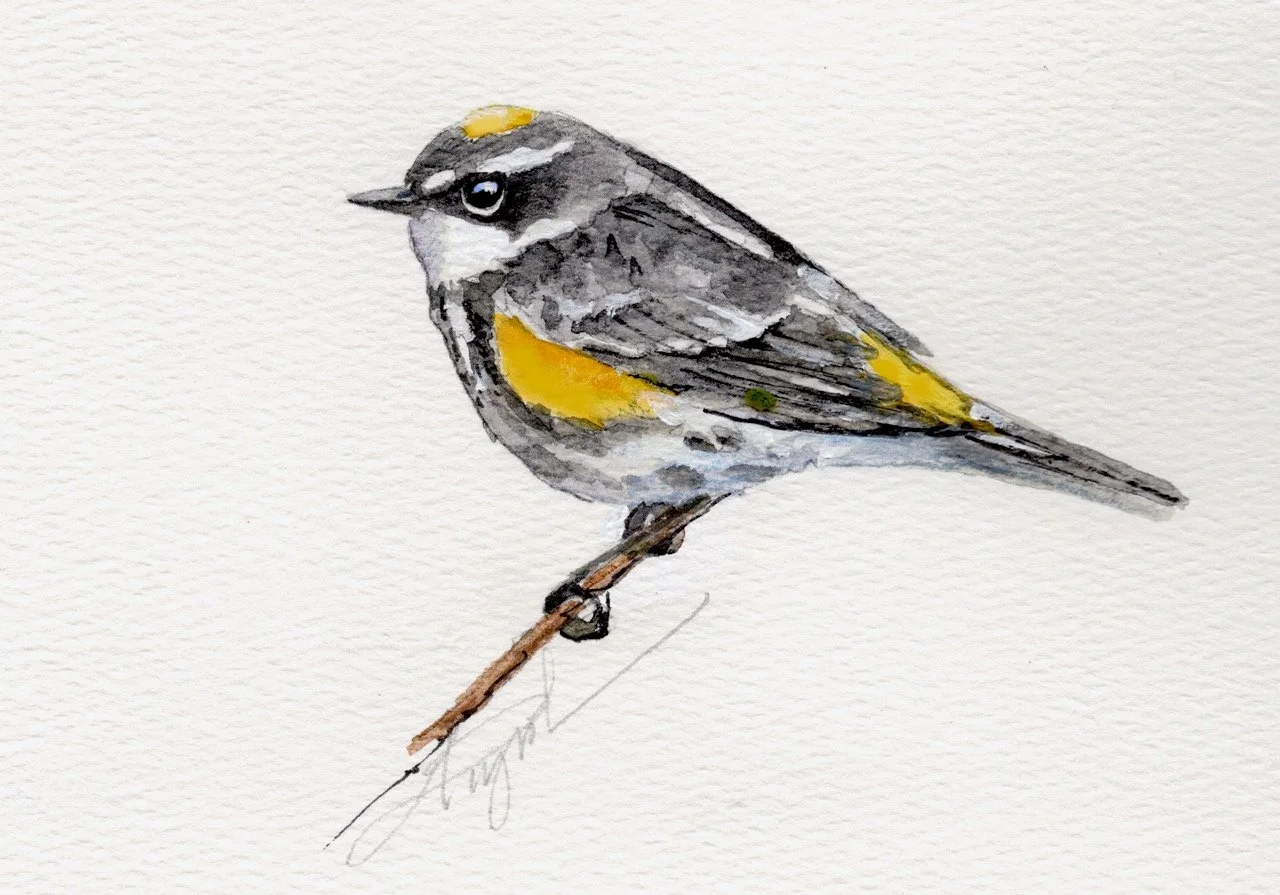
Illustration by Adelaide Murphy Tyrol
By now, most migratory songbirds have left our region, winging their way south on the promise of abundant food and warm temperatures.
Insectivorous species, including the multitudes of warblers, tend to depart before killing frosts diminish their food supply.
One hardy exception is the yellow-rumped warbler.
Many remain in the Northeast through the winter, especially along the coast, trading the hazards and energy demands of long-distance migration for frigid nights and dwindling food stocks.
How do these birds manage this feat when all their kin have left?
Unique among our warblers, yellow-rumps have evolved a neat trick: they can digest waxy berries, especially those of the bayberries (genus Myrica), which remain on plants through the winter. The waxy coating on bayberries protects the fruits from drying out, frost damage, and insect and fungal pests. The berries are composed of different fats, with small amounts of protein and carbohydrate.
Yellow-rumps have a suite of digestive traits to break down that waxy outer layer and convert it into fuel. It may not sound impressive, but wax is surprisingly difficult for most animals to digest, and this dietary skill is the key to yellow-rumps’ ability to survive in cold climates.
In 1992, ornithologists Allen Place and Edmund Stiles described these specialized features in a scientific article titled “Living off the wax of the land: bayberries and yellow-rumped warblers.” The list of physiological adaptations includes extra processing time for the berries in the warbler’s muscular gizzard, slow gut transit time for the waxy materials, and elevated bile-salt concentrations in the intestine and gallbladder. When fully digested, the waxy material alone may be sufficient to keep the warbler going through the winter.
The relationship between bayberries and yellow-rumps is not just one-sided in favor of the warbler, however. The bayberry benefits by having the warbler serve as a seed disperser, and there is also evidence that bayberry seeds have higher germination rates after passing through the warbler’s gut – a process known as “scarification.”
In addition to the fruits of the bayberries, yellow-rumps consume fruits and berries of many other species, including wild grape, juniper, red cedar, Virginia creeper, viburnum (Viburnum spp.), honeysuckle (Lonicera spp.), mountain ash, poison ivy and poison oak, spikenard, greenbrier (Smilax spp.), and dogwoods (Cornus spp.). But it is their relationship with bayberries – especially northern bayberry from Newfoundland to North Carolina and wax myrtle from New Jersey to the Gulf Coast – that likely led to their lingering in the Northeast.
Yellow-rumps have a broad breeding range, extending from Alaska across to Newfoundland and Labrador, south through the Appalachians to Pennsylvania, and in the West into Mexico, with a small breeding pocket in Guatemala’s mountains.
Formerly split into two species – the eastern “myrtle warbler” and western “Audubon’s warbler” – taxonomists lumped the two (now considered subspecies) together into one species in the mid-1970s. The “myrtle” name given to the eastern birds reflects that strong association with the wax myrtle and other species in the Myrica genus.
Despite their impressive dietary habits, yellow-rumps are sometimes the subject of birders’ good-natured ire. During fall migration, yellow-rumps can be so numerous that they swamp out other species, popcorning out of trees and shrubs, and prompting an exasperated “Oh, it’s just another yellow-rumped warbler,” from birders hoping to see something “more exciting.”
In addition, young yellow-rumps can give birders trouble with their drab plumage and nondescript features. Most warblers make a habit of dressing down in the autumn, trading in their bright wardrobe for more muted tones. Why flash those gaudy colors when they would only serve to catch the eye of a predator? First-year birds in particular can be remarkably bland. This has led to more than one bird field guide creating a “confusing fall warblers” section to help birders navigate the fog of dull plumages, with yellow-rumps squarely in the mix.
But instead of dismissing yellow-rumped warblers as common or confusing, we should admire their remarkable dietary adaptations that allow them to stick around the Northeast, and the little flashes of yellow they bring to the late autumn and winter landscapes.
Loren Merrill is a science writer and photographer with a PhD in ecology. The Outside Story is assigned and edited by Northern Woodlands magazine and sponsored by the Wellborn Ecology Fund of New Hampshire Charitable Foundation.