
Board meets tonight at 6 p.m. to move process forward
November 18, 2026 | By Lisa ScagliottiThe debate over whether to close two elementary schools in the Harwood Unified School District next year has continued over the past week, with dozens of community members attending meetings and emailing the school board in the hope of influencing the decisions ahead.
The school board meets tonight in the Harwood library with the public portion of the meeting starting at 6 p.m. There will be extended time for public comment, however individual commenters will be kept to just 2 minutes. Board Chair Ashley Woods said that nearly 50 people were signed up to comment and the advance sign-up form has been closed.
In anticipation of increased attendance, additional space with a screen for remote viewing will be set up in the Harwood auditorium.
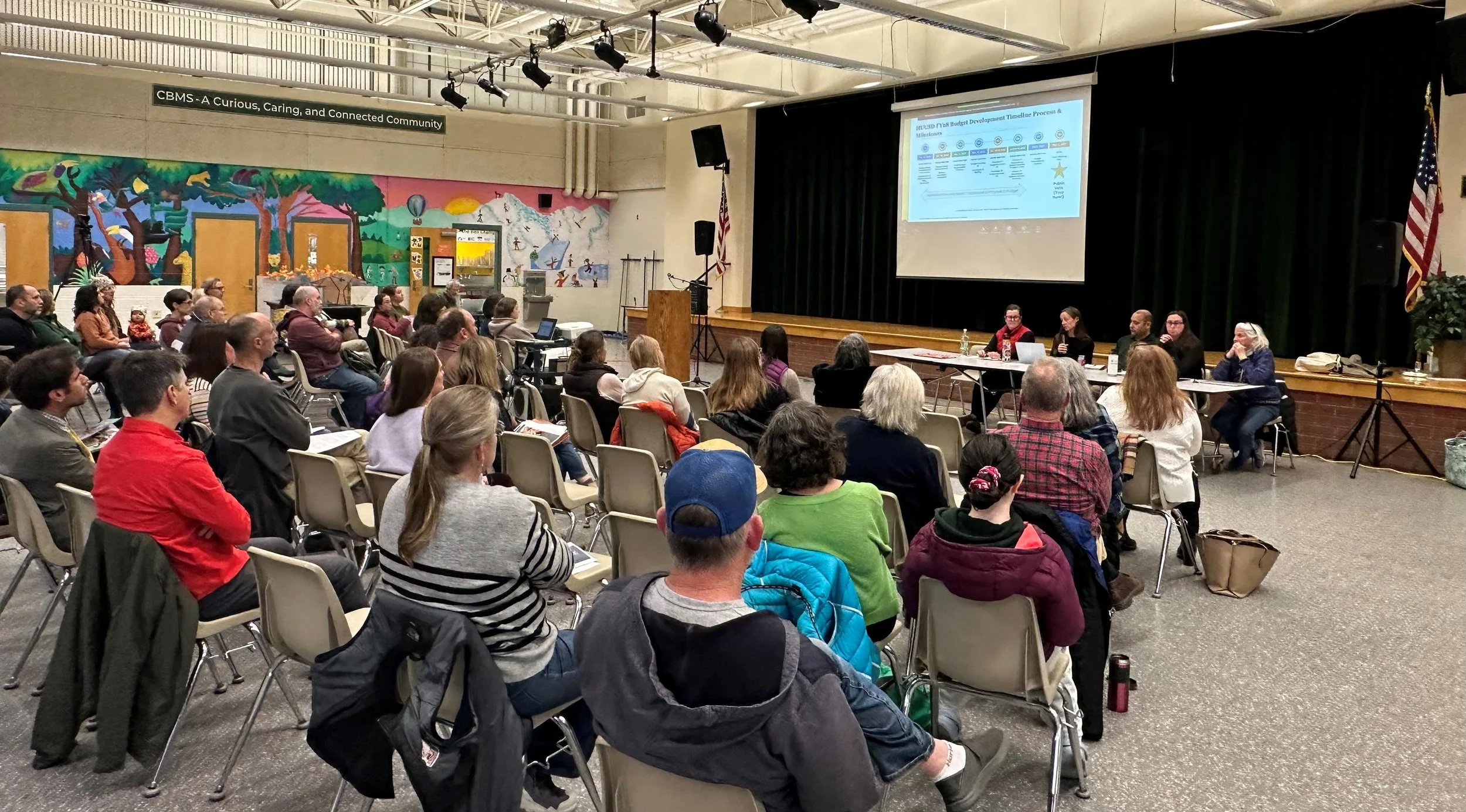
Local residents attend a community listening session at Crossett Brook Middle School on Nov. 12. At the table (l to r) are Waterbury school board members Pam Eaton, Theo Hanna, Robert Dabrowski, and Duxbury reps Emily Dolloff and Cindy Senning. Photo by Lisa Scagliotti
Copious public input
Several hundred members of the public have attended in person and via livestream meetings held at Waitsfield Elementary School, Crossett Brook Middle School and Warren Elementary School in the past two weeks.
Superintendent Mike Leichliter remarked that despite the difficulty of the decisions ahead, the gatherings in particular have been beneficial. “These are really hard things that we’ve been talking about. I've just been so impressed with the community conversations and the thoughts that have come up,” he said to the Crossett Brook audience. “There have been points that have come up that have been so helpful for us to think through.”
Behind the scenes, school board members say they are hearing from dozens via email as the board weighs starting the formal process that would lead to a vote in early January on closing schools ahead of the 2027-28 school year.
This drastic step is prompted by this year’s unprecedented budgeting circumstances. District leaders have outlined how growing costs of running seven schools, combined with a declining student population, will make budgeting in the customary way untenable given new state parameters designed to rein in education spending.
Building a budget for 2027-28 that essentially continues current operations would result in an estimated $2.7 million state penalty. Hearing strong public opinion to keep school property taxes in check, the school board has agreed it wants to present voters in March with a budget without a state penalty.
Administrators mapped out how that choice would require more than $3 million of cuts, such as ending most busing, cutting more than half the district’s athletics programs, and removing specialized student-support staff.
Considering those steps too detrimental, the board has decided to explore an alternative that calls for closing two of the four elementary schools in the Mad River Valley. That option could result in a budget under the state’s spending cap without a penalty.
At its Nov. 4 meeting, the Harwood School Board steered the discussion toward keeping the schools in Warren and Moretown, and closing Fayston’s and Waitsfield’s schools.
Administrators have shown that the move could be done for fall 2027 without any new construction. It would involve combining preschool-through-fourth grade students in the two remaining schools; all fifth- and sixth-grade Valley students would join their peers at Crossett Brook and Crossett’s seventh- and eighth-graders would move to Harwood’s 7-8 grade wing.
The rearrangement would impact six of the district’s seven schools. Operations at Waterbury’s Brookside Primary School would remain unchanged for the 2027-28 school year. District leaders, however, envision an eventual configuration where Brookside is closed and its prek-4th grade classes attend Crossett Brook. That would be several years from now because it would require construction to expand and update the building to accommodate the younger students.
Tonight’s meeting
The school board begins tonight at 5 p.m. with an executive session regarding ongoing labor negotiations for the teachers’ contract that expires in June. After public comment, Woods said each of the 14 board members will be asked to share their thoughts prior to any votes taking place.
The board would need to vote on whether to move ahead with the process to close schools, choosing which to keep and close. Three required public hearings would need to be scheduled and the agenda lists proposed dates: Dec. 1, 3 and 14. The board is required to hold one hearing in the community where a school is proposed for closure. Board leaders say they would like the final vote on closings to happen at their Jan. 6 meeting, giving them just a few weeks to complete the budget for the March Town Meeting Day ballot.
According to the district’s rules, a vote to close a school must be approved by a two-thirds majority of the school board using its weighted voting system. The weights are based on town population: Fayston 5%, Duxbury 5.2%, Moretown 6.4%, Waitsfield 6.7%, Warren 7.2%, and Waterbury 9.75%. Waterbury has four board members; the other towns each have two.
Crossett Brook conversation
On Thursday, Nov. 12, several dozen people attended a community listening session at Crossett Brook Middle School, led by three of Waterbury’s four school board members – Pam Eaton, Robert Dabrowski and Theo Hanna – and Duxbury members Cindy Senning and Emily Dolloff.
They began with a slide presentation offering an overview of the budget process and the options school leaders are considering for building the budget to run schools for 2027-28.
Outlining the list of nearly $3.4 million in cuts that would be needed to keep operating seven schools and avoid a state penalty, Hanna summed up: “This was just a non-starter.”
They described potential advantages of their preferred approach to close two Valley schools. For example, combining would allow for larger cohorts in each grade, which could have both social and educational benefits. It could mean increased staffing time for positions such as nurses and art teachers, roles shared among schools currently. Specialized instruction could potentially be offered in small groups rather than one-on-one with more students in just two locations.
Having fewer buildings to maintain would be another benefit, given the district’s estimate of needed maintenance and upgrades across its seven campuses exceeds $120 million.
District officials say that the elementary consolidation could save $1.8 million next year and would cut 16 full-time positions. Likewise, the grade 5-8 moves at Crossett Brook and Harwood would save another $2.1 million and cut another 16 positions. The result would be a reduction of $3.9 million, putting the overall budget under the state’s spending threshold and avoiding a tax penalty for the district, board members explained.
Feedback runs the gamut
For two hours, members of the audience took turns at the microphone. While many attendees and speakers were Waterbury and Duxbury residents, a number of Waitsfield, Warren and Moretown residents also were there. Opinions and questions covered a wide range of issues from urging the board to reconsider its preliminary preference for closing Waitsfield school to strong pleas for the district to retain preschool programming in the future.
Waitsfield real estate attorney Jennifer Faillace asked for details on busing costs under the two-school plan for the Valley. She also asked if school officials could estimate tax increases if the budget were to include a state penalty.
Board members pushed back on the latter, saying they feel strongly about avoiding a penalty in order to present a budget voters will accept in March.
“We have gotten flooded with emails and comments from the community, which is so awesome because it tells me that everyone cares about their schools and everyone cares about their kids,” Eaton said. “And for every time we hear a comment about ‘Let me pay more taxes. Let me pay more to do this,’ we also have a comment from someone saying, ‘I can't afford to live here. I can't afford my taxes. Please keep the quality programming, but keep my taxes low because I can’t afford it.’ So, we’re trying to balance out all of those ideas.”
Dabrowski noted that one-time state funding has tempered tax increases over the past two years, but that is unlikely this year. “Regardless of whether we close one school, two schools, zero schools, your taxes are going up, right? So closing one school is not enough,” he said.
Duxbury resident Susan Senning, who has worked in municipal planning and zoning, urged the board to consider geography in choosing which schools to keep open. “I strongly beg this district to no longer invest in buildings that are located in the floodplain. Those events are happening more often. They’re going to be worse,” she said.
Waitsfield resident Libby Babbott-Klein and Moretown parent Andrew Pappone said they hope the board could figure out a way to only close one school next year. They said state Rep. Dara Torre, D-Moretown, has indicated there may be proposals coming forward for the legislature to consider in the new session that might revise actions taken this year that are impacting the budget landscape.
Eaton was skeptical and pointed out that none of the school district’s four elected state House members were in attendance. She said the school board would continue to communicate with elected state representatives and senators. “We’re relying on all of you to do the same,” she said.
Waitsfield resident Mike Schavone, who is the general manager at the Village Grocery in Waitsfield, brought up the broader issue of economic impacts that will be felt after schools close. He called the business a community center that’s invested in making its space “more child and family” in recent years. He also noted that it donates a portion of gasoline sales to local charities each month.
But the business may not even be viable should the nearby elementary school close. “A conservative effort estimate by us is that the closure of Waitsfield Elementary would cost us 5% annually, which is more than the entirety of our profit margin,” Schavone said.
Economic impacts of school closures were a big part of the discussion at Monday night’s meeting in Warren. Board Chair Woods several times reminded the audience that “we’re just the school board” and that future uses of school buildings will be determined by the wider communities where closures happen. The Warren meeting also included multiple parents of students from Granville and points south who attend the Harwood district schools. Their top concern was for the distance fifth and sixth graders will have to travel to attend Crossett Brook under the proposed plan.
Considering student impacts
Waterbury resident Caitlin Hollister, who chaired the Harwood school board several years ago, said she supports the consolidation effort, particularly as it will help preserve high school programming.
“We want to make sure that kids still want to be here and families still want to be here when they’re in the middle and high school, and they want really rich experiences,” she said. “We have an amazing high school and we just want to protect that tradition.”
Waterbury parent Michelle Downing was one of several parents to make a similar argument for preschool.
“As a parent of a 2-year-old right now who had to fight tooth and nail to get child care for my own kids and took years and commuting two hours a day, I don't want to cut pre-k. I don't want that for anybody because there is no option B for those families if they want to stay in the workforce or if they want their kids to have a different sort of academic environment,” she said. “That is reason enough to move forward with a consolidation effort.”
Moretown parent Carla Francis echoed support for keeping preschool in the public schools, describing in detail her search for a future spot for her now-2-year-old should the school district end its program.
Francis is also a board member at The Children’s Room at Brookside Primary School. Opened in 1984, the independent nonprofit runs a space and programs for children up to age 6 and their parents. Being located in the primary school has many benefits associated with getting youngsters acquainted with school from an early age. Francis asked that the district include space for The Children’s Room in its future building plans.
Leichliter confirmed that school leaders intend to do just that. “It’s been in existence a long time. The community has supported it, and we want to make sure that we continue to support that resource for parents, especially young parents,” he said.
Describing himself as a “close-one-school guy,” Waitsfield parent Nathaniel Vandal asked for more details about transportation costs related to running just two Valley schools. I really do wonder whether those costs have actually been fully modeled,” he said.
Superintendent Mike Leichliter said that bus costs are factored into the estimated budget under consolidation, but detailed routes have yet to be worked out.
In addition to concern about longer bus rides for Valley students once fewer schools are in operation, Waterbury parent Michelle Cilley Foisy asked about the transition for Crossett Brook’s rising seventh graders if they are to attend Harwood next fall.
She said her sixth-grade student is already worried about that change. “He said I’m not going to school if I have to go to the high school,’” she shared, asking how teachers will help students know what to expect so they can be comfortable with the notion.
Board members replied, explaining how Harwood Middle School has its own wing, that there are step-up days for incoming students to tour the school, and how Harwood’s first day each fall is for seventh and ninth graders only, so they can start with fewer people in the building.
Leichliter chimed in, saying, “The team does a really good job.” He also pointed out that Crossett Brook Co-Principal Duane Pierson has been principal at Harwood Middle and High Schools and he would be particularly attentive to making sure Crossett students were ready for the move.
Time to act
Waterbury resident Robbie Adler told the board members that the Harwood district has been “kicking the can down the road for a long time” regarding consolidation. “Thank you for taking it on and doing your work to preserve quality education in our district – and not to just maintain buildings while allowing our curriculum to continue to be cut.”
He said he’s concerned that families with school-age children are a minority in the district, and the school board needs to consider the limitations on older residents to afford education taxes. “We are an old state and there are a lot of people in Vermont who do not have kids and it doesn't mean they don't care about education,” he said. “I feel for the valley schools, and I understand it's a really hard problem, but I encourage the board to hold strong and to ensure that we're right-sizing our district so we can invest in our kids.”
Waterbury Center parent Dana Hudson, whose children are a high school student and a recent Harwood graduate, agreed with Adler. “I remember consolidation conversations 10 years ago. We voted on merging schools. We have voted on bonds to fix the high school,” she said, referring to failed district votes. “And we’re now at a place that we just have to do it.”
Hudson said everyone’s morale – students and staff alike – suffers from the uncertainty. “This is hard for everybody. It’s hard not just for the people in this room. It’s hard for the kids. It’s hard for the teachers,” she said.
While community members have expressed widely differing views on what the district should do, one common refrain has been in virtually every speaker expressing gratitude to their school board members. The sentiment was returned in an exchange between Waterbury board member Hanna and Waitsfield resident Babbot-Klein, who thanked board members for allowing her time to speak “even though this is not my school.”
Hanna responded with a correction: “This is your school. I don’t think we can say it enough that we are all one district… all of these schools belong to all of us.”
Here is the agenda for tonight’s school board meeting. It has links for watching the livestream on Zoom and YouTube.
Read a letter from board leaders about the process ahead here.
Video recordings of Harwood School Board meetings are online on YouTube here.