
At halfway mark, school redistricting task force reviews first draft map proposal
The group has just four meetings left to come up with three possible school district maps for state lawmakers, and anxiety among members is mounting.
October 3, 2025 | By Corey McDonald | VTDigger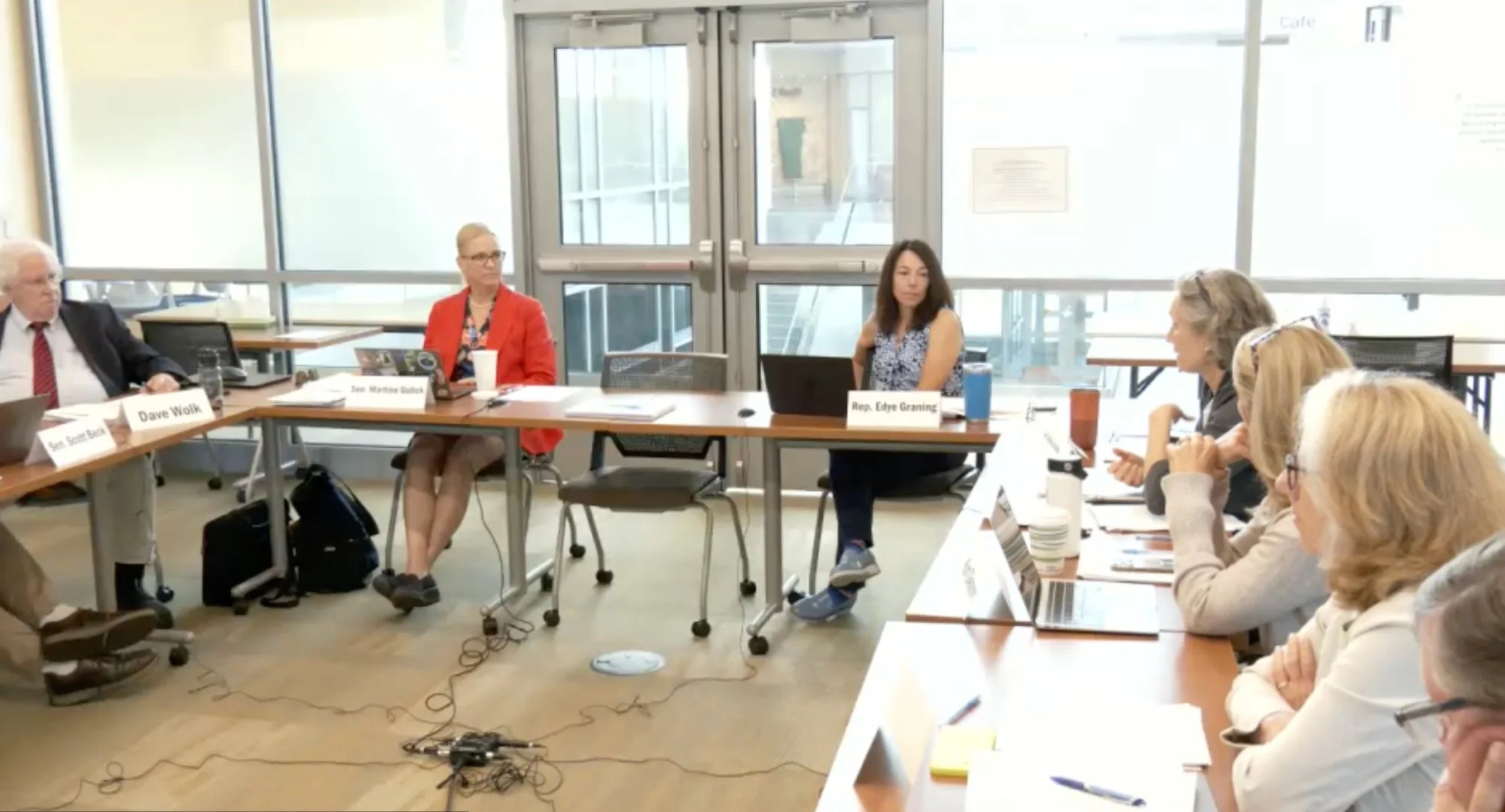
The Vermont School Redistricting Task Force meets on Monday, Sept. 29. Screenshot
The Vermont School Redistricting Task Force, now at its halfway mark, began its review of a draft map for the first time since launching in August. The group is tasked with proposing up to three possibilities to the Legislature by Dec. 1.
During the task force’s fourth meeting on Monday, Sept. 29, Sen. Scott Beck, R-Caledonia, and Dave Wolk proposed a map of 14 school districts that nearly mirror the state’s 15 career and technical education regions, each identified by the technical education center that anchors it.
One of the hypothetical school districts would combine the boundaries of two service regions in northwest Vermont, those encompassing Cold Hollow Career Center in Enosburg and Northwest Career & Technical Center in St. Albans.
Wolk is Gov. Phil Scott’s appointee to the board. He is a former state senator and the longtime president of Castleton University. Beck works as a classroom teacher at St. Johnsbury Academy, a private school that operates a center for career and technical education.
Prepared with the help of Agency of Education officials, the proposal would create districts that “span a greater variety of communities” and that “eliminates artificial barriers to ensure that students have the same opportunities to succeed, regardless of where they live,” the proposal reads.
During the meeting, Beck called it a “rough-edged proposal,” telling fellow task force members that the goal was to put the proposal forward to jumpstart the process.
“There’s a whole bunch of different decision points, a whole bunch of different things to consider,” Beck said. “This is a first pass at what something like this might look like.”
‘Running out of time’
The Vt. School Redistricting Task Force is eyeing the map of career and technical education centers as a template for new school districts for the state. Click to enlarge
The school redistricting task force is confronting a gargantuan task under a tight timeline. The 11-member task force, made up of legislators, former superintendents and other experts, was created under Act 73 to craft new school district boundaries for Vermont’s public education system in time for next year’s legislative session, which starts in early January.
The goal is to create three map configurations to consolidate the state’s existing 119 school districts — currently contained within the 52 supervisory districts or supervisory unions — into anywhere from 10 to 25 future districts.
But with four meetings left, and a Dec. 1 deadline to submit those three maps to the Legislature, task force members on Monday said they were feeling the pressure.
“We’re running out of time to put out ideas,” said Rep. Rebecca Holcombe, D-Windsor Orange-2, a member of the task force.
Much of the state’s public education system is feeling the anxiety as well.
Jay Badams, a former superintendent and a task force member, cautioned the board that they “need to be super sensitive to the fact that we’re creating huge public anxiety around this.”
“And it’s because we’ve got this deadline,” he said. “We’re going to build this foundation in three more meetings, that we’re going to build a whole house on, and it’s going to serve the children of this state for decades? I’m sorry, I feel a lot of pressure to get it right.”
Rep. Edye Graning, the co-chair of the task force, addressed the “frustration and concern that is bubbling up in every single community across the state” as education leaders wait on the task force’s work.
“I really want to reassure the public and reassure everyone here that we are working really hard to get up to three maps that will work for the state,” she said. “It takes time, it takes a lot of effort, and the work that we do, we hope the Legislature will take very seriously and use in its work over the next session.”
‘Elephant in the room’
Task force members appeared sympathetic to using career and technical education regions as the organizing principle behind at least one of their map proposals, though many questions remain unanswered.
The proposal was “still very much in its early stages,” Toren Ballard, the communications and policy director with the Agency of Education, said at the meeting.
For one, that map, as presented, would be lopsided, with the Burlington Technical Center and the Center for Technology in Essex representing one district with more than 22,000 students.
The second largest district, home to the Stafford Technical Center in Rutland City, would have more than 7,000 students. Nine districts, Stafford included, would have between 4,000 and 8,000 students, as suggested in Act 73’s language. Five districts would fall below the 4,000 threshold, with the lowest student count in a district anchored by Bradford’s River Bend Career and Technical Center, with just over 2,000 students.
Another unanswered question — the “elephant in the room,” as task force member Jennifer Botzojorns put it — was the question of how these hypothetical districts would be governed. Specifically, which district governance model would be used, supervisory districts or supervisory unions.
Supervisory unions and supervisory districts both provide back office functions such as accounting and payroll and may oversee the provision of special education services and curriculum coordination. But the two systems differ in their structure: supervisory unions are made up of school districts that each have their own board of directors, while supervisory districts have only one governing board.
“I think that that needs to be encapsulated in our drawing of maps and moving forward,” Botzojorns, a retired superintendent for the Kingdom East School District, said.
In addition to continuing work on the career and technical education draft map, task force members on Monday agreed to propose a map at a future meeting that centered on existing county boundaries, and another that centers on establishing comprehensive, regional high schools.
Sen. Martine Gulick, D-Chittenden Central, a co-chair of the task force, said whatever plan they put forward for regional high schools “has to include some kind of construction aid.”
“It has to look that idea and that problem in the face,” she said. “We cannot ignore it anymore.”
Task force members also agreed to work on a map organized around regional BOCES, or a Board of Cooperative Educational Services, a type of educational governance entity used to help school districts collaborate on services such as special education and transportation.
The Mountain Views Supervisory Union in August became the first public school governing body in Vermont to adopt such a structure. Sherry Sousa, the superintendent of the supervisory union, gave a presentation to the task force about the structure on Monday.
More maps will likely be proposed at the task force’s next meeting on Oct. 10. Graning, the co-chair, cautioned members that “there will be many details that we can’t figure out in the next four meetings.”
“But we’re not creating the law,” she said, “we’re creating a map.”
This story was originally published by VTDigger on Oct. 1. It is republished with permission from VTDigger, which offers its reporting at no cost to local news organizations through its Community News Sharing Project. To support this work, please visit vtdigger.org/donate.
View the video recording of the state task force meeting on ORCA Media here. More information is online on the Vermont School Redistricting Task Force website.
Harwood school board drafts redistricting survey
At its meeting on Oct. 8, the Harwood Unified Union School District School Board will review a draft survey of community members to gather input to share with the Vermont School Redistricting Task Force.
Board members will review and discuss the draft survey submitted by the board’s Outreach Committee. Once finalized, it will be shared with community members on a variety of platforms, with responses open through Oct. 31.
The board meets at 6 p.m. on Wednesday in the Harwood library and online via Zoom with a livestream on YouTube. Links in the agenda.
~ Lisa Scagliotti