
From seven schools to three: Harwood committee envisions the future
June 25, 2026 | By Lisa ScagliottiCORRECTION: The target enrollment for future merged Vermont school districts was incorrectly reported here originally. Act 170, recently passed by the legislature and signed by Gov. Phil Scott, calls for creating merger study committees representing contiguous school districts having a combined enrollment of at least 2,000 students. That target has been reduced from the 4,000 to 8,000 outlined by Act 73 in 2025. This story has been updated to reflect the new lower target.
A committee of the Harwood School Board is poised to recommend that the full board and the residents of the district’s six towns explore a radical new setup for the district within five years.
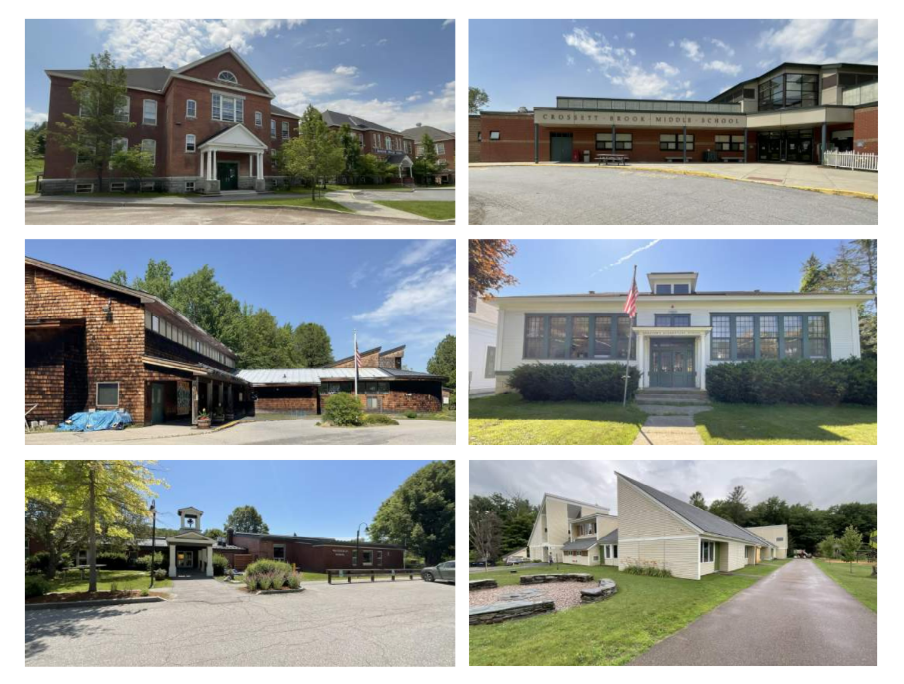
The Harwood Unified Union School District operates five elementary schools, one middle school and one middle/high school. Top to bottom: Brookside Primary School in Waterbury, Crossett Brook Middle School in Duxbury, Fayston Elementary, Moretown Elementary, Waitsfield Elementary and Warren Elementary. Photo collage from TruexCullins 2025 facilities report
They propose that the district consider a major downsizing from operating its current seven schools to running just three schools: a middle/high school at Harwood, a single elementary school in Waterbury/Duxbury, and building a new, single elementary school in the Mad River Valley on a site to be determined.
The board’s Building Use and Visioning Committee met Monday to discuss this concept with an eye toward making a formal recommendation to the full school board in late August, when it returns from its summer recess.
If the board agrees to pursue the proposal, it would look to bring the concept to district residents in a series of public meetings starting this fall.
The Harwood Unified Union School District School Board takes a break for the month of July and much of August, with its typical first meeting of the new academic year at the end of August.
Building committee Chair J.B. Weir of Waitsfield plainly stated the business at hand as the Monday meeting opened. “The time has come for meaningful change,” he said.
Reading from prepared remarks, he summed up the challenge and introduced the plan to develop a five-year plan to combine school operations into three buildings.
“With shifting demographics, declining enrollment, and rising operational costs, which we are unable to control, continuing exactly as we have for decades is no longer financially viable under this Act 73 framework. The state is strongly incentivizing districts to scale up, regionalize services and voluntarily merge with our neighboring communities,” he said, referring to the public education reform law enacted in 2025. “On a high level. This makes sense. By expanded collaborative efforts, we can pool our resources, expand our programming for our students, and avoid the financial penalties that will come very soon under the new legislation. However, I think that this can be achieved within our own district without being tethered to decisions from schools up to 50 miles away, should we choose to merge.”
The building and visioning committee has spent time so far this year considering issues related to the condition of the district’s seven schools – five elementary schools, one middle school, and the middle/high school at Harwood. Principals from each school attended the committee’s April meeting to discuss their facilities and issues of operations, capacities and condition.
The committee has pored over reports from consulting architects at the Burlington firm TruexCullins that have detailed maintenance and renovation needs by building. The firm in 2025 also compiled an exhaustive report of potential ways to reconfigure the district to operate using a myriad of combinations of fewer schools.
All of that information now is set against the backdrop of the state-level push from Gov. Phil Scott’s administration and the state Legislature to ultimately run public pre-K-through-grade-12 schools more cost-efficiently, concentrated into fewer, larger school districts, with fewer physical schools. The consolidation goal now calls for merger study committees made up of contiguous school districts with a combined enrollment of at least 2,000 students “as practical.” That's down from a target of 4,000 to 8,000 students outlined in Act 73 in 2025. Harwood currently has just under 1,800 students from preschool through high school. It’s grouped with other central Vermont districts for the efficiency and consolidation efforts.
The governor recently signed legislation that calls for school leaders to work together on two fronts: to band together to find operational efficiencies at a group scale, and to assess how they might redraw boundaries to merge and create larger districts.
Other new legislation puts pressure on school districts in the short term by lowering benchmarks for school budgets starting next year. School districts will have tighter restrictions on how much they can ask voters to spend to run schools for the 2027-28 school year and beyond without getting hit with tax penalties from the state. An overhauled state education funding formula is also on the horizon.
Harwood administrators estimate needing to slash upwards of $625,000 from the current $51.9 million school budget so that the 2027-28 school year budget avoids state penalties. “That excess spending threshold is weighing heavily on all of us, especially Lisa and me,” Leichliter said, referring to district Finance Director Lisa Estler.
On Monday, Harwood’s building committee, joined by several additional board members and administrators, had the most frank and direct debate to date on what they might recommend for the future.
A bold recommendation
Committee member Langford Davidson of Fayston led off by recalling the effort that led to the creation of Harwood Union High School, which opened in 1966. A study group was created in 1955, he noted, and a bond to build the new school that would replace high schools in Waterbury and Waitsfield was voted down multiple times before the project moved forward.
“I think we’re going to face those same challenges in making unified elementary schools in Waterbury as well as in the valley,” Davidson said. “It’s important that we try to have that conversation in the most clear and honest way so that we end up with the best possible situation.”
Weir agreed, acknowledging the difficult path ahead. “This is not easy to even say, let alone do. But I think the writing’s on the wall, and we have a board and school administration that could set this in motion the right way,” he said. “We can really shape the future of the district and the community rather than somebody trying to shape it for us. I think that’s the goal.”
School Board Chair Ashley Woods was in attendance and stressed that point. “If we’re not the ones to do it, I’m just afraid of what the outcome could be,” Woods said. “We’re in a help-ourselves position, and we need to move forward as such. We, 14 people, represent this district. These administrators work for this district. This is our responsibility.”
Several committee members suggested that by reducing the number of schools in operation, it may be possible to bring back things that the district has recently cut, such as the foreign language program for elementary students. “There can be a real cost savings there. And I think we’re going to end up with a better product, and we’re going to have better outcomes,” Davidson said. “What really matters to me is providing the best possible education to the kids.”
Weir noted that Vermont communities aren’t attracting enough families to stay or move here. “I think in the long run, something like this plan might go a long way to reversing that trend,” he said.
Waterbury committee member Pam Eaton agreed, pointing out that an advantage to operating fewer schools is that the district can better focus on quality. “We might be losing some buildings, but I do think we’ll be enriching the culture and the community,” she said. “This declining enrollment is not something that’s fictitious or made up or a figment of our imagination. It’s real, and it’s impacting our kids now.”
Leichliter in the discussion noted that administrators are keeping a close eye on incoming student enrollment figures for the fall, and kindergarten classes – especially in the valley schools – are low. As of this week, Warren has eight kindergarteners enrolled, Waitsfield has 11, Fayston has 13, and Moretown has 17, he said.
Asked after the meeting about incoming kindergarteners for Brookside in Waterbury for the fall, Leichliter said the principals say they have an average of 17 per class for each of three classes. That compares to an average of 23 third graders per class and 21 fourth graders for the school year that just ended with those grades having three classrooms each.
Board member Macon Phillips from Warren, who is not on the building committee, worried that a plan to cut multiple schools ultimately will undermine public education. “I just couldn’t disagree more,” he said after hearing the plan. “We will never satisfy the motivations of the wolves raiding the education budget.”
Woods said the Harwood board can advocate at the state level, but its main focus should be on making its own operations sustainable and accountable to its community. “I think there are the groups within the community that are going to hate this, like we all have for so long, and want to not do it,” Woods said. “But I think you’ll find that there are other groups in our community that really do struggle with their tax, and don’t want to move away, and are living poorer lives than maybe we realize.”
Moretown board member Steve Rosenberg, who is not on the building committee, cautioned about the unknown impact of the statewide process to consolidate school districts.
“We’re kind of ignoring whatever the state will mandate. Any consolidation that happens in this district doesn’t change the total number of students, and we’re below what the state wants to see for the size of the district,” he reminded the group. “I think the committee is doing the right thing of going ahead with these discussions, but we do have to keep in mind that the state can throw curveballs at any time.”
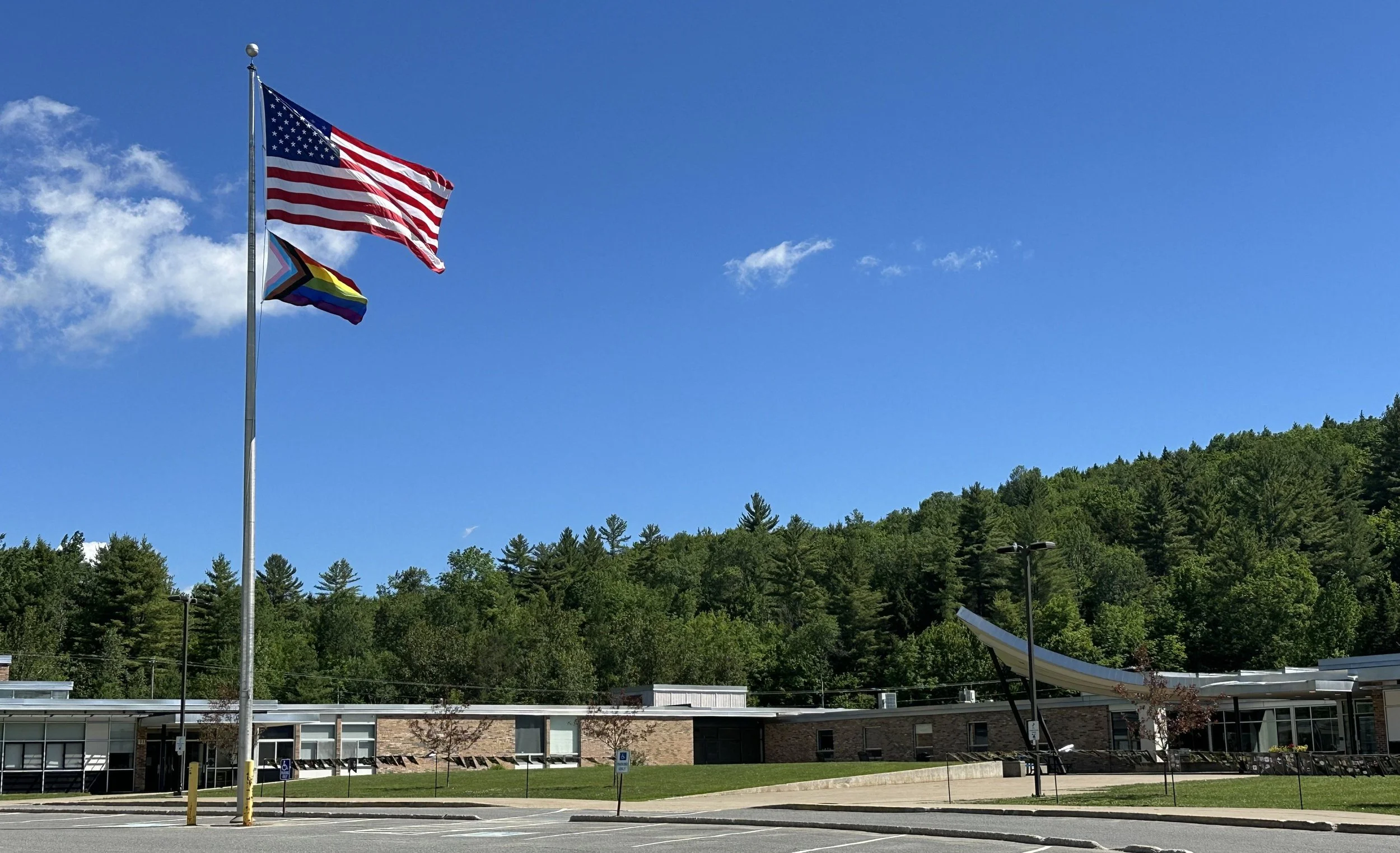
Harwood Union Middle/High School. Photo by Lisa Scagliotti
Looking ahead
The discussion provided a good preview of the broader conversations that lie ahead for both the full school board and the community at large, as group members acknowledged both the challenges ahead and opportunities to reinvent the district for the current times.
Rosenberg acknowledged that downsizing – and especially building a new school for the Mad River Valley students – could be a “tremendous enhancement” for the district.
“But there’s going to be tremendous pushback. There just is. And we have to expect that. I’m kind of on the fence myself,” he said. “But I am quite worried that if we don’t do something, it’ll be death by a thousand cuts… I really appreciate that this committee is coming up with a push towards a master plan, but it’s going to be tough.”
Offering a long-view perspective in the debate was school board vice chair and building committee member Cindy Senning, who was the last principal at the Duxbury School before it merged with Waterbury in the mid-1990s to build Crossett Brook Middle School and send all primary students to Waterbury.
“I think that we’re talking about really creating a new school district – coming together as a combination of six towns to create a school district that provides incredibly excellent education for all its kids,” she said. “Nobody loved their little schools more than I loved Duxbury – I can’t say that enough times… but the little schools just aren’t working. It’s not working anymore.”
Should the full school board support exploring the consolidation idea, Leichliter said community meetings could occur in the fall, similar to the meetings the board held two years ago when it considered renovating Harwood Union High School. That project was put on hold in spring 2024 and has not moved forward.
Woods recalled that the renovation community meetings were productive despite the project not coming to fruition. She said she hopes the community will respond similarly to having this next discussion. “We were not met with resistance. People had a lot of questions, but people had a lot of ideas,” she said. “It had a very positive, upbeat attitude and vibe about it.”
School board member Karl Naden from Fayston, who is not on the building committee, said he hopes the board can set that tone around downsizing the district.
“This is a very emotional topic, and it’s very natural to focus on the hard parts about it,” he said. “I would challenge us as a group, as a board, as a community, to figure out how to look to a positive vision that we can all feel good about as a community instead of having something less good rammed down our throats within the next few years.”
Ultimately, Phillips commended the group for suggesting the five-year consolidation plan. “I’m proud that the [committee] is taking the initiative to get the data and try to make good decisions,” he said. “So far as that’s all this is, and doing it on the up and up and getting people’s attention around some hard choices, I’m all for it.”
He also suggested that school leaders invite elected state legislators from the school district to attend community discussions about any consolidation proposal; Woods approved of the suggestion.
First, more data
The building committee on Monday refrained from voting to formally recommend the consolidation plan to the full board. It agreed to take that up at a meeting in August, prior to the full school board’s first meeting after its summer break.
One step needed before then will be to ask the TruexCullins architects for more data based on the facility reconfiguration work done to date. Weir noted that one of the options (G1) in the architect’s 2025 reconfiguration report called for operating just three schools, with Waitsfield Elementary serving the valley communities, but a closer look at the building makes that less viable due to structural issues, site constraints, and its potential for flooding.
“We know due to the structural integrity of the main existing building [that it] could not hold a second floor,” said Weir of the Waitsfield school.
The committee and other board members in attendance agreed that they will need data that incorporates the cost of building a new school as part of the proposed future scenario. And that prospect introduces an additional significant hurdle.
“Just getting the money to build a school is going to be really challenging,” Davidson said.
Leichliter noted that the state’s 20-year freeze on contributing to school construction is beginning to thaw. Although the Legislature has not committed funding yet, recent legislation outlines future financial incentives for districts considering construction, and even more so if they are involved in a merger, he noted.
Steps to closing schools
Committee members asked Leichliter about the district’s process for closing schools. He explained that the authority rests with the school board to close a school, with three public meetings required before a board vote is taken.
The articles of agreement that formed the unified district nearly a decade ago say that the district must offer a school property to the town where it is located for a nominal fee of $1. The articles also require that a town receiving school property to own it and use it for “community and public purposes” for at least five years before selling it.
The five-year plan that the building committee discussed on Monday envisions the Harwood district closing all four elementary schools in Moretown, Fayston, Waitsfield and Warren and replacing them with a new school. Weir described having one elementary school in Waterbury, but he was not specific as to which one that would be.
Asked for clarification on which school on the north side of the district that might mean keeping – Brookside Primary, the district’s oldest school, or Crossett Brook Middle School, the newest – Woods said she believes the recommendation would “very likely” be to close Brookside and continue to operate Crossett Brook as an elementary school. That would mean closing a total of five of the district’s seven current schools.
The board chair stressed that the five-year plan for downsizing is in its very earliest stage. “This is just us opening up the door,” she said.
See a recording of the June 22 Building Use and Visioning Committee meeting on Harwood’s YouTube page here. The committee set its next meeting for Tuesday, Aug. 18, at 4:30 p.m.
See a letter from School Board Chair Ashley Woods and Vice Chair Cindy Senning in From the HUUSD in Education and in Opinion.