
UPDATED: Committee sends buildings report on to full Harwood board for review on Oct. 22
October 4, 2025 | By Lisa ScagliottiThis post was updated following the Harwood School Board’s Building Use and Visioning Committee meeting on Sept. 30.
The Building Use and Visioning Committee of the Harwood School Board on Tuesday got its first look at the architect’s report that assesses the condition and construction needs at six of the district’s seven schools.
TruexCullins architects shared their findings in a slide presentation to the committee, which consists of several school board members, as well as the superintendent, finance manager, and facilities chief. About 20 people attended the meeting held on Zoom. The recording is posted on the district’s YouTube page.
The presentation slides were updated slightly ahead of the meeting, with a revised figure noted for the total estimated costs of renovations from $45.3 million to $48 million. That encompasses recommended updates to the district’s five elementary schools and Crossett Brook Middle School. TruexCullins did a similar evaluation of Harwood Union Middle/High School two years ago, and the figure referenced in this new report is just over $73 million for a grand total of $121,049,746.
Architect David Epstein called the latest assessment a “snapshot in time” that the school board, administrators and the community can use to create a master plan to prioritize facility projects. Some items can be put on a schedule over a period of time, while the most pressing needs may require a construction bond. Epstein said the new report calculates costs in 2027 dollars, given that it’s likely to be a couple of years before any work begins.
In presenting the findings to the school board’s buildings committee, Epstein credited the district with its facilities management to date. “Kudos to Ray and all the others taking care of the buildings,” Epstein said, referring to Ray Daigle, the district’s buildings maintenance chief.
In the report, several categories for each school building were given a numerical score to indicate their condition and each school receives an overall score. The numbers for the Harwood schools are “not as bad as some other districts,” Epstein noted.
The architectural team visited each school for the evaluations, and the new report catalogs areas to be addressed in each school building, such as replacing electrical and heating systems, repairing roofs, and updating many details to bring them up to modern building code standards.
The report contains several slides per school listing specific areas that need to be addressed.
The numerical scores – called the Facility Condition Index – are calculated using a ratio of deferred maintenance costs to the current replacement value. “It can be viewed as a percentage of the building systems that have failed or are at risk of failure,” the report explains.
Overall, Crossett Brook and Warren Elementary had the lowest scores, indicating the lowest percentage of failing systems; Harwood and Fayston Elementary had the highest scores.
During Tuesday’s presentation, Leichliter emphasized in the discussion with the buildings committee that while the findings are enlightening about the physical condition of the schools, they don’t reflect on the quality of education taking place, which he said is “second to none.”
Noting that he had spent the day filling in at Warren Elementary School, Leichliter said, “Our schools are some of the most caring places I’ve worked in. Schools are not just brick and mortar.”
The committee asked the Truex team to attend the full school board’s regular meeting on Oct. 22 to share the presentation with the board and the public. They also asked that the architects revisit the renovation cost estimates from the January Truex report that listed more than a dozen scenarios to consolidate the schools in the district, given the more detailed first-hand data collected for the new report.
School Board Chair Ashley Woods said she is looking forward to sharing the information with the full board and the public. “I’d be hoping to hear some more public comment. I know that a lot of people have concerns about the expense of things,” she said. “We all are aware that if we kick things down the road, they get more expensive.”
Leichliter said scheduling the presentation for the board’s second October meeting would allow time to notify the community. “I would like to see dozens of people who are tuning in to listen to this and to give comment to the board on what should be the next step,” he said.
Committee Chair J.B. Weir of Waitsfield then suggested that anyone who attended Tuesday’s meeting or watching the meeting recording afterward could email questions and comments to the full board. Messages may be sent to the school board using the address cen-huusdboard@huusd.org.
The TruexCullins presentation is posted on the HUUSD.org website. The meeting recording is on the HU Webapp YouTube page.
The original story about the buildings report is below.
Harwood leaders to review facilities report as need for a construction bond grows
September 28, 2025 | By Cheryl Casey and Lisa Scagliotti An architectural report on the physical condition of the schools in the Harwood Unified Union School District is complete and school officials this week will begin reviewing its findings.
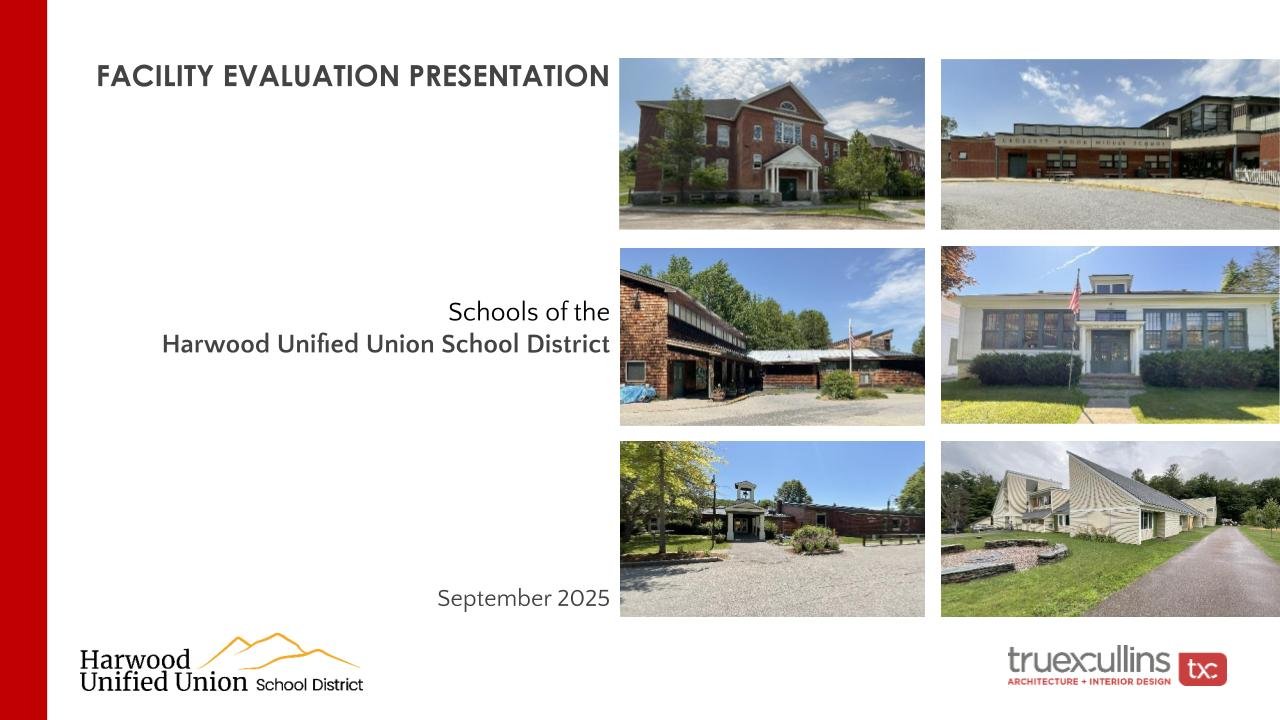
The latest report by TruexCulins for the Harwood school district offers a detailed look at facility needs in the district’s elementary schools and Crossett Brook Middle School.
The report from Burlington architectural firm TruexCullins was requested to inform district leaders as they look to prioritize facility needs and maintenance projects, as well as their ongoing discussions over whether to consolidate the number of schools the district operates. In 45 slides, it details $45,354,980 in work needed across the district’s five elementary schools and Crossett Brook Middle School. An additional $73 million is noted for Harwood Union Middle/High School, as was determined in 2024. The overall pricetag for facility repairs and upgrades in the report totals $118,357,780.
The School Board’s Building Use and Visioning Committee will discuss the report when it meets on Wednesday, Sept. 30, at 6 p.m. on Zoom only. The meeting agenda includes the presentation slides from TruexCullins.
Assembling details piece-by-piece
The school board in the spring halted its discussions regarding potential consolidation of district schools until a thorough assessment could be made of each school’s condition.
Such an assessment was done several years ago of Harwood Union Middle/High School when district leaders looked to launch a major construction project for that school and a bond to pay for it. That effort was eyeing renovations and upgrades ranging between $60 million and $90 million, but that process was sidelined after voters in 2024 rejected the school budget on Town Meeting Day.
Later last year, school officials turned to the Burlington architectural firm that’s worked with the district for the past decade on evaluating and planning for facilities projects to prepare a report offering scenarios for the district to potentially consolidate its seven schools.
In January, TruexCullins presented 15 scenarios that were later narrowed down to their top six recommendations in March. The options were met with opposition from community members and staff, mainly regarding the schools suggested for closure. All of the six scenarios called for closing the elementary schools in Fayston and Moretown; two scenarios also suggested closures for Warren Elementary and Brookside Primary School in Waterbury.
The school board paused that process in April, opting to spend an additional $110,000 with TruexCullins to do the full facility evaluation project that it has now completed. The initial step that produced the various consolidation options cost $48,500.
At last week’s school board meeting, district administrators said they have already met with the architects to review the new report and its recommendations for priority maintenance projects.
Superintendent Mike Leichliter acknowledged the report is very thorough and makes very clear what deferred maintenance is critical to address right away and what “may not be critical and required, [but] going to be wise to do in the short term.”
Finance Manager Lisa Estler called the report “an eye opener” and noted that some cost estimates have come down “quite a bit” from earlier versions.
The board’s buildings committee will hold the first public review of the report this week. The full board is expected to take up discussion of the recommendations in October.
Considering a construction bond
School leaders are hoping that having the detailed building evaluations will inform the next big steps to address the most pressing facility projects and inform decisions about potentially reducing the number of schools the district operates.
The need for action to address deferred maintenance projects and upgrades to the district’s seven school buildings was a key topic discussed at the board’s Sept. 10 meeting. School administrators stressed to the school board that building needs far exceed the funds the district has for facility improvements – which raises the prospect of a construction bond to fund work at all of the schools, not just the high school.
While reviewing the status of building needs spanning fiscal years 26-29 on the district’s Capital Projects Plans list, board member Dan Roscioli, of Waterbury, noted that the timeline for completing roof work on the high school included mention of a bond, asking, “How did that sneak in there?”
Superintendent Michael Leichliter said the note referencing a bond in the spreadsheet is likely from the bond discussion two years ago, but “if you look at our capital maintenance fund, it’s low. Even if there is a consolidation of districts, there’s still going to be a great need,” he explained, adding, “It would be a wise thing to discuss a bare-bones type of bond to do some of the basic work we know is going to have to be done.”
The current plan, covering FY26-FY29, estimates $81,610,550 in building maintenance, repairs and upgrades, $1,425,140 of which was budgeted for work this fiscal year. The next three years project spending between $1.09 million and $2.18 million annually. Estler noted that the district’s capital maintenance reserve currently holds roughly $1.8 million.
She told the board that the district should have a minimum of 8% of the total estimated maintenance costs in reserve for capital improvement projects. “And that’s light,” she added.
Estler emphasized that the capital reserve is critically low, “and we need to be having a reserve especially because we only have a maintenance reserve. Our school doesn’t have an unrestricted reserve.” The maintenance reserve is the only backup in the event of a catastrophic event, she added.
Board members asked Estler to clarify, and she replied, saying that she thinks $8 million to $10 million in the reserve is most prudent.
“Wow,” said board Chair Ashley Woods after a few beats of silence.
Maintenance and Operations Director Ray Daigle pointed out that the projected budgets for FY28 and FY29 currently represent known projects in today’s dollars. “As we go along and we find more projects that are priorities, you’ll see that number grow,” he explained.
“I honestly don’t think you’re going to budget your way out of this,” Daigle said, acknowledging that the board “is going to have to find some very large funds somehow.”
When asked if a bond of $10 million would satisfy the maintenance needs for the foreseeable future, Daigle responded, “$10 million would be a start.”
Board member Emily Dolloff, of Duxbury, pointed out that “this is a problem that has been getting kicked for years” and worried that some maintenance has now been deferred for too long. “What happens when the roof starts leaking in the science wing in the winter?” she asked.
Estler reminded the board that the district used to be able to roll over close to $1.6 million into maintenance reserve annually. On Town Meeting Day, voters are asked to approve both a budget for the coming school year and the allocation of unspent funds from the prior year into the district’s Maintenance Reserve Fund. Up until 2022, that allocation had totaled over $1 million. There even were years (2018 and 2020) when the board allocated some of the surplus into the regular operating budget in addition to the maintenance account.
That changed in 2023 when the surplus dropped to just under $697,000. In 2024, the allocation was $535,000 and this year, it dropped to just $500,000. “It’s getting less and less and less every year because we’re budgeting very tight,” Estler told the board.“That’s why we’re going to have to look in our immediate future for a bond to address these immediate needs.”
Pam Eaton, another of Waterbury’s four board members, wondered about “the community’s appetite for a bond, with all of the uncertainty hanging over us with Act 73.”
Eaton was referring to the new state law passed earlier this year that calls for major changes to Vermont’s preK-12 education system from overhauling the funding formula to redrawing school districts to combine the current 119 districts into 10-25 much larger ones.
Whether the state redistricting process will result in reducing the number of schools in operation remains to be seen. Harwood officials last spring said they would continue their process to assess the district’s schools’ condition and operations as the state process continues to move forward. Act 73 does not address school construction and whether the state would resume aid to districts for building projects. The state in 2007 ended its support for school projects; lawmakers are considering whether to resume such aid, but a plan and funding have yet to be offered. Any school construction projects proposed now would be the responsibility of individual districts.
“Well, there you have it,” replied Woods. “The bond process is like selling anything else – it’s really difficult, and we need to convince people in our communities that this is our responsibility now.” She directed her fellow board members, “Put your thinking caps on.”
Career center bond vote is Nov. 4
The Harwood board’s facilities discussions come as voters in the district soon will be asked to weigh in on another major school construction bond first.
The Central Vermont Career Center School District has called a special election for Nov. 4 for voters in its six sending districts – including Harwood – to decide whether to bond for $149 million to build a new, modern career center facility in Barre that would more than double the vocational career training programs the center provides.
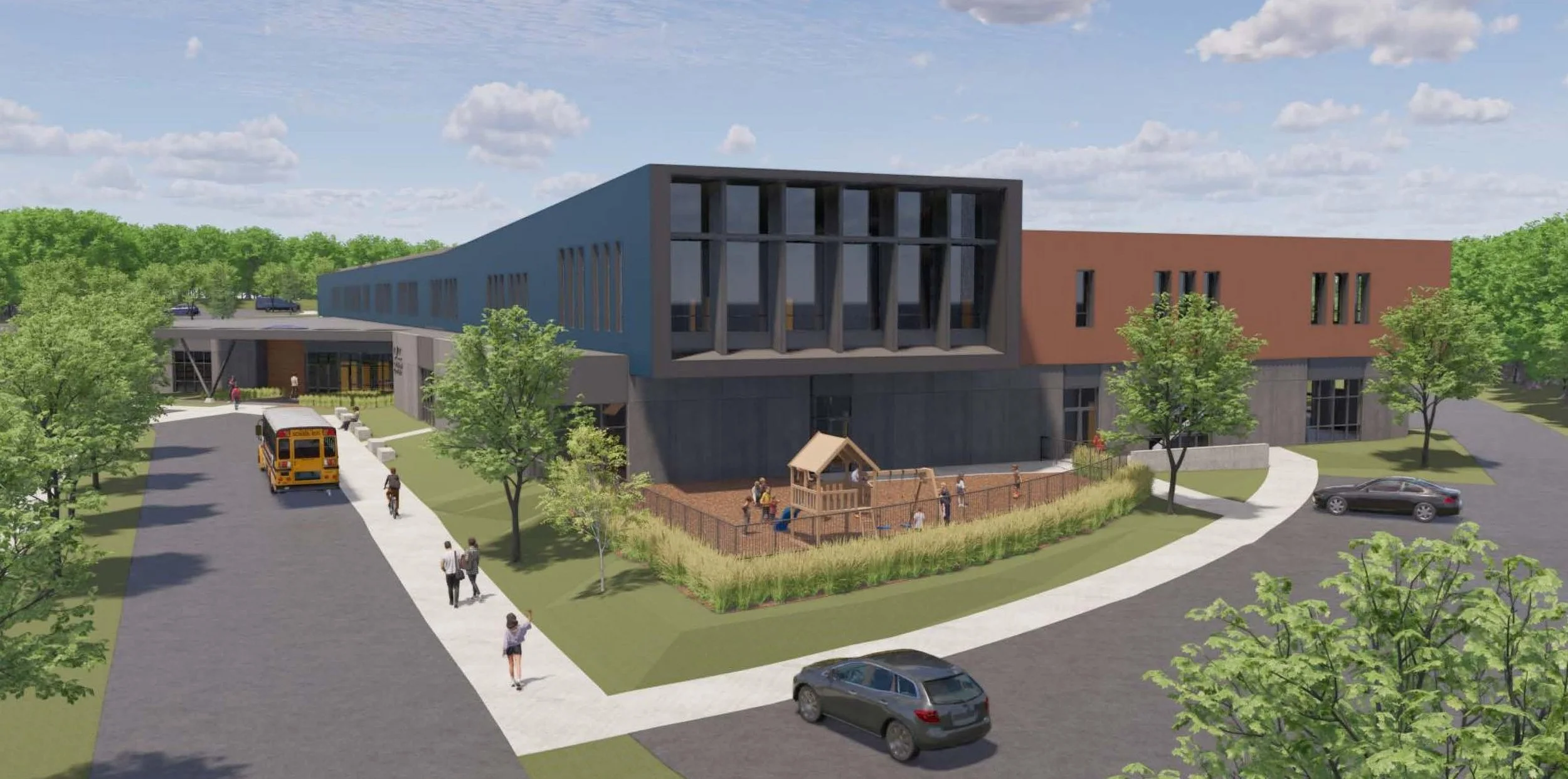
An architect’s drawing of the proposed new CVCC facility. Image courtesy CVCC
In recent years, demand for the programs has grown, with the career center unable to accept more than half of the applicants interested in programs from culinary arts to construction trades, graphic design to emergency medical skills, and more. TruexCullins is part of the design team for the proposed new 167,000-square-foot complex, to be built on a 27-acre parcel in the Graniteville section of Barre.
This is not an election year, so voters in the 18 communities that make up the Central Vermont Career Center School District will have just this one issue to decide on Nov. 4. The CVCC School Board holds a public informational meeting in person and online about the project on Oct. 7. See more information online at cvtcc.org.
Harwood’s full school board meets next on Oct. 8. Board and committee meeting recordings are posted online on the school district’s YouTube channel. Board meeting agendas and minutes can be found online at HUUSD.org.