Q&A: Reporting internship inspires Harwood grad Claire Pomer
June 16, 2026 | By Lisa Loomis | The Valley Reporter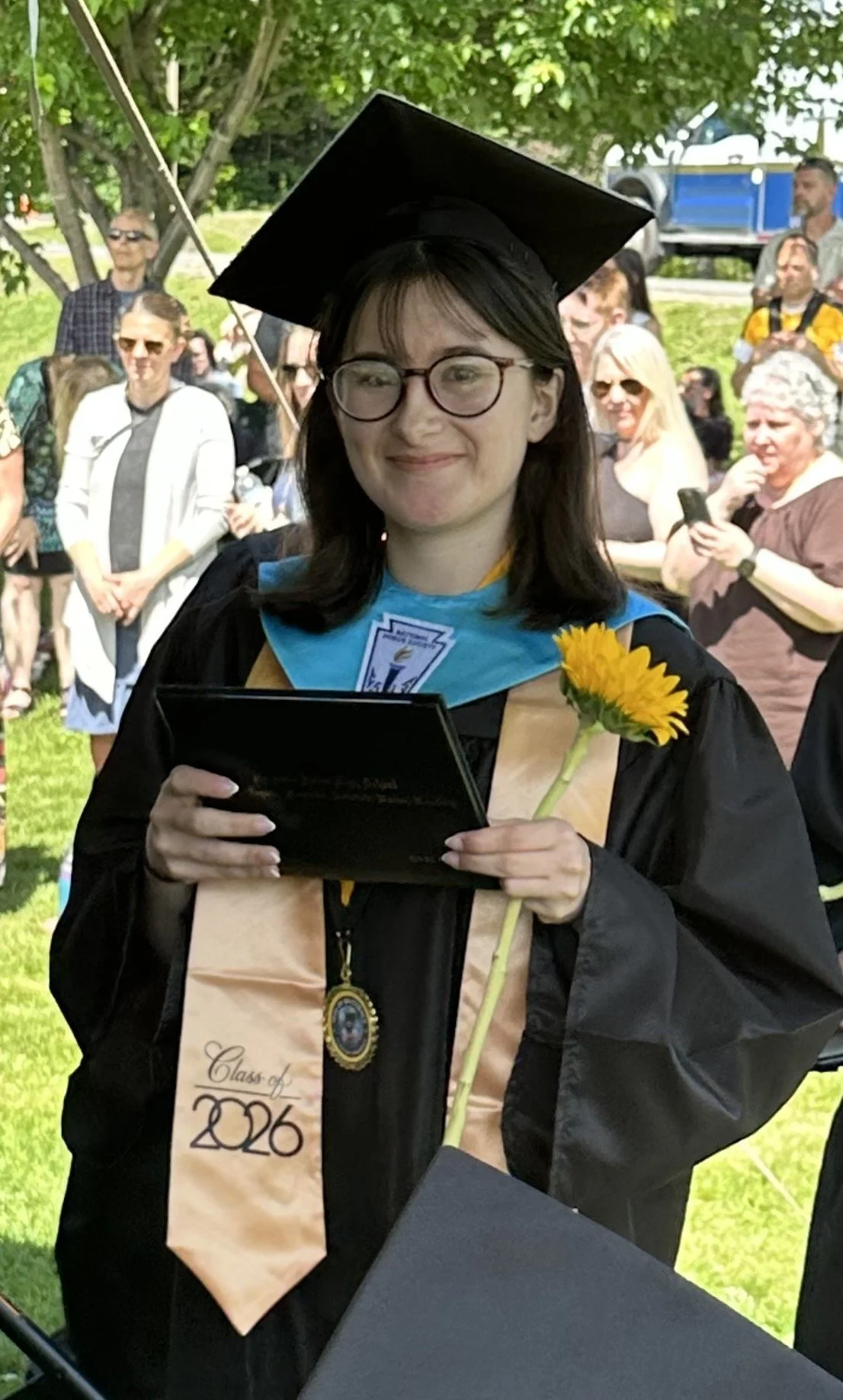
Claire Pomer at Harwood graduation, June 13. Photo by Lisa Scagliotti
Harwood Union’s internship program introduced recent graduate Claire Pomer to newspaper reporting when she was a sophomore, and in the fall, she is headed to Northwestern University’s journalism program in Chicago.
Pomer, who graduated on Saturday, said she began by telling internship program director Rachael Potts that she was interested in doing something challenging that involved writing. Potts connected her with The Valley Reporter newspaper, and the semester-or-two prospect turned into a three-year stint and ultimately shaped Pomer’s college choice.
Along the way, the Waterbury Roundabout picked up Pomer’s stories and contributed to her assignments with additional freelance reporting over the past two years. Roundabout readers have seen her byline on many stories from Harwood schools, along with news and feature stories in Waterbury. Her reporting on a rare white monarch that hatched at the Waterbury Public Library was published in the Times Argus. Other pieces included covering Duxbury’s Have Your Say Day pre-Town Meeting gathering this January and features on the library’s watercolor class and Silent Reading Parties last summer.
Lisa Loomis, editor and publisher of The Valley Reporter, sat down with Pomer shortly before graduation to talk about the experience. Excerpts of their interview as a Q&A are below.
~ Lisa Scagliotti
Q: What did you expect when you started?
A: I didn’t think it would go on for this long. I didn’t realize I would get this into it, or that I would become so excited about it. At first, I just wanted the practice. Now I’m going to college for journalism.
Q: I remember you telling me you liked writing, but journalism was something you hadn’t really done before.
A: Right. School writing is different. I remember really struggling with my first article. But now it’s so much easier.
Q: One thing I’ve watched you develop is the ability to organize information so readers understand it step by step.
A: That definitely came with practice.
Learning reporting
Q: Were you scared when you started?
A: Yes. Especially because one of my first assignments was covering The Laramie
Project. That was challenging because it wasn’t just covering an event. It was a whole group of people, and I had to interview them. Group interviews are still hard.
Q: One of the hardest assignments I gave you was the Waitsfield wastewater meeting. You had to gather a lot of information about topics you didn’t know much about and put it all together. That’s when I realized you had some real writing chops..
A: Another really hard one was covering the discussion around the film The Encampments.
Q: How did that feel?
A: I’m always careful about my words, but that was the only time I was really agonizing over word choices. I knew if I said something wrong, the blowback would be on me. There was so much material to go through—the statements from Dr. Mike, the community statement, the statement from the club. There were a lot of different perspectives involved. I felt like it was ultimately handled properly and in a way that was respectful to everyone who had concerns, but it was definitely one of the stories where I spent the most time thinking about how to phrase things.
Building confidence
Q: A lot of beginning journalists are nervous about approaching people. Were you?
A: Yeah. That seems to have gone away, though. I’ve gotten better at asking.
Q: Do you remember a moment when you realized that?
A: I cold-called someone from the Agency of Education for an interview. That was sophomore year, and I was really proud of myself for doing it.
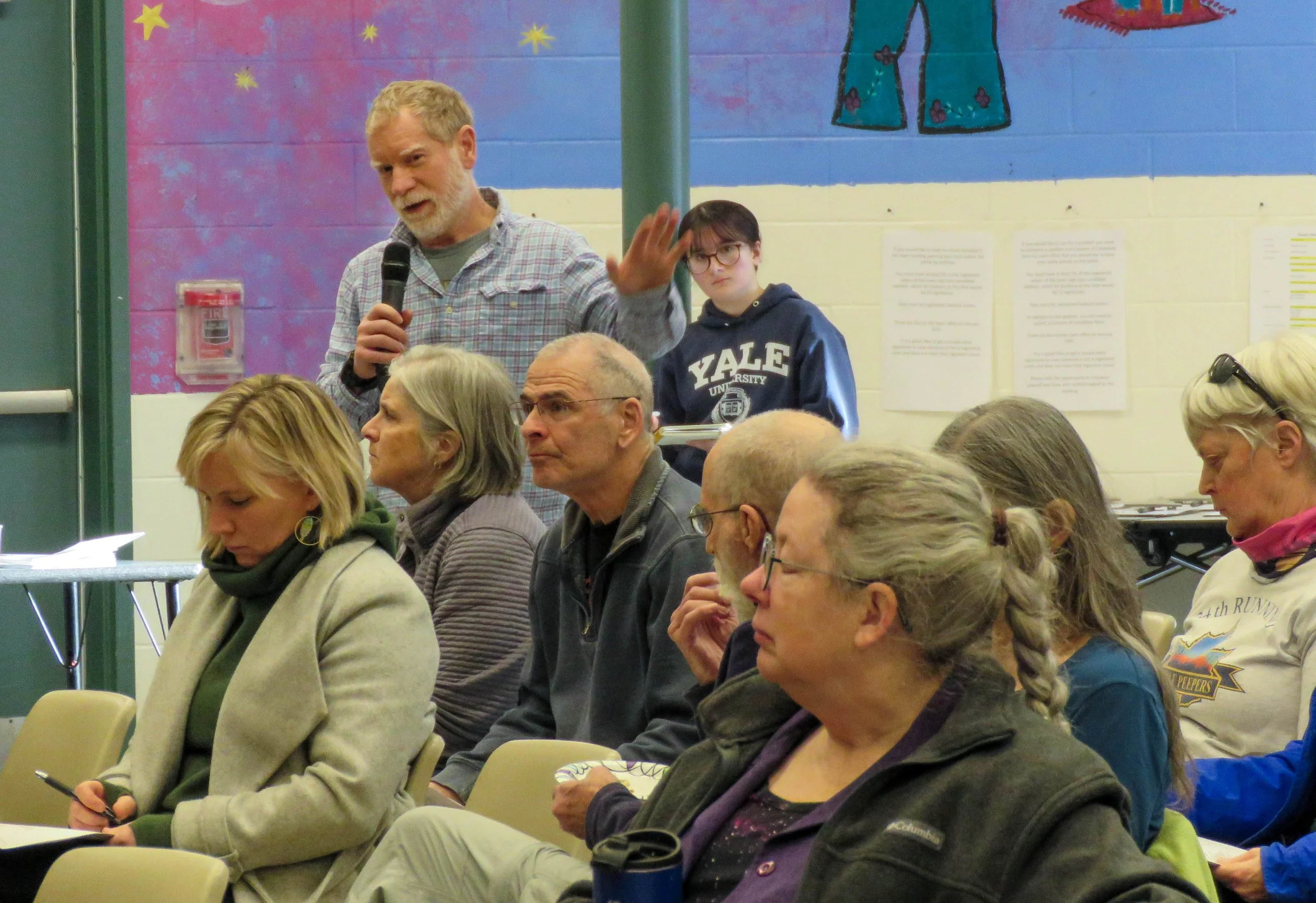
Claire Pomer covers Duxbury’s “Have Your Say Day.” Photo by Shawnee Perry
Q: How do you feel about deadlines?
A: The deadlines themselves don’t bother me. The frustrating part was when I couldn’t reach somebody. If I was emailing someone and they wouldn’t answer, that was hard.
Q: Did you learn workarounds?
A: Yeah. You kind of have to adapt and find another way forward.
Favorite stories
Q: What was the most fun article you worked on?
A: Once I got into the groove of it, I really liked writing about the inbound exchange students.
Q: Why?
A: Every student had such unique things to say. The first interview, I was kind of winging it. By the last few, I had a set of questions I knew worked. The fun part was when somebody said something unexpected, and I could follow that.
Q: The exchange student series is also a remarkable body of work. Taken together, it captures six very different experiences and perspectives.
A: That series was fun because every conversation went somewhere different.
Q: Were you a reader as a kid?
A: Yeah. I started reading on my own really early.
Q: I see that connection all the time. Strong writers are usually readers. What are you reading right now?
A: I just finished “Wuthering Heights.” I’m also doing a project on Gabriel García Márquez. I read One Hundred Years of Solitude a couple of summers ago and bought a few more of his books.
Choosing journalism
Q: When did journalism become something you wanted to pursue?
A: When I was working on my college applications. I was looking at everything I’d done outside of school and trying to see it from the perspective of an admissions officer. A lot of my activities were centered around journalism. I liked it even before I decided to major in it. I was just a little worried about job prospects and pay. But when I looked at my application as a whole, it didn’t make sense to do anything else.
Q: Tell me about Northwestern and its journalism program.
A: One of the things I like is that they have an entire school dedicated to journalism. Everybody starts with the same journalism foundation, and then you can branch out into different specialties.
We also have to do a journalism residency, which is basically an internship. I could do it in Chicago, or even somewhere like London, working for a media organization.
Q: Looking ahead five or six years, what do you see?
A: I don’t know. I’ve thought about graduate school, but that’s something I still have time to figure out. Right now, I know I want to write.
Q: Print? Television?
A: Mostly writing. The only other thing I’d seriously consider is video journalism, like the kind of work the Times has been doing. But writing is what I really enjoy.
Seeing stories
Q: Do you find yourself thinking about what would make a good story?
A: Yeah. I almost pitched the multi-school art show at Lareau. I actually wanted that to be my final article.
Q: During the student intern presentation, you said it was fun when people started pitching stories to you. Do you remember the first one?
A: I don’t remember exactly. I think it might have been a school-wide dialogue.
Q: How did that feel?
A: It felt good.
Q: One thing journalism does is teach people how to synthesize information.
A: I noticed that with AP Language. One of the essays is a synthesis essay where you get a bunch of sources and have to write an argument, and that felt really easy to me.
Q: You’re very good at that. You can take a lot of different pieces of information and present them in a way that helps people understand them.
A: I think journalism definitely helped with that.
Editor’s Note: We are incredibly proud of Claire and her hard work and her next steps. We will miss her and look forward to watching her grow.