Redistricting task force grapples with school choice as it works on three map proposals
November 1, 2025 | By Corey McDonald | VTDigger.org Protect Vermont’s school choice system. That was the loud and clear message to the Vermont school redistricting task force during its Oct. 22 public forum at Rutland High School.
But some task force members see putting guardrails around school choice as one way to reduce costs for public education across the state.
At the same forum in Rutland, task force members also heard from Barstow school district board chair Debbie Singiser, who testified about the impact of school choice on her community. State taxpayers were “increasingly funding education for students with limited or only temporary ties to our community,” she told them.

Task force member Jennifer Botzojourns makes a presentation during a meeting of the Vermont School Redistricting Task Force in Winooski on Tuesday, Oct. 28. Photo by Glenn Russell/VTDigger
Indeed, in the past five years, half of the 122 students who received public funding to attend private schools through Barstow Unified Union School District did not graduate from Barstow Memorial School’s 8th grade. And nearly half of the students using the tuition system from Barstow’s district in the past five years attended Killington Mountain School, a ski academy.
Source: Vermont Agency of Education data. Chart by Erin Petenko / VTDigger.org. Click to enlarge.
The data, compiled by task force members, supports Singiser’s comments at the public forum suggesting families are “moving into our school district to take advantage of that school choice and the tuition for high school.” That raises costs of taxpayers statewide, task force members argued.
“None of this is technically illegal. I mean, it’s just, is this what we want for our public school system?” Singiser said in an interview earlier this year. “We’re talking about how public education is getting expensive, and our property taxpayers are struggling, and when I look at that happening, I feel like we should fix that problem.”
During the task force’s Oct. 28 meeting, David Wolk, Gov. Phil Scott’s appointee to the task force, said it “shocked” him when he saw the data around tuition out of Barstow. He called it a problem that the Legislature “has got to change.”
“There has to be guardrails. There has to be some way to change this,” Wolk said. “It’s not right.”
As the state’s school redistricting task force continues its work to craft new school district maps, members are taking a microscope to the intricacies of the state’s 119 school districts and 52 supervisory union or supervisory districts, and highlighting some of the inefficiencies in school districts like Barstow.
The 11 members of the body have spent three months analyzing the state’s complex public education system, with one month left to go. The group is tasked with developing no more than three maps of new school boundaries for the Vermont Legislature to consider for the upcoming legislative session, which starts in early January.
So far, the task force has three map proposals in development. One creates 13 school districts to emphasize broader access to existing career and technical education opportunities. Another focuses on creating regional comprehensive high schools for underserved (and over-served) regions.
The third seeks to organize merged districts around regional BOCES, or a Board of Cooperative Educational Services, a type of educational governance entity used widely in New York and other states to help school districts collaborate on services such as special education and transportation.
That map, drafted by task force members Jennifer Botzojorns and Rep. Rebecca Holcombe, D-Norwich, takes the first stab at highlighting in detail where the state could target mergers and why.
Among other suggestions for mergers is Barstow, which Botzojorns and Holcombe said could be absorbed by the Rutland City School District as a way to control costs.
But time is limited. The task force has only two meetings left before it is required to finalize a report with three maps. Rep. Edye Graning, the co-chair of the task force, on Tuesday called it a “herculean” task for the body.
“I just keep coming back to the time crunch. We don’t have enough time,” Graning said. “We just don’t have the time to do the work … with the quality and level of detail that we would all love to be able to do it in. It makes me sad, because this is a big deal.”
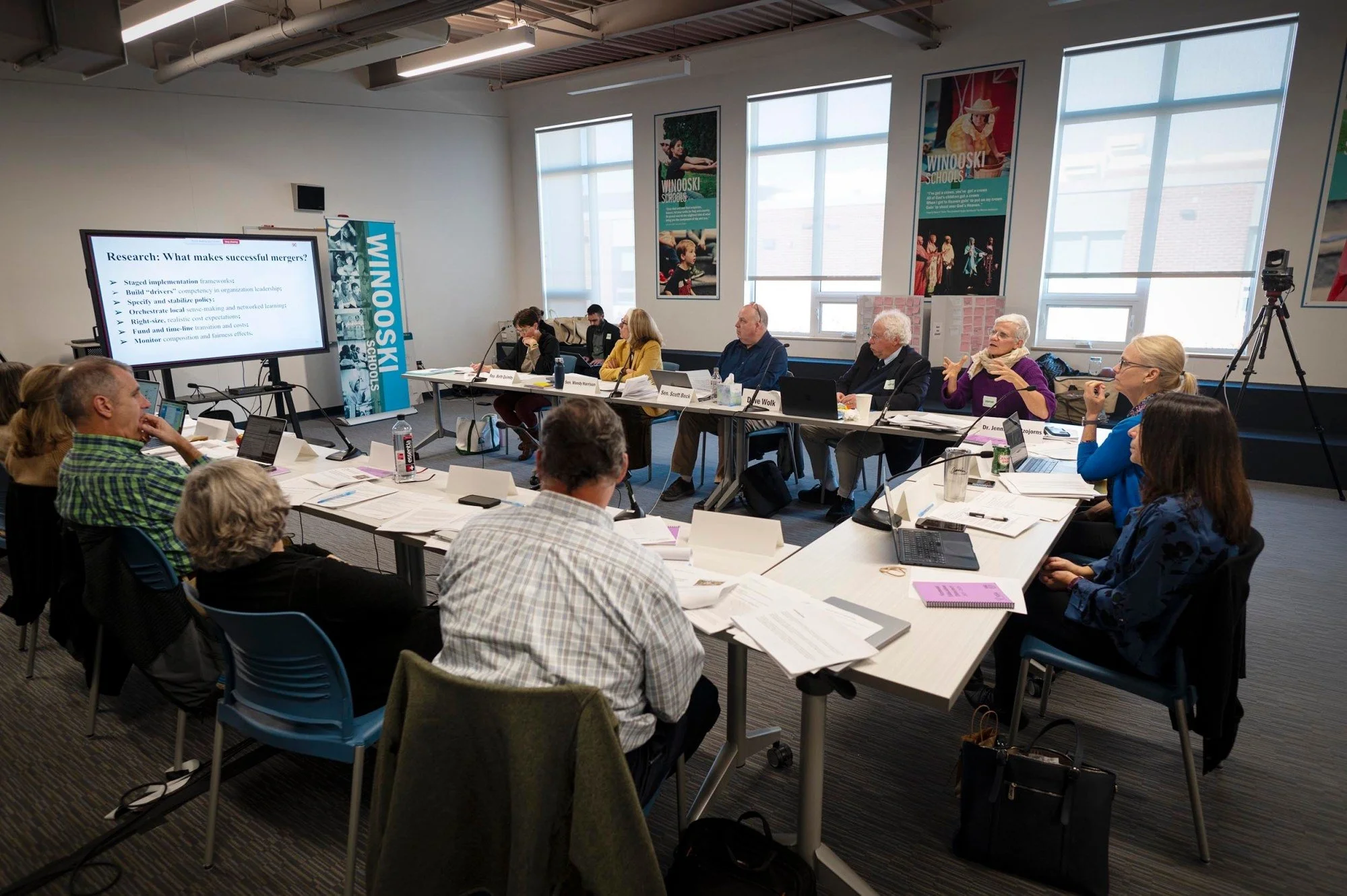
The Vermont School District Redistricting Task Force meets in Winooski on Tuesday, Oct. 28. Photo by Glenn Russell/VTDigger
‘Half baked’
At the task force’s meeting on Tuesday, Botzojorns and Holcombe discussed three examples of areas where enrollment and resources were either declining or not being used efficiently, and where the state could look to merge districts.
These different cases were meant to show the kind of detailed analysis needed to determine where specifically to draw district lines in a way that both reduces the cost to taxpayers and increases access to opportunities for students, they said.
Those merged districts would then be overlayed with cooperative education service areas to allow collaboration on shared expenses like travel and special education.
One example is typified by the state’s capital region, which “has a unique opportunity to coordinate” high schools in Barre, Montpelier and Twinfield, Botzojorns said.
This kind of area has “stranded costs,” where student enrollment was dropping faster than the disparate school districts’ ability to decrease costs. Costs at these school districts remained the same despite enrollment declines, putting financial stress on the overall system.
Merging districts could also improve access and save costs in districts like the Bennington-Rutland Supervisory Union. There, public school funds are being used to pay tuition for private schools in choice systems, siphoning tax dollars spent by the state away from the public school, Holcombe and Botzojorns argued.
In that supervisory union, the Winhall School District, a non-operating district, could be merged into the neighboring Taconic and Green School District to bolster overall enrollment and per-pupil-spending.
And in their third example, Holcombe and Botzojorns discussed areas with “sparsity loss,” where schools have become so small they may be considering closure. The proposal pointed to towns like Danville, Windham, West River, Twin Valley, Readsboro, Stamford and Halifax as examples. Merging in these districts would strengthen the isolated public schools, so they don’t close and potentially create regions with public school deserts.
Task force members on Tuesday also looked again at a map first proposed by Wolk and Sen. Scott Beck, R-Caldeonia, earlier this month. That map would create 13 school districts that closely mirror the state’s 15 career and technical education regions, each identified by the technical education center that anchors it.
The proposal aims to expand career and technical education opportunities to students and honor “school choice where it presently exists,” Wolk said.
A revised version tweaked some of the boundaries in existing districts, but little else was changed from the map’s first iteration. District sizes remained lopsided. One district covering Chittenden County and a part of Grand Isle County would have nearly 22,000 students, while the smallest, the River Bend Area District, would have just over 2,000 students.
Another proposal, developed by Holcombe and Jay Badams, would center a new map around comprehensive regional high schools.
By identifying and targeting construction aid at regional high schools, the state could incentivize neighboring districts to collaborate on the design and development of new regional high schools and potentially access state construction aid. Shared governance would then ensure communities retain a voice in how schools meet the needs of students, Badams said.
“If we were to designate the areas that we identify as likely sites for comprehensive public high schools, we could give (school districts) their own designation and give them priority in school construction funding and other things,” Badams said.
Badams, like the other presenters, called his proposal “half baked.” The exact number and location of the regional high schools has not yet been finalized. But he noted on Tuesday that the three map proposals shared so far all have elements that could be worked into each other.
“I think if we could weave them together a little better, we might be on to something that can be actionable,” he said
All three proposals, however, have yet to address how new districts would be governed. Specifically, which district governance model would be used, supervisory districts or supervisory unions.
Both models provide back office functions such as accounting and payroll and may oversee the provision of special education services and curriculum coordination. But the two systems differ in their structure. Supervisory unions are made up of school districts that each have their own board of directors, while supervisory districts have only one governing board.
Badams called governance the task force’s stumbling block. “We have three maps on the table right now that don’t really get to the whole idea of governance in a way that was contemplated” by the legislature, he said.
“We’re tinkering,” he said. “We’re trying to make an omelette without breaking a single egg.”
The task force will continue to flesh out its proposals for their Nov. 10 meeting. Members are expected to vote on which maps to recommend to the legislature at its final meeting next month.
“None of us wants to upset anyone,” Graning said, “and at the same time, that’s what we’ve been asked to do, is to make recommendations.”
This story was originally posted on VTDigger.org on October 31. It is republished with permission from VTDigger, which offers its reporting at no cost to local news organizations through its Community News Sharing Project. To support this work, visit vtdigger.org/donate.