
School board talks bonds, budgeting, redistricting
October 15, 2025 | By Cheryl Casey | Correspondent
Workers from Evergreen Roofing remove the old shingles from the south building at Brookside Primary School. Photo by Gordon Miller
The Harwood School Board has decided not to take a public stand as a group on the $149 million bond to build a new Central Vermont Career Center, but several members at last week’s meeting expressed their individual support for the project.
At the Oct.10 board meeting, Waterbury member Corey Hackett, Harwood’s representative to the Central Vermont Career Center School District School Board, summarized the bond proposal and took questions.
Hackett said the career center received 443 applications for this school year and could only accept 228 of those students. Of the 60 Harwood applicants, 38 students were accepted. The new facility, which would be located in the Graniteville section of Barre Town, would accommodate 450 students and up to 500 if needed.
“It’s a really nice-looking building that Truex has put together,” said Hackett, referring to the architectural firm TruexCullins on the design team. The firm also works for the Harwood district.
Board members voiced concerns about the effects that the new facility would have on enrollment and budgeting at Harwood Union High School. Harwood Director of Finance and Operations Lisa Estler said pupil count is expected to decrease at the high school and the amount of money the district sends to the career center as tuition payment for the students is expected to increase by about $500,000 from the current annual payment.
Currently, ninth- and tenth-graders are invited to explore the career center’s programming through shadowing opportunities. Students must be 16 years old or in tenth grade by the time of enrollment if their application is accepted. Hackett acknowledged that the career center may revise the exploratory program so that eighth-graders would be eligible to participate. The center also plans revisions to its curricular model to integrate other educational criteria into its programs so that students would spend the full day at the career center rather than the current half-day program model. The career center project design includes features such as a gymnasium that will allow the center to shift to full-day attendance.
Hackett added that the tax rates across the sending towns are projected to increase anywhere from 2.6% to 8.9%.
Moretown board member Steve Rosenberg said he will vote in favor of the bond. “We live and die by budget issues,” Rosenberg acknowledged, “but we all know there’s a tremendous need for people in the trades, and a tremendous desire among our students to go there.”
Harwood senior Cashel Higgins, a student member of the school board, asked whether the career center bond would hurt the Harwood school district’s chances of gaining voter approval for a construction bond of its own, recognizing that there may be a bond proposal in Harwood’s future.
Board members acknowledged that with so many moving pieces, the politics involved, and the long list of unknowns, there’s no easy answer or prediction to address Higgins’ concern.
Harwood Board Chair Ashley Woods acknowledged that Higgins recognized the board’s greatest challenge. “The single question that the board is wrestling with [is], how do we bond for our own work?” she said.
TruexCullins architects will share a presentation of their latest facilities review of Harwood district schools at the school board’s Oct. 22 meeting. Superintendent Mike Leichliter has written a letter to the community encouraging the public to attend. The report reviews the physical condition of the district’s five elementary schools and Crossett Brook Middle Schools listing needed repairs and renovations for district leaders to use in their planning. It estimates that the buildings need a combined $48 million in upgrades in addition to an estimated $73 million of work at Harwood Union Middle/High School.
Also among the unknowns regarding school facility planning is the ongoing state process to reorganize the state into fewer, larger school districts. A state panel is working on drafting proposals to present to the state legislature soon. Asked if the new career center facility could be derailed by redistricting, Hackett admitted, “We’re not sure, but it could be.”
For her part, Woods said she intends to vote in favor of the career center bond. “If we kick this project again…they have worked incredibly hard to bring a bond to the table,” she explained. “We all here know how hard that is, and how brave it is. This is a hell of a temperature to bring a bond to the table.”
The vote on the Central Vermont Career Center bond is Tuesday, Nov. 4. Early/absentee voting is open now, with ballots available in person and by mail from municipal clerks. More information about the project is online at CVTCC.org.
Budget planning begins
As discussion shifted to the next agenda item, the budget planning timeline, Estler reiterated her most frequent message: “It’s going to be a very, very tight year.”
The budget development process for fiscal year 2027 has begun, and Estler said she anticipates ongoing challenges, including preliminary expectations that health insurance rates will increase by 10-12%.
“Last year was extremely difficult to get to the number we needed to get to. We had to make cuts. Even seeing the numbers coming in already this year for certain things—special ed, supplies, maintenance—we are going to be running very tight,” she explained.
Rosenberg raised the issue of busing and its relevance to the conversation around budgeting challenges. At the start of the meeting, during public comments, Moretown resident Michael Brown, who lives on Moretown Mountain Road, described to the board the impact of bus route consolidation on his family and others on his road when their bus stop was removed from the route.
“I pay the same tax rate and get taxed the same as other homes in Moretown that are located on a Class 3 town road,” he stated. “The lack of a bus has caused us to spend more on after-school child care, reduced my capacity for work, and to drive more.” Brown added, “I feel that we are entitled to the same opportunities as other households that are taxed the same and located on a Class 3 or better town road.”
Estler confirmed that a driver shortage was the impetus for consolidating some bus routes and removing some stops. She said she is working with the First Student bus company to identify possible revisions as they negotiate a new contract.
“Moretown was not the only town that was affected” by route consolidation, Estler pointed out. In Moretown’s case, she said the only option to address Brown’s neighborhood’s situation would be to add a route. “That additional bus will cost $80,000 for a year,” she said.
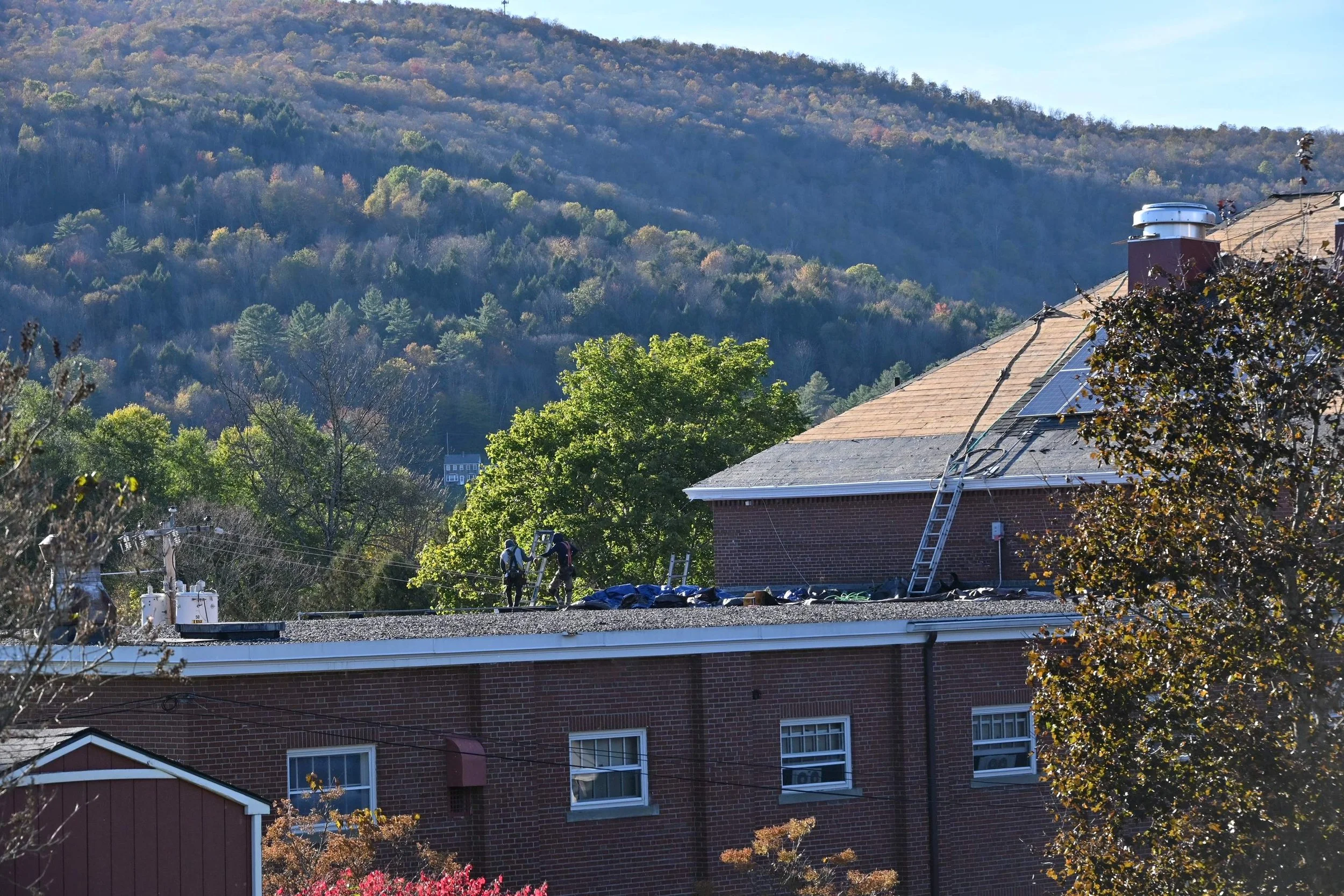
The Harwood school board approved the emergency roof replacement at Brookside Primary School. Photo by Gordon Miller
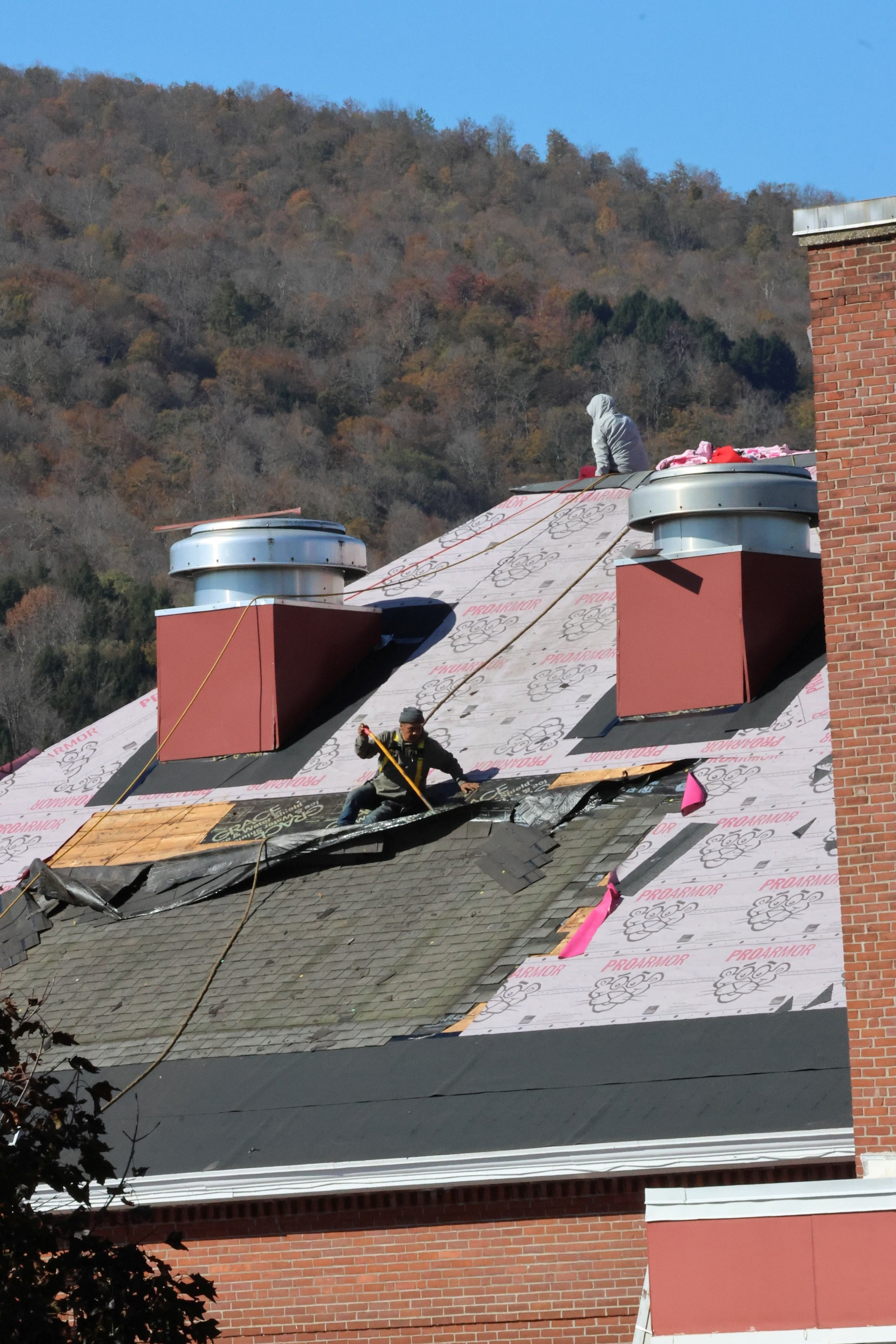
Roof replacement under way at Brookside Primary School last weekend. Photo by Gordon Miller
Another pressing financial issue the board heard about was the need to immediately replace Brookside Primary School’s south building roof. It began leaking recently, and an assessment by Evergreen Roofing concluded that it required attention now.
“There is no way to repair that roof,” Estler said, noting that the replacement was scheduled to take place in summer 2026, but the current condition indicated that the work should be done before winter. She asked the board to approve $56,000 from the district’s Maintenance Reserve Fund, which has funds given that the district underspent on projects this summer.
The board approved the request and work began on the project on Friday, Oct.10.
Community survey
The other action item was to approve a survey of residents of the district’s six towns to collect input about the state school district redistricting process, asking for the community to weigh in on priorities, concerns and ideas.
“We have to get people to realize this is ongoing right now and changes are going to happen,” Woods said. “There could be great ideas from anyone.”
Rosenberg, who chairs the board’s public outreach committee, explained that “The main focus of the questionnaire is to get people in the district thinking about what Act 73 is going to mean for them.”
The 10-item survey primarily consists of open-ended questions soliciting public input about the opportunities they think exist in a redistricting initiative, the risks and concerns, and the resources needed to support successful redistricting efforts.
Woods and board Vice Chair Cindy Senning will compile the responses and share the results with the state School Redistricting Task Force in November. That panel is currently conducting a series of hearings to gather public comment. The next meetings are Oct. 16 and 22; they are livestreamed and recorded.
The Harwood community survey closes on Oct. 26. The board has shared a letter with families of children in the schools and with the local newspapers explaining the survey and asking people to fill it out and share it. The survey is online only. The board suggests that those without computer access visit their local library to complete it.