
November 16, 2026 | By Lisa Loomis | The Valley Reporter In the debate over which HUUSD elementary schools to keep and which to close in the Mad River Valley, the discussion includes expected topics such as enrollment trends, building condition, and classroom capacity.
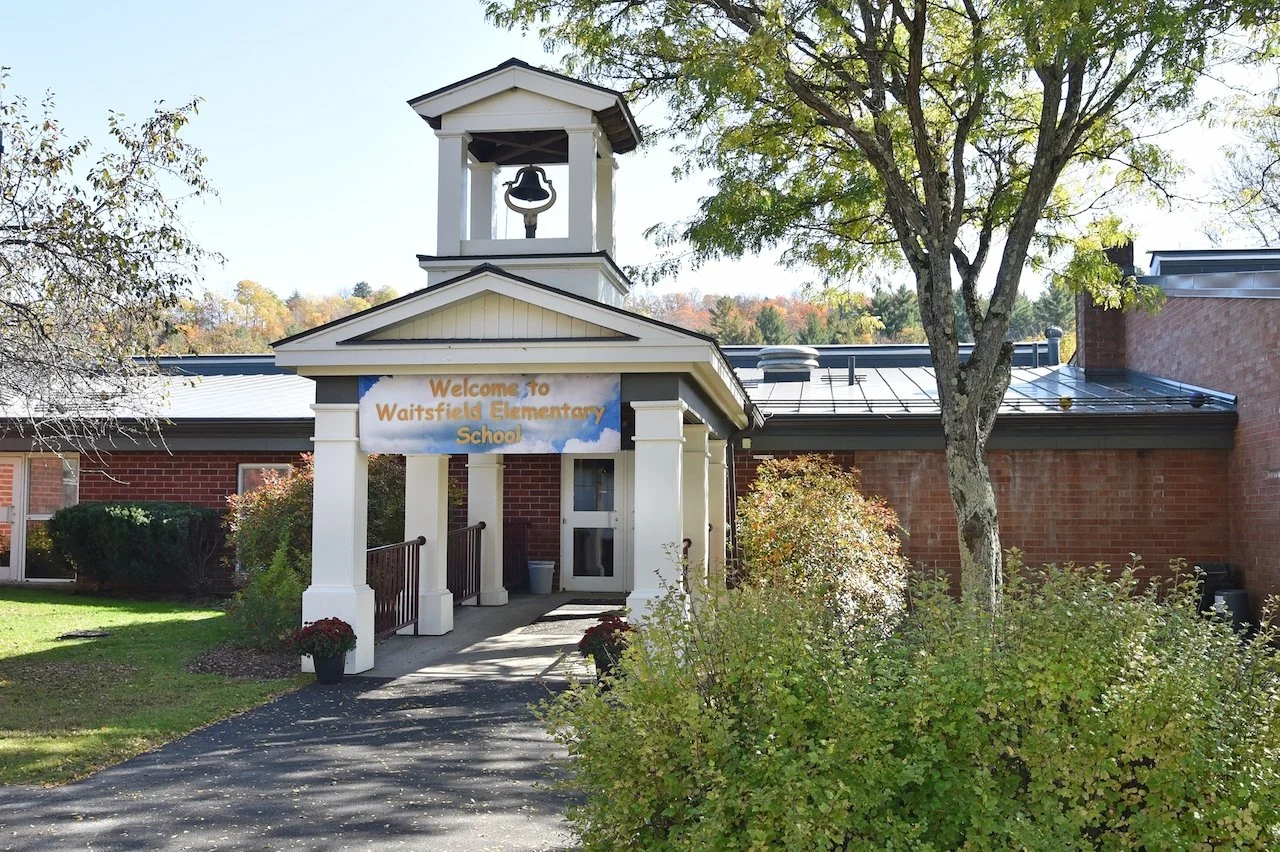
A new municipal wastewater system could allow for future expansion at Waitsfield Elementary School. File photo by Gordon Miller
But as school board members and the public dig into the details, one seemingly mundane aspect is getting increased attention: wastewater.
In particular, the wastewater discussion has recently focused on Waitsfield Elementary School and the plan to connect it to the town’s new $20 million wastewater system that’s under development with construction expected to begin in 2027.
The issue has come up as Waitsfield and Fayston schools were the top two choices of the Harwood School Board from Nov. 4 to explore for potential closure for the 2027-28 school year. Growing pressure to rein in operating costs and avoid state spending penalties is forcing district leaders to look to reducing the number of schools operating in the future rather than make deep cuts to the operating budget for its current seven schools.
On-site systems
The Valley elementary schools all use on-site septic systems that currently have similar capacities: Fayston’s is 250 people per day, Moretown’s is 235, Warren’s is 237 and Waitsfield’s is 230-300. Those are all standalone systems.
In Waitsfield’s case, however, wastewater capacity will increase when the school is connected to the new municipal system. At that point, additional capacity would also allow the school building to be expanded into space on the property currently used for leach fields.
In a special election in June 2024, Waitsfield voters approved a $15 million bond to finance the new municipal wastewater system. The project has moved forward and went out to bid this month, according to town officials. Construction is slated for 2027-28 and the system is expected to become operational in 2028.
Federal funding
In addition to the bond, the roughly $20 million project includes about $7 million in grants and forgivable loans. That includes a $1 million Northern Border Regional Commission grant to extend the service area from the northern end of Slow Road in Irasville through Waitsfield Village and north to Mad River Property Management, across Route 100 from the school.
The Northern Border Regional Commission is a federal-state economic and community development partnership focused in Vermont, Maine and New Hampshire. It provides federal funding and technical assistance for rural projects including water/wastewater systems.
Part of that grant application included an April 17, 2025, letter of support from the Harwood Unified Union School District. Superintendent Mike Leichliter wrote that the lack of wastewater infrastructure in Waitsfield had limited residential development and contributed to declining school enrollment, alongside the town’s aging population. The district said it supported the project and was open to further collaboration.
Questions & Answers
In an interview with The Valley Reporter, Waitsfield Select Board member Chach Curtis discussed the town wastewater project, commitments to the school, taxpayer costs, and potential longer-term benefits for the school district and The Valley.
Curtis explained that the town’s goal is to support a walkable, mixed-use village where people can live near jobs, services and the elementary school. He described the project as a long-term effort to address a housing shortage that affects The Valley and the school district, not simply an infrastructure project for existing properties.
VR: What does the $1 million Northern Border Regional Commission grant pay for, and how was the school included in the application?
Curtis: The grant supports extending the service area through the historic village to the school and the Mad River Property Management building, which is at the northern end of the planned service area. The school was specifically mentioned in the grant application, including in the district’s letter of support, but the grant was not written solely to pay for a pipe to the school.
The $1 million is the commission’s maximum grant amount. It is one part of approximately $7 million in outside funding the project has secured: about $4.9 million in grants and another $2 million in forgivable loans through the Clean Water State Revolving Fund.
The broader purpose of the grant is important. The town is extending service through the village, and the school is one of the facilities within that service area.
VR: How much wastewater capacity is being set aside for Waitsfield Elementary, and what does that allow the school to do?
Curtis: The town has allocated 4,500 gallons per day of capacity for the school, more than its current use. That allocation accommodates growth in the number of students and staff.
Connecting to the municipal system also allows the school to retire its existing leach fields. Those fields occupy land behind and beside the building and limit the potential for physical expansion. Once they are no longer needed, the school could potentially expand into some of that space.
VR: What will Waitsfield be covering on the school’s behalf?
Curtis: The town will cover the connection costs for the school as an initial priority user. We are covering those costs for initial priority users because their existing wastewater systems may pose risks to public health, the environment and nearby drinking water wells. The school is considered a priority user. The connection fee is distinct from the cost of construction.
For a non-priority property owner who wants to reserve capacity for future development, the draft commitment fee is roughly $5 per gallon of daily capacity, or a little more than $1,000 for one equivalent residential unit. An equivalent residential unit, or ERU, is based on an estimated 210 gallons of wastewater per day, roughly the amount assigned to a single-family home. Using that preliminary calculation, 4,500 gallons per day for the school translates to an estimated upfront capacity commitment of roughly $20,000 to $21,000.
These figures need to be confirmed against the town’s final fee schedule.
The town will also pay the cost of extending the physical connection from the sewer main along Route 100 to the school. That expense is likely to be substantially greater than the capacity commitment fee, but we do not yet have a firm figure. The detailed cost is part of the project estimate, and the bids will provide a clearer picture of construction costs.
VR: Can you quantify the value to the school district of the town’s wastewater project?
Curtis: The town is making a specific financial commitment to the school by agreeing to pay the cost of physically connecting it to the sewer main and that portion of the costs of constructing the pipe and treatment facility. The town is covering the initial connection and construction costs. The school district will pay an ongoing user fee once the school is connected. The school district will be among the system users paying quarterly fees to cover operations and debt service for the funds borrowed. The town’s draft annual fee is $925 per ERU, with one ERU representing 210 gallons per day. Applying that rate to the school’s 4,500-gallon daily allocation produces a rough estimate of about $20,000 a year.
This is an estimate, not a final bill. The actual charge will depend on the final fee structure and how the school’s use is calculated.
VR: What would it cost to replace the school’s existing wastewater system if it had to remain on-site?
Curtis: A conventional system for a single-family home can cost between $30,000 and $60,000, with costs tending toward the higher end in constrained locations such as village areas. Applying that general comparison to a school system with substantially greater capacity, you might estimate that a replacement system could cost in the range of $500,000 to $750,000. A larger system could benefit from some economies of scale, but the school’s proximity to the floodplain would add constraints.
That’s not an engineering assessment or a construction bid – just a broad comparison to illustrate the potential cost of replacing an on-site system.
VR: Beyond the school connection, how could the wastewater project impact school costs, including per pupil spending?
Curtis: The larger potential benefit is the opportunity for additional housing in Waitsfield and the resulting effect on enrollment and the tax base.
The wastewater system is designed to support residential development beyond the initial priority users. Based on the town’s earlier planning estimates, the service area could accommodate roughly 70 additional one and two-bedroom housing units.
More housing could bring additional families and students into the district, helping spread the cost of education across more students. New development would also add taxable property to the grand list, potentially distributing the education tax burden across a larger tax base.
VR: When will the town know what the school connection and the overall project will cost?
Curtis: The project has gone out to bid, and we expect bids to provide more reliable construction figures than the engineers’ estimates used during planning. Bids are due and will be opened on Dec. 22 and 23 at the Waitsfield Town Office at 11 a.m.
Lisa Loomis is editor of The Valley Reporter newspaper.