
Braving subzero temps, backcountry teams rescue two hikers on Camel’s Hump
February 10, 2026 | By Lisa ScagliottiTwo young hikers survived an ordeal on Camel’s Hump this past weekend that led to a nine-hour rescue operation in life-threatening subzero conditions by multiple local and state backcountry rescue crews.
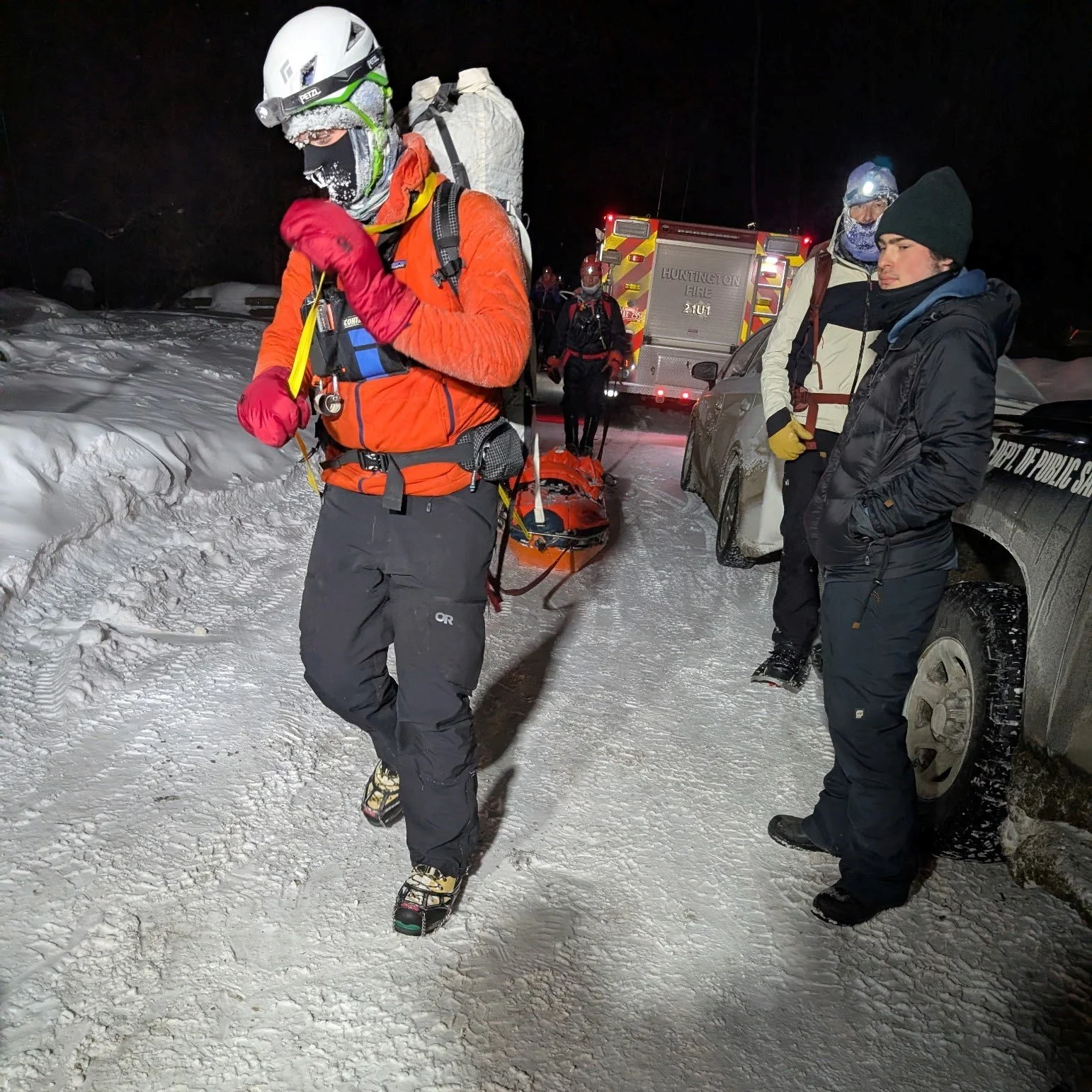
Pre-dawn on Sunday: Rescuers transporting one hiker in a litter reach the Monroe Trail trailhead parking lot. Team members here are from Richmond (front) and Huntington (rear). Photo courtesy of Waterbury Backcountry Rescue
Local volunteers began to mobilize shortly after 6 p.m. Saturday after a 911 call from one of the hikers on the Long Trail near the summit of the 4,083-foot peak. The pair – a 21-year-old man and a 19-year-old woman, both of Ontario, Canada – were “extremely cold and needed assistance,” according to the Vermont State Police account.
Weather conditions at the time included below-zero temperatures with wind chills approaching -20°F, and the trail was blanketed in deep snow.
In their account of the events that unfolded, the Richmond's Camels Hump Backcountry Rescue described the night as “a call that would become among the most challenging calls in our history.”
The response began at 6:15 p.m. when Drew Clymer, the state’s Search and Rescue Coordinator, contacted Waterbury Backcountry Rescue Team, relaying that the two hikers already had been on the mountain for approximately 7 ½ hours.
“Their water was frozen, food supplies were minimal, and they were unsure of their exact location,” according to the Waterbury team’s report.
The pair was reported to be around 3,700 feet in elevation and in knee-deep snow. The male caller said they were mobile, but having trouble continuing. Eric LaRose with Waterbury Backcountry managed to plot the coordinates of the hikers’ suspected location. Along with Clymer, they advised the hikers to head toward the Alpine Trail and to take that for their descent, where rescuers would head to meet them.
With that goal, four Waterbury team members left and were joined at the Monroe Trailhead in Duxbury by three members of the team from Richmond. Huntington Search and Rescue was called to be on standby and soon was requested to join the operation, according to the Waterbury report.
A two-part rescue
Before rescuers entered the woods, an update indicated that the female hiker’s condition had deteriorated rapidly and she was no longer able to continue walking. Huntington personnel were requested, and just after 7:30 p.m., an initial six-member team from Waterbury and Richmond, led by LaRose, left to meet up with the hikers to begin warming and providing food and hydration.
The local responders were soon joined by Vermont State Police and Department of Public Safety search and rescue team members at the trailhead. Just after 10 p.m., a second six-person team led by Huntington headed up the mountain trail with a rescue litter that would enable the crew to carry the incapacitated hiker.
Shortly before 11:30 p.m., the first team reached the hikers, who were sheltering under a tree, according to the Waterbury account. The hikers were suffering from hypothermia, and the rescue crew members began providing immediate treatment to help warm the hikers and prep for their descent.
The male hiker was “cold and fatigued,” but rescuers said they were able to warm him and convince him to begin moving down the trail with assistance from the Waterbury crew members. The Camels Hump personnel remained with the other hiker to await the arrival of the litter.
The hiker on foot and his accompanying rescue detail reached the trailhead at 2:15 a.m. A Waterbury Ambulance Service team was waiting and evaluated him and he was released, the account says.
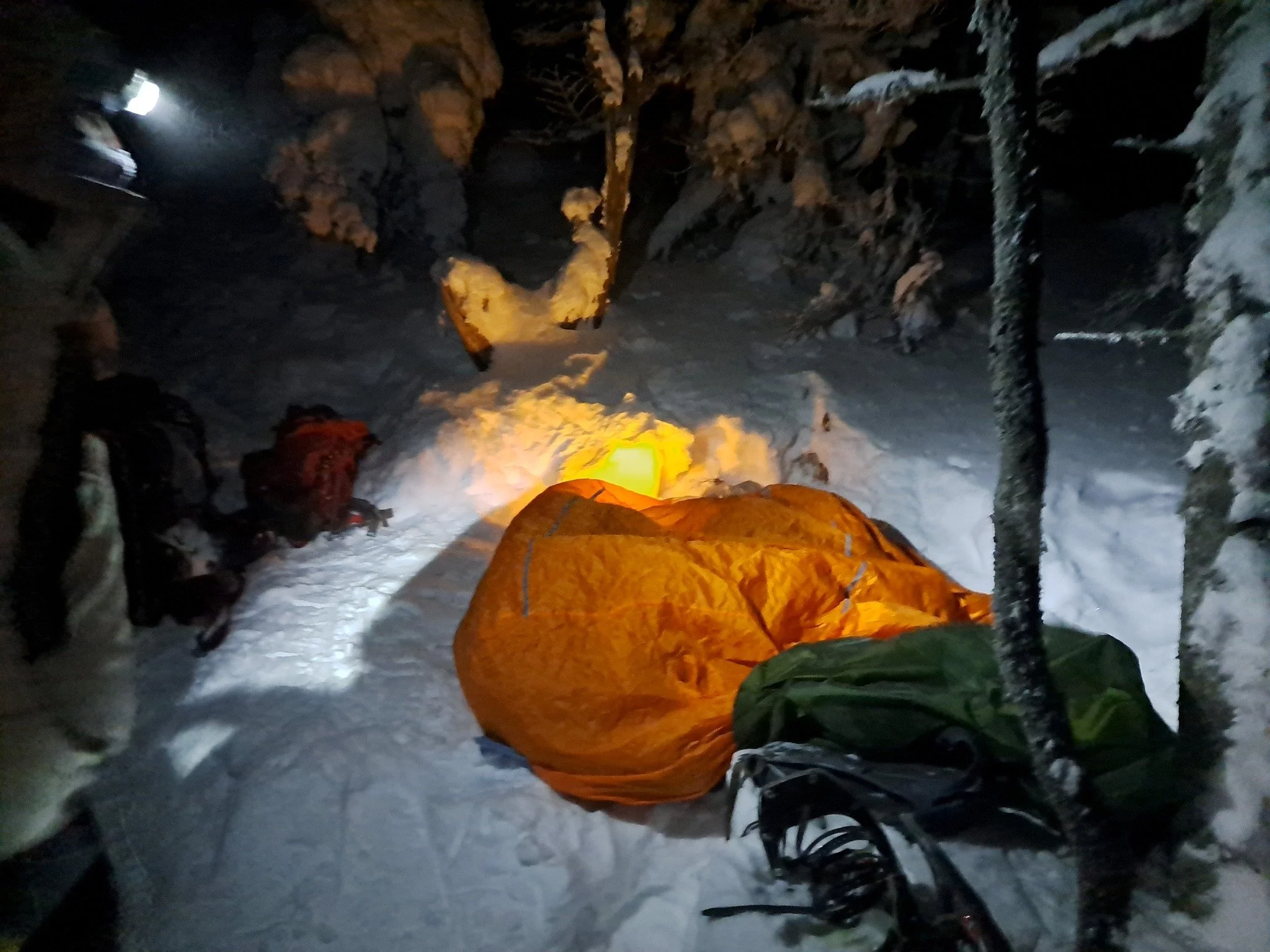
In this photo from Richmond's Camels Hump Backcountry team, the patient is completely inside a Bothy bag and in a sleeping bag outfitted with an extra-large chemical heat pack for the trip down the mountain.
The team escorting the hiker on the litter – bundled in thermal bags with heating pads inside – reached the ambulance at 3:22 a.m., the incident report notes. In more serious condition, she was transported to the University of Vermont Medical Center with injuries consistent with excessive cold exposure, the rescuers reported.
The rescuers reported that all personnel were accounted for and headed out of the woods by 3:28 a.m.
Both hikers were expected to make a full recovery, state police said.
Clymer and Vermont State Police Lt. Thomas Howard, commander of the state Search and Rescue Team, agreed that the combined efforts of the rescue crews in incredibly challenging conditions saved the lives of the two hikers.
Rescuers caution: ‘The mountain will always be there another day.’
In filing his report, Waterbury Backcountry’s Lt. Adam Mattessich noted the extraordinary circumstances of this rescue: “This incident was compounded by extreme cold (estimated -30°F to -40°F wind chill), deep snow, as well as intermittent and frozen communications. Despite these factors, all personnel completed this unified overnight rescue effort successfully, leading to survival for these two individuals,” he wrote.
Richmond’s Camels Hump Backcountry Rescue saluted their neighboring backcountry teams from Waterbury and Huntington for the high level of cooperation needed for this rescue. “The 12 members from the three teams were an exceptional group who managed to take care of two dangerously cold hikers while still taking care of themselves in an extreme environment. Our frequent joint trainings have paid off, as everyone was familiar with each other and the systems we use,” their account states.
All of the teams shared messages of caution for those headed out to backcountry trails for winter recreation, stressing the importance of being prepared for winter conditions. It’s critical to know the terrain where you are headed, carry sufficient gear and supplies for the weather, Clymer and Howard said. It’s also critical to ensure that your abilities are up to the task, “and be willing to turn back at any time,” they said.
The state police team reminds the public that, unlike some other jurisdictions, Vermont does not hold people who call for backcountry assistance financially liable for their rescues. They encourage people not to delay calling 911 for help due to fear of being billed, because doing so only increases the danger for everyone involved.
Rescue team members frequently are able to offer guidance to those in need of help in the backcountry by phone to direct them to where rescuers can meet them. Not waiting to call also increases the chances of having a working cellphone to communicate with rescuers.
The Richmond team advises keeping perspective when it comes to taking recreation risks in winter. “We want to take this opportunity to remind hikers that although our mountains are small by global standards, they still pose a considerable threat to unprepared hikers, especially in the winter,” they noted. Their report from the call references a list of “10 essentials” that the Green Mountain Club advises winter hikers to pack, including food, water, lights and batteries, extra clothing layers, fire starters and navigation aids.
“And don't be afraid to turn back if you are not prepared for the conditions you find. The mountain will always be there another day. Your job is to make sure that you are, too,” the team advises.
Waterbury Backcountry Rescue Team is part of Waterbury Ambulance Service. Camels Hump Backcountry Rescue is part of Richmond Rescue. Huntington Backcountry Team is part of the Huntington Fire Department.