
Survey asks regulars and those who skip for input
November 25, 2026 | By Lisa ScagliottiThe first Tuesday in March may seem like a long way off, but a dedicated group has been investigating how to improve Waterbury’s annual Town Meeting Day for the past year, and now they want to hear from the community.
An online survey is one of the final steps by the Town Meeting Study Committee, appointed by the Waterbury Select Board last fall and led by Waterbury’s Town Moderator Rebecca Ellis. The committee is looking for input from the public about what could make the annual civic gathering easier or more worthwhile for more people to attend and participate.
The committee was created to explore ways to boost interest and participation in Town Meeting after the topic came to the forefront in discussions and debate at the gatherings for the past several years.

Waterbury’s in-person Town Meeting is held in the gym at Brookside Primary School while Australian ballot voting takes place simultaneously. Photo by Gordon Miller
Waterbury conducts its annual Town Meeting in person on Vermont Town Meeting Day, the first Tuesday in March. It also holds an all-day election by paper ballot for town offices such as select board members, library commissioners, listers, and school board members.
The main event of the meeting involves discussion, debate and voting on the various items for the town budget for the year ahead. Questions pertaining to school budgets are done by paper ballot.
While attendees at the hours-long in-person meeting fill chairs and bleachers in about half of the gym at Brookside Primary School, they typically number fewer than 300 people. All-day balloting gets a much higher turnout. This year, for example, 1,531 of Waterbury’s 4,578 registered voters cast ballots in the March election, a turnout of 33%. The in-person meeting attracted fewer than 200 people, roughly 4% of the town’s voters.
The disparity has bubbled up at the in-person meetings for several years. In 2025 and this year, the Select Board sought to build interest by holding informational meetings in early January to present the draft budget that would be debated and voted on in March. Modeled after Duxbury’s Have Your Say Day January informational meetings, Waterbury’s sessions only attracted a few dozen attendees, many of them members of town committees and regular audience members at Select Board meetings.
In Duxbury, a dedicated following of voters has embraced the January meeting approach after voters in 2022 decided to end their in-person March Town Meeting. Since 2023, Duxbury has put all town business – the budget and all elections – on paper ballots that voters cast using a drive-through system outside the town office. The unique arrangement began during the COVID-19 pandemic and town officials and voters opted to continue the practice, which boosted voter turnout. To not lose the in-person discussion, the January informational meetings were established to give citizens a chance to have their say before voting.
Duxbury’s Have Your Say Day meetings for several years have attracted about 100 or so people each. They resemble March Town Meeting with tables for town committees and civic groups to share information and volunteers serving pies contributed by attendees. But there is no voting.
In 2025, Waterbury town officials decided to offer voters a similar change to all-Australian ballot voting, which ultimately received a cool reception. That year at Town Meeting, a lively debate about whether to move all town business to the paper ballot failed by a vote of 144-64.
That decision preserved the traditional in-person meeting format, but many attendees agreed that an effort to boost participation was worthwhile. Last December, the Waterbury Select Board created the Town Meeting Study Committee with the charge to spend a year exploring ways to improve the quality and quantity of citizen engagement in public decision-making at March Town Meeting.
The committee formed early this year has met regularly. Its work is documented on the town website, including a draft report that was summarized into a presentation to the Select Board last month. Feedback from the ongoing community survey will be incorporated into the final version along with recommendations for the Select Board to consider ahead of the upcoming 2027 Town Meeting.
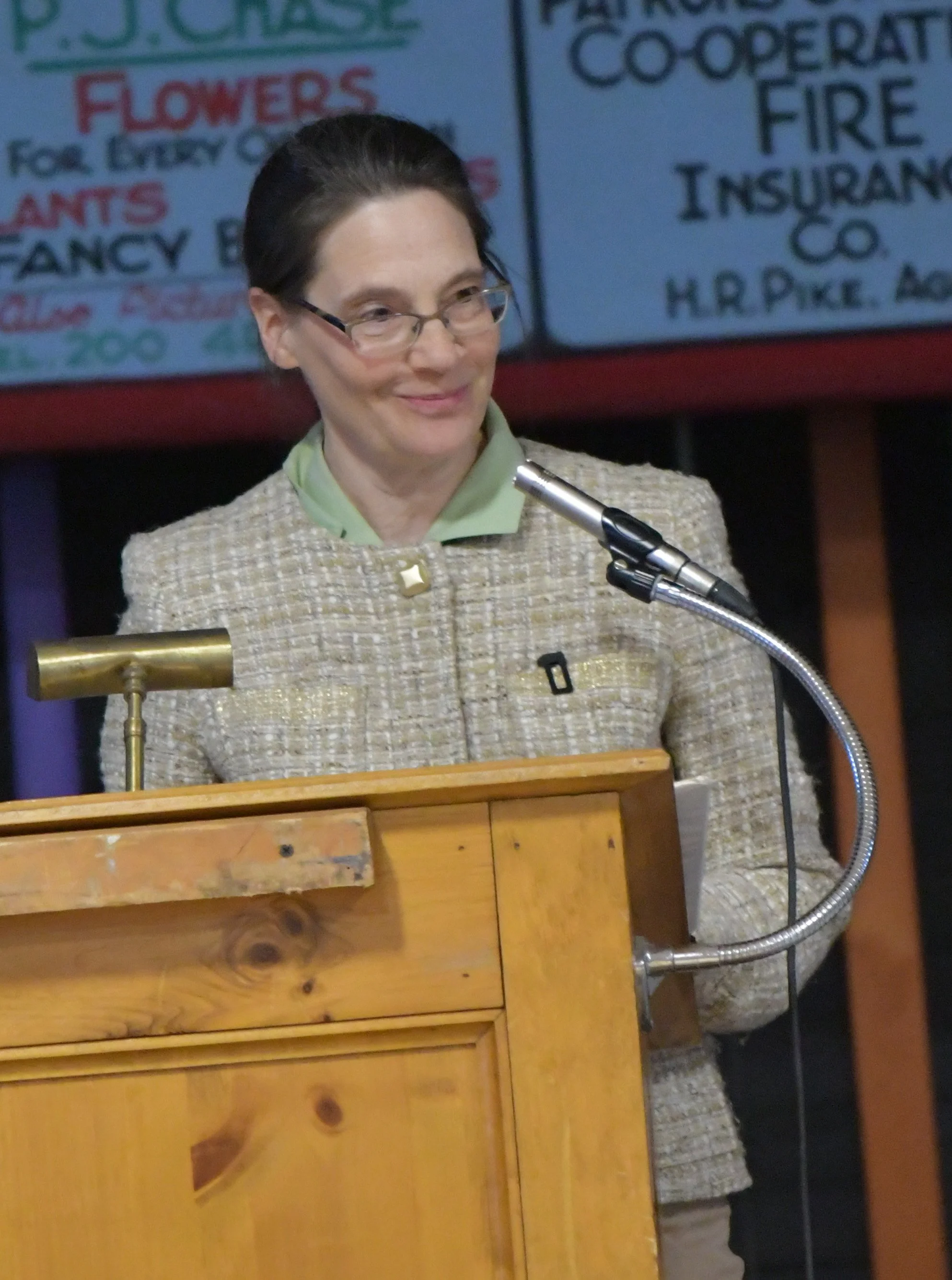
Waterbury Town Moderator Rebecca Ellis at Town Meeting in 2025. Ellis chairs the Town Meeting Study Committee. Photo by Gordon Miller
SUBHEAD
The Town Meeting Study Committee has heard from a variety of people involved in Town Meeting processes in other communities around Vermont to learn about other approaches and philosophies.
“It was really interesting, and we learned a lot,” Ellis told the Select Board.
The group began with two presentations by Town Meeting Moderator Susan Clark from Middlesex, an expert on the Vermont tradition. An educator and researcher, Clark co-authored the book, “All Those in Favor,” with UVM political science professor Frank Bryan. Published in 2005, the book remains relevant today in its research on the Vermont Town Meeting tradition and the growing pains communities face as they try to preserve it.
Clark shared highlights of her research on the Town Meeting tradition in Vermont, New England, and even other countries. She gave the committee two presentations focusing on the quality and quantity of participation, and examples of initiatives by other towns to improve their systems.
Ellis summed up the discussion, noting that in-person floor meetings offer a chance for good quality discussion and understanding. But that discussion can be long, and it attracts fewer people than Australian ballot voting, which generally takes just minutes, making it popular for a larger quantity of participation.
“In the end, what Susan Clark’s point was is that there’s nothing perfect and that floor meetings can be improved, Australian ballots can be improved,” Ellis said. “She kind of gave us a challenge to try to find things that would improve both quality and quantity. You don’t have to think of them as diametrically opposed.”
Other guests to the committee included Duxbury Town Clerk Maureen Harvey and former state legislator and justice of the peace Adam Howard from Cambridge, who served on a similar committee there. Officials from Brattleboro joined the committee in May to discuss that community’s long-running system of representative Town Meeting, which voters there recently decided to end. Others included representatives from the Vermont Secretary of State’s office and the Center for Rural Studies at UVM.
All of the various presentations are documented in the committee’s minutes and in its report.
The committee also reviewed details of elements of Waterbury’s current system that could be revised such as the day and time the meeting is held (Tuesday mornings), how town reports are presented, and whether technology could be used to improve accessibility.
Ellis and multiple committee members shared their draft report and its recommendations with the Select Board at its Oct. 6 meeting. The presentation began with a discussion of change, saying, “A general principle from public-sector change management is that the scale and complexity of a change should be considered alongside the organization’s current capacity to absorb it.” It concludes that “smaller or more contained changes tend to tolerate transition more easily.”
Ellis said she believes that a key to making any change is to go slowly and to engage the community, so transitions happen smoothly.
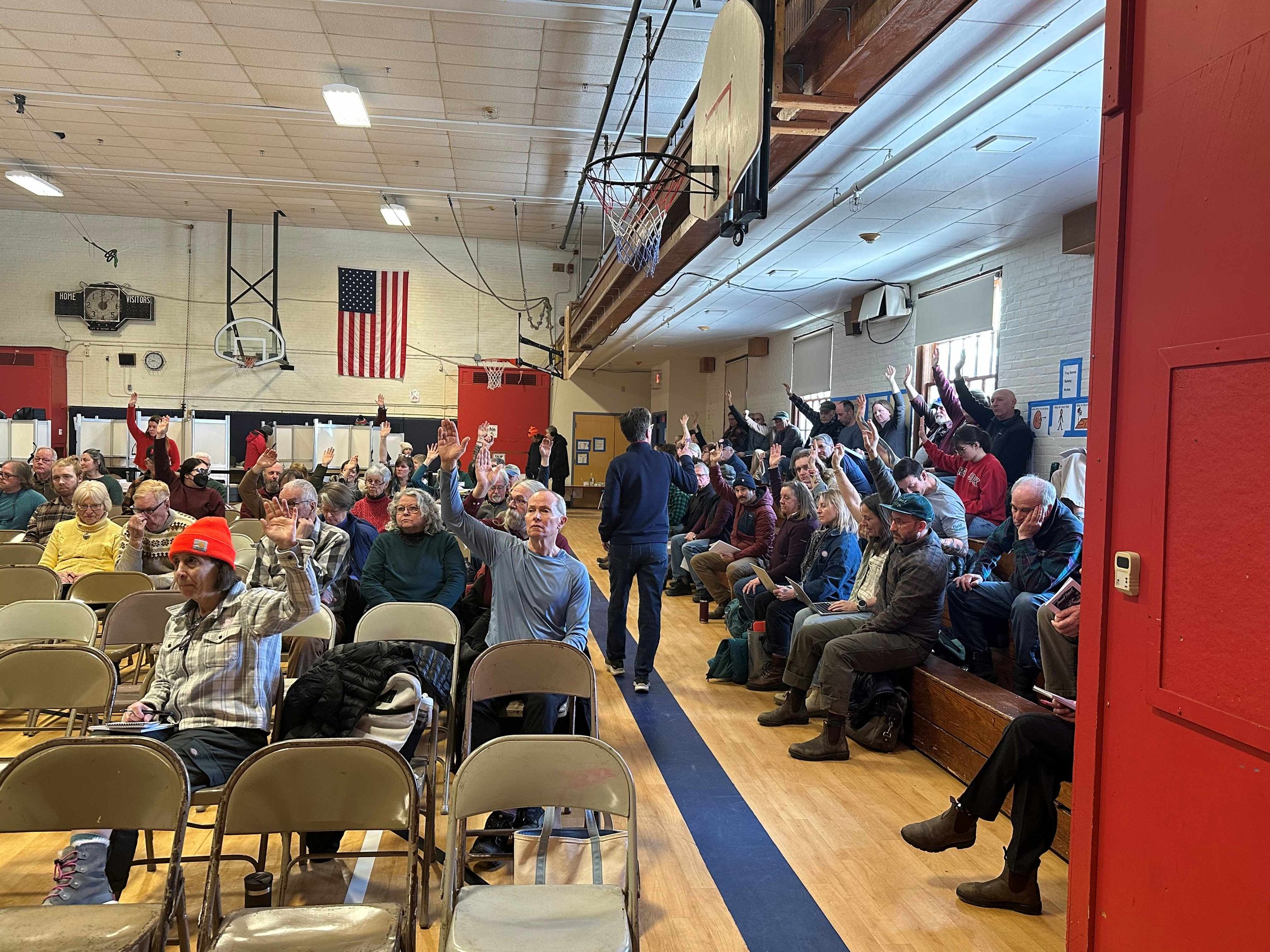
People vote by a show of hands on a question during Town Meeting 2026. Photo by Lisa Scagliotti
Although the group explored various structural changes, Ellis explained that it is not recommending any major revisions to Waterbury’s Town Meeting. In fact, it leans into the current hybrid arrangement of in-person budget discussion and voting, with elections by ballot. The committee, however, does like the new approach to an early informational meeting, seeing potential to make those events more interesting.
The committee’s main recommendations are around details for revising aspects of the current set-up such as improving town reports, adding better sound amplification in the school gym for the meeting, possibly forming a committee to assist with Town Meeting details each year, and creating a Town Meeting guide for the many voters who are unfamiliar with the process.
One key topic the committee discussed was the system for incorporating various municipal donations to nonprofit organizations into the meeting, which can take an hour or more of the meeting time. Each year there are about 20-30 requests for amounts ranging from $500 to close to $10,000. While some of the small requests of $1,000 and below are grouped together for a vote, larger ones are presented individually. Discussion often proceeds slowly with audience members asking questions, although many of the requesting organizations do not have representatives on hand to address them.
The committee presented a memo and draft policy regarding these special Town Meeting articles to the Select Board at its Nov. 5 meeting. The board voted to adopt the proposal, which calls for creating a formal application and a review system for the requests. The Select Board said it would have further discussion of how the requests are presented at Town Meeting with the goal of making the process shorter.
As Ellis noted to the board, the committee cannot institute any of the changes it considered because it is merely an advisory group. “You’ll have to make all the decisions,” she said.
The survey
To help prioritize steps ahead for the 2027 Town Meeting, the committee is now seeking input from the public.
Ellis stresses that feedback is important both from people who regularly or occasionally attend Town Meeting, as well as from those who rarely or never attend. “Your voice as a registered voter matters,” she said. “We span all generations in this town, and we want to make sure our local democratic traditions are accessible, convenient, and meaningful for every resident—from first-time young voters to our long-time neighbors.”
The survey asks those who attend Town Meeting what they value most about it. And to those who answer saying they rarely or never attend, it asks why and what might make them more likely to attend in the future. Some suggestions include moving the day and time of the meeting, such as a weekend morning or evening, offering child care, capping the time for the meeting, and even having a short training ahead of time to explain the process. The questions are multiple-choice, with an opportunity at the end for participants to offer comments.
The Town Meeting Community Survey is online; paper copies are available at the Waterbury Public Library, the town clerk’s office, and the Waterbury Area Senior Center. It should take just a few minutes to fill out; responses are anonymous, with an option to include your name. Responses are due by 4:30 p.m. on Monday, Nov. 30.