Gov. Phil Scott delivers budget address
January 27, 2026 | By Waterbury RoundaboutGov. Phil Scott delivered his 10th budget address to the General Assembly on Jan. 20, outlining highlights of a $9.4 billion spending plan for the coming year, addressing property taxes, the state’s transportation fund, education, housing, public safety and more, while repeating his familiar call to reverse Vermont’s aging demographic trends.
The governor’s proposed budget reflects an increase of 3% from what lawmakers passed in 2025. Calling it “disciplined,” Scott noted that it addresses the reality of shrinking federal funding that has buoyed many Vermont programs in recent years.
“Since I took office, I’ve directed my team to keep three key goals in mind when considering new initiatives and ask themselves: Does it grow the economy? Does it make Vermont more affordable? And does it protect our most vulnerable? And if it doesn’t satisfy at least one of the three, it doesn’t move forward,” Scott said.
The governor asked lawmakers to not just fund, but to fix systems that are no longer working, and he repeated his frequent theme that the state needs to reverse its trend toward an older, smaller population.
“By setting clear priorities, we can keep our focus on the areas of greatest need and the greatest impact. Issues like education, housing, affordability, and public safety are key to reversing our demographics, building a stronger workforce, and bringing in more revenue organically – rather than asking more from taxpayers. When we’ve worked together to pass budgets that met these principles, we’ve had success.”
Despite the anticipated belt-tightening due to shrinking revenues, Scott’s proposal calls for spending up to $105 million to shore up education spending, to anticipated property tax increases across the state by more than half for next year.
Scott urged lawmakers to “embrace opportunity” while remembering history in order to learn from it, while facing today’s challenges.
Lawmakers will take the governor’s proposal into consideration as they craft budget legislation this session. The fiscal 2027 budget would go into effect July 1 and run through June 2027.
Elected in 2016, Scott is in his fifth two-year term as Vermont’s governor. He has not yet announced whether he will seek a sixth term in office in this year’s election.
A 37-page summary of the governor’s proposed fiscal year 2027 budget is available online. Below is a transcript of Scott’s full budget address. Watch a video recording of the speech on ORCA Media here. Read coverage of the address by VtDigger here and The Times Argus here.
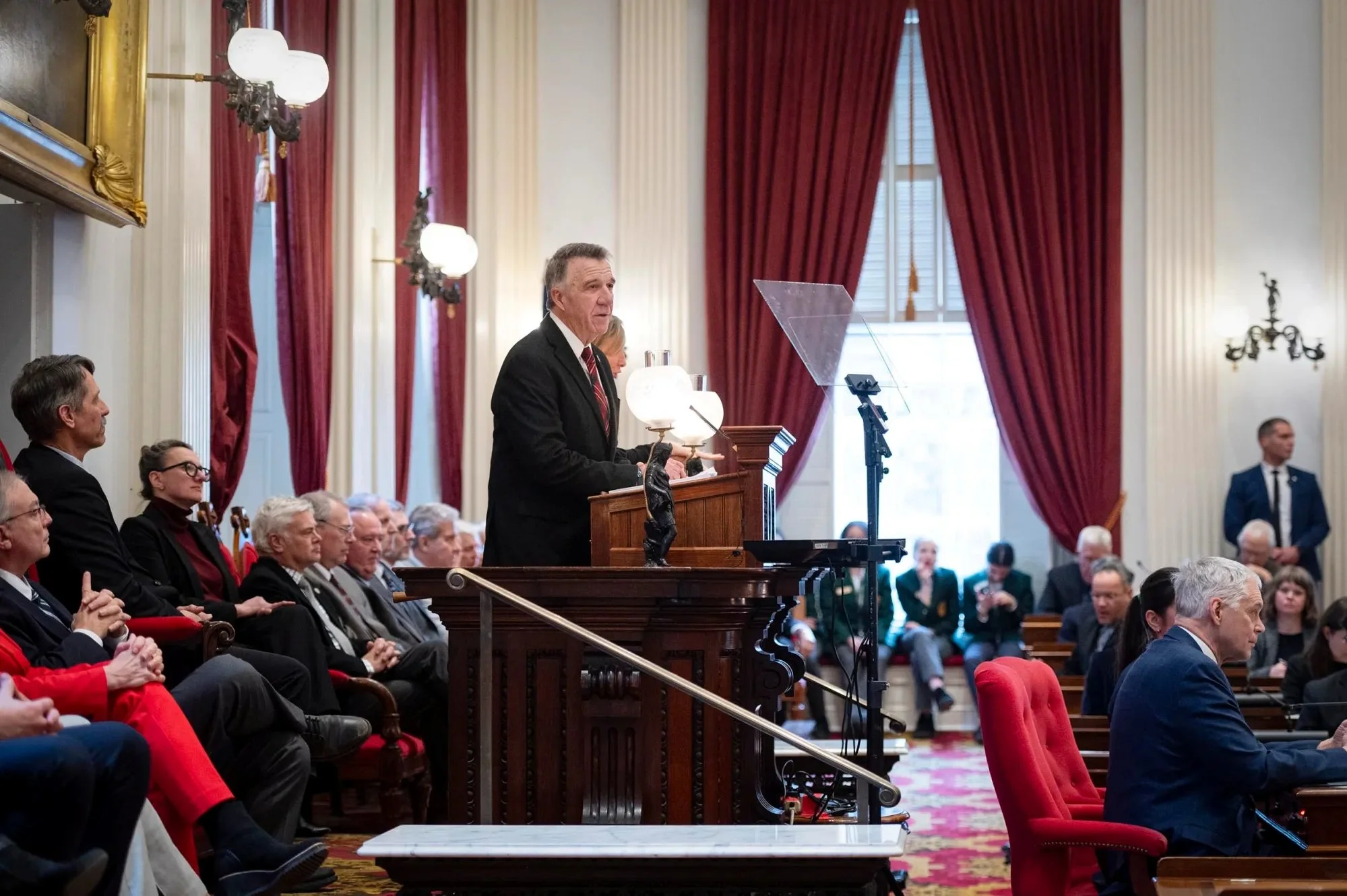
Gov. Phil Scott delivers his budget address at the Statehouse on Jan. 20. Photo by Glenn Russell / VTDigger
Mr. President, Madam Speaker, Members of the General Assembly, and my fellow Vermonters:
Less than two weeks ago, I delivered the State of the State explaining why education transformation is essential, not only for education itself, but for the many other challenges we face.
I look forward to working with you this session so that when we adjourn, we’ll have followed through on what we started and given our children and taxpayers the future they deserve.
***
Since I took office, I’ve directed my team to keep three key goals in mind when considering new initiatives and ask themselves: Does it grow the economy? Does it make Vermont more affordable? And does it protect our most vulnerable?
And if it doesn’t satisfy at least one of the three, it doesn’t move forward.
It’s not just a slogan. It’s a principle we apply every day, and it’s helped guide us in every budget we’ve built.
By setting clear priorities, we can keep our focus on the areas of greatest need and the greatest impact.
Issues like education, housing, affordability, and public safety are key to reversing our demographics, building a stronger workforce, and bringing in more revenue organically – rather than asking more from taxpayers.
When we’ve worked together to pass budgets that met these principles, we’ve had success.
Even before the large infusion of federal funds from the pandemic, we started to turn the corner.
In those years, even though budget growth was slim, we were able to invest in clean water, childcare, downtown revitalization, housing, addiction and more – without raising taxes.
And we went from revenue downgrades in 2017 to upgrades in 2018 and 2019.
***
This year is going to look a lot more like those early years.
For some time, we’ve benefitted from billions in stimulus dollars through COVID relief, ARPA funds, IIJA, FEMA recovery funds, and more.
And rather than just spending it, we made strategic and historic investments in housing, broadband, infrastructure, climate change mitigation, and weatherization.
And the good news is, that money is still being put to work.
But today, even the traditional funding we’ve come to expect from Washington is uncertain. And from what I’ve seen, no amount of political posturing or strongly worded statements will change that.
So, it’s more important than ever to focus on the issues we can control, stay disciplined, and set clear priorities so we make sure Vermonters get the most out of the resources we do have.
***
Here’s what that looks like:
Without raising taxes, this year’s budget, across all funds, totals $9.4 billion.
And while that’s a lot of money for a small state, over a third comes from the federal government.
It’s also important to keep in mind that just last Friday the revenue forecast was downgraded.
That’s new territory for some, because many of you have only experienced the upgrades of the last few years.
Let’s start with General Fund revenue which we use for operations and services.
An $8 million reduction from what we expected, based on the July forecast, leaves us with $2.53 billion this year.
And, as you’ll see, that money goes quickly.
It will cost $139 million more in FY27 to do exactly what we’re doing this year due to inflation, increased costs, and other pressures.
Pensions, for example, have increased yet again this year by 9.7%, despite some of your recent efforts to reform the fund.
This single item will now require $331 million from the General Fund for a total of nearly $550 million across all funds.
As Dave Coates, who was a managing partner at KPMG and an advisor to many governors and legislators, repeatedly warned us: this is what happens when you throw more money at a problem without fixing the structural issues.
***
Next, we have the Transportation Fund, totaling $317 million in FY26 – which is a downgrade of about $9 million over last year.
As a result of the July forecast, the Agency had already begun making hard choices on new projects and reductions in workforce.
Today, transportation spending faces a $33 million structural deficit, leading to further difficult decisions.
But I have faith in our team at AOT to manage their way through this challenge as they’ve done before.
Because we’ve known for quite some time that supporting the Transportation Fund with the Gas tax would eventually lead to shortfalls, as fuel mileage has improved and electric vehicle use has grown.
We also need to keep in mind: the more it snows, the more overtime hours are racked up, and the more salt we need, which also impacts the T-Fund.
Although snow is great news for the General Fund, with more skiers coming to enjoy Vermont, resulting in more Sales tax and Rooms and Meals revenue, and more money added to local economies.
But for those looking for a quick and easy fix to the short fall, I want to be crystal clear, I will not support raising the Gas tax.
And we shouldn’t have to.
If all transportation revenue actually went to the T-Fund, we’d be in good shape.
Decades ago, when the T-Fund was flush and the General Fund was struggling to keep up with demand, transportation money was directed to other parts of government.
But over the last few years the roles have reversed. The T-Fund has struggled while the General Fund has become healthier.
This is another structural challenge we can fix, and we’ve made progress towards rectifying that, but it’s been gradual and slow.
Last year we put an end to the JTOC transfer, which some of us have been trying to do for decades.
But the transfer of the Purchase and Use tax to the Ed Fund is still in place, which was over $50 million last year alone.
So, to build toward making the T-Fund whole, I propose reducing the transfer of Purchase and Use by $10 million this year with a goal of eventually ending that transfer all together.
***
That brings me to the Ed Fund which will require $2.56 billion.
That’s up 39% in just the last five years, partially paid for by a 41% increase in property taxes.
All in, including federal funding and other General Fund investments, the total cost of our education system is creeping towards $3 billion. And remember, that’s for about 80,000 kids.
***
Now, I know we’ve been over this before, but it’s important to remember where that money comes from.
This year, on top of property taxes, we’ll use:
Every dime of the sales tax – $641 million.
All proceeds from the lottery– $33 million.
Nearly a third of the purchase and use tax – another $42 million.
And a quarter of the rooms and meals tax – about $76 million.
All told, we’ll send almost $800 million to the Ed Fund just this year.
But even that isn’t the whole story.
Because the $248 million we need for Teachers Retirement and other benefits also comes out of the General Fund.
So, it’s over $1 billion in additional state money on top of property taxes paying for education expenses. Money that’s no longer available to further support other things like housing, childcare, and revitalizing our downtowns.
Yet there are advocates who say, “All we need to do is shift the cost to the income tax, or ask more of second homeowners.” But that money already pays for something else.
So, what program or service would you like to cut, and for how long? Especially when, per-student, we already spend more than nearly every other state in the nation.
This isn’t rhetoric, it’s reality… and why following through on all aspects of Act 73 is essential.
Because we cannot continue to prop up a failing system at the expense of other priorities, and we cannot ask Vermonters to continue to pay more while providing less and less for our kids.
***
While we do the hard work to fix the structural issues in education, I propose dedicating $105 million through Budget Adjustment and the Big Bill for property tax relief. This will cut the projected increase by about half.
While I’d like to do more, we need administrators and school boards to dig deep and get creative to reduce this year’s growth in spending.
And, I’ll be honest, I’m worried about what I’m seeing in the news and what we saw last year when we made a similar investment.
This money is to ease the burden on taxpayers, not to create space for school budgets to continue to grow.
Last year we tried to buy down the entire increase, but when some districts saw that, they upped their spending.
That’s not the goal and frankly, it hurts schools that struggle to pass budgets.
I know many districts are doing their best, but we need everyone pulling in the same direction to lower the tax burden on Vermonters this year.
To help build a bridge to the future, and prove to the naysayers that we can work together to solve this problem, I’m also asking you to consider Senator Baruth’s education spending cap proposal to help avoid another increase next year.
***
Housing is another major challenge where we need to change our approach.
And whether the concern is the cost of a mortgage or rent, the quality of homes and apartments, or just being able to find somewhere to live, the answer is simple: more housing.
More housing will help stabilize the market, bring down rent and prices, and decrease the property tax burden.
This has been a priority for my Administration since day one.
And we’ve taken action: investing nearly $800 million since 2020, creating new programs like VHIP
and MHIR, passing the Home Act in 2023, and CHIP, which could leverage up to $2 billion for infrastructure to support more homes.
But, as I’ve frequently warned, it hasn’t moved the needle quick enough because we haven’t aligned the old regulatory system to meet current demand – which is about 30,000 homes over the next four years.
So, it’s clear we need to rethink our regulatory process to make real headway.
That’s why last summer, I signed an executive order to reduce red tape, and with it, the cost of building a single-family home dropped by about $25,000.
So, we’ll again present a package to continue to modernize Act 250.
It starts with extending the interim housing exemptions to 2030.
We also need to adjust the requirements for those exemptions so that smaller towns can plan their future at the local level, and we aren’t simply replacing old restrictions with new restrictions.
And, we should repeal the Road Rule, because making it even harder to build, especially in smaller more rural communities, at a time when we need to INCREASE housing, isn’t fair and just doesn’t make sense.
***
Let’s also expand the new ideas we know are working.
VHIP has been incredibly successful, preserving and adding more than 1,000 rental units over the course of the last five years.
At an average cost of just $39,000 per unit, it’s by far the best tool we have in our toolbox, so I’m yet again proposing to make its funding permanent.
And last year’s Downtown and Village Tax Credits will leverage nearly $70 million for building improvements and public infrastructure.
They provide millions each year for projects that spur growth, enhance downtowns, and bring left-behind communities back to life.
So, I’ll ask you to continue your support for this important program.
***
The housing crisis also makes it more difficult to address homelessness.
But the hotel/motel program has not worked.
Even with the best intentions, it’s done more harm than good by just warehousing people and creating dangerous situations for many.
So, this budget will build upon my Administration’s current strategy, to shift funding from hotels and motels to emergency shelters with services and support.
Let’s finally move forward and put more people into more stable conditions, with the goal of finding a more permanent place to live, instead of just prolonging the crisis they’re in.
***
I’m pretty sure that everyone in this room has heard from a constituent about housing… whether their rent is too high, or they can’t find a home.
I also know many of you talked about it on the campaign trail. So, now’s the time to get it done.
I understand some worry that if we do too much, we could lose some of the character of our communities, some of that rural charm that makes Vermont special.
But if we want the next generation of Vermonters to afford to live here, we’ve got to treat housing like the crisis it is and make real change this session.
***
Affordability has become one of the most talked-about issues in national politics today, and it’s refreshing to hear previous skeptics acknowledge it matters.
Because the affordability crisis that some of us have been talking about for decades is real.
The cost to rent or own a home is just the tip of the iceberg.
Think about this: low-income Vermonters face the highest energy burden in the nation paying more than 10% of their income on energy.
According to the Department of Public Service, disconnection rates have increased 31% since 2022.
Too many Vermonters are literally struggling to keep the lights on.
Unfortunately, previous policy decisions made in this building prioritized ideology over reality and results.
Some have said that higher electricity and heating costs are the price we must pay to fight climate change.
I just don’t believe that’s true.
But what is true is that higher costs are hurting families, small businesses, and large employers.
There’s a better way to lower energy prices and reduce emissions much faster if you’re willing to work with us to change course.
First, we need to give ourselves credit for the clean sources we’re already using.
Without sacrificing emission reductions, clean energy meets our goals faster than the inflexible standard in place today.
In fact, if you adopt our proposal, we’re confident utilities can achieve 100% clean energy by 2030 at a substantially lower cost than current policy requires.
It’s time we join other Northeastern States who have already recognized that proven renewable and clean sources – like solar, hydro, and yes, even nuclear – must be part of the solution.
Because if we want to keep the people and jobs we have today, and attract more of both, we need to be more strategic with more affordable energy options.
This is something we can control, so let’s do what’s right for Vermonters, and the environment, in all parts of our state.
***
We need to take the same transformative approach in healthcare.
In 2010, the Affordable Care Act was passed in Washington.
Whatever your views on the ACA, it established important protections, for things like pre-existing conditions, and it provided flexibility, with guardrails for states to be creative and find ways to expand access, increase choice, and lower costs, with more people covered.
But Vermont took a very different approach, and the opportunity to build more options was set aside to pursue a government-run single-payer plan that failed after years of empty promises and millions of dollars.
Despite that, its regulatory framework remains embedded in our healthcare system, resulting in some of the fewest choices and some of the highest costs in the nation.
And when healthcare costs rise, so does the cost of living, of doing business, of running government and schools… it affects all of us.
This issue is compounded by demographics because as our population ages, more services and care are typically needed.
We all know healthcare delivery, administration, finance, and policy are complex. But complexity can’t be an excuse for halting essential change.
And just like housing, education and energy, small changes here and there are not getting us where we need to go.
We need a new approach.
For reform to work, it must be guided by a few basic principles:
First, affordability for families, employers, and taxpayers.
Second, real choices in care and coverage.
Third, a system that rewards value, prevention, and accountability.
Our experience in Vermont demonstrates, beyond any doubt, that when policy abandons those principles, costs rise, choices disappear, and the people who pay the highest price are working Vermonters and seniors on a fixed income.
***
So, let’s start with commonsense steps to restore affordability and choice.
We can expand options, especially for young people and working families, by offering access to a wider range of insurance plans like they do in other states at far lower costs.
And in a system with more choice, we can use tools like reinsurance to lower costs as well.
And, thanks to new federal funding, over the next five years, we’ve got a plan to put nearly one billion dollars into rural health to expand primary care practices, give underserved areas access to more choices for care, and rebuild our healthcare workforce.
These are just a few of the healthcare proposals we’ve brought forward this session.
Because when essential systems begin to fail, we need to look at the foundation.
And when the structural damage is straining families, workplaces, and entire communities, it takes more than a few bandages to fix it.
***
We’ve seen this across the board, including in public safety.
For too long, our criminal justice policies have been out of balance, prioritizing offenders’ interests to the detriment of victims and communities.
As a result, rates of violent crime have increased. And some lower-level crimes, which have a big impact on our quality of life, are at historic highs.
Drug trafficking and addiction are at the center of many of these trends, as is less accountability within the system.
Much of the crime in our communities, and the cases in our courts, are caused by repeat offenders.
Over a quarter of the current backlog involves people with five or more pending criminal cases.
There are too many released pre-trial, who ignore court orders and court dates and face little or no accountability for violating conditions of release or failing to appear.
We’ve reached a point where there are no consequences for failing to show up at all.
That’s the definition of a broken system.
Now, we’ve made some improvements in recent years, like restoring bail, modernizing a few drug and competency laws, and requiring courts to expedite hearings for certain situations.
But like every other area we’ve talked about today, much more work remains.
So, let’s keep moving towards the middle with a legislative package that prioritizes safety, health, and the welfare of victims, families and communities, as well as opportunities for offenders to turn their lives around.
***
We also have a juvenile system that fails to hold young adult offenders accountable.
So, this year, we should repeal – not just delay – the “raise the age” legislation for 19-year-olds.
It was a mistake, and we need to change course.
I’m also asking you to act on my proposals from last session to give prosecutors the ability to charge violent offenders who are under 19 years old in Criminal Court for serious crimes like aggravated domestic assault and aggravated stalking.
And we need to restore accountability for 19- to 22-year-olds. Because our system allows some to strategically run out the clock without ever meeting a caseworker, seeking treatment, or returning to court.
That’s not accountability, and it fails the community and the young Vermonter who needs our help.
We need to make sure these offenders have a path to a fresh start, but we also need to make sure they’re earning that path and get the support they need to stay on it.
We can also improve systems that aren’t working well, and expand those that are.
Pre-trial Supervision, if done right, can improve safety, support accountability, provide connections to services, and help people show up for court.
That’s why this budget increases base funding to expand Pre-trial Supervision statewide, and we’ll work with you to address the shortcomings of the current approach.
***
None of this succeeds without continued commitment to mental health, addiction treatment, and recovery – and we’re making progress.
Drug-related overdose deaths dropped sharply last year, cut nearly in half.
But if we want to reduce drug use and crime, we need to reprioritize all four legs of the stool: Prevention, Treatment, Recovery and Enforcement.
That’s why this budget invests over $2 million more from the General Fund for shelter beds and a recovery employment program – on top of funding for residential treatment, peer support, and expanded services in Corrections.
It’s been well over a decade since we first began to recognize the growing opioid crisis and all that came with it.
And while it may not get the same headlines it did then, we can never lose sight of our duty to prevent tragedy and foster hope for Vermonters, families, and communities in every corner of the state.
***
We’ve seen the result when leaders have an open mind, a little humility, and are willing to try something different.
In Burlington, our Community Accountability Court has shown we can effectively reduce the case backlog, connect repeat offenders with service providers, and offer the hope of a healthy stable future.
After years of escalating public safety concerns, one special prosecutor with a caseload of over 900 has closed over 500 active criminal cases involving 60 repeat offenders – and it only took about 50 court days.
Importantly, we’ve interrupted a cycle of drugs, crime, and violence, giving offenders a chance to turn the corner toward recovery.
This effort brought together partners from the Judiciary, my Administration, city government, clinicians, businesses, and community leaders. And I want to thank all of them for working together.
I especially want to thank Prosecutor Zach Weight and the public defenders, retired Judge Maley, and the field team at AHS for stepping up to do this work.
We’ve learned a lot from this experience, and this budget includes funds to replicate this effort in other counties across the state.
Because when we expect accountability from criminals, ourselves, and our systems, communities are safer, quality of life improves, and people trapped in a cycle of crime and despair have a real chance to change.
***
Now, I’ve been up front, this budget looks a lot more like those from before the pandemic.
Which means we had to be very clear about our goals and carefully prioritize.
Gone are the days of saying yes to every group asking for more funding. But there are pockets of money in every agency, department and division, that will make a real difference for all of us.
Like eliminating some of our agricultural fees, investing in VOREC to continue to expand our outdoor economy across the state, and helping UVM get the new multi-purpose center back on track, which will be a huge economic driver for both the state and university, without using General Fund dollars or pulling from other important needs.
At the same time, the federal stimulus money is still supporting major housing, broadband, weatherization, and flood mitigation across the state.
I appreciate the work my team has done through this entire process to prioritize the things that will give us the greatest return. And that’s the approach I’m asking each of you to take as we work together in this shifting economic environment.
***
In January of 1991, Governor Snelling returned to this chamber and gave what would be his final inaugural address.
Facing a budget deficit of $151 million, he said: “We cannot and will not set lower standards for the education of our children, for the health of the population, for assistance to the troubled, jobless or homeless, or for protection of the environment. But we clearly must rethink how those goals are to be achieved.”
What followed was a time of transformation for Vermont.
Under his vision, and then Governor Dean’s leadership, the legislature and administration worked to renovate old programs and failing systems, to better meet the challenges of a growing state guided by innovation and strict fiscal discipline.
That architecture is now at least 35 years old, built to solve a different set of problems at a different point in history.
To be clear, our immediate fiscal challenges are not even close to what they were facing, or those of 2009 and 2010.
Just ask the Deans of the House and Senate, Representative Emmons or Senator Cummings – I was there as well – when we repeatedly received bad news about plummeting revenue and rising caseloads. And state government had no choice but to cut almost 1,000 positions over the course of the Great Recession.
We are not in that place, and we have the opportunity to make sure we don’t get there by transforming our most critical systems and leaving Vermont better than we found it.
***
I began today talking about my Administration’s core values: growing the economy, making Vermont more affordable, and protecting the most vulnerable.
While we know we can’t do everything we want to do, those three goals, give us the freedom to be flexible, so we’re not cemented to a certain way of thinking, approach, or political ideology.
Because at the end of the day, I believe all Vermonters want to have a decent home they can afford and be proud of.
They want to feel safe in their neighborhoods and downtowns and have roads that are safe and kept up.
They want more affordable healthcare and utilities; they want us to protect the environment.
And, I believe we all should want the best education system in the nation to give our kids the best start in life we can.
But we can’t do any of this unless we’re willing to change and reshape the future.
If we don’t, our outdated systems and programs will continue to erode, and eventually when times get really tough, Vermont will face impossible decisions like we did in 1991, 2009 and 2010.
If we tap into that Yankee ingenuity and commonsense that I know still exists, we can make a lasting impact on Vermonters.
We can embrace opportunity, we can remember history, and learn from it, and move towards the future on a new path with the tools to confront whatever the next challenge may be.
THIS is the Vermont I can see… and I hope you can as well…