
School board approves $1 million in building repairs for 2026-27
February 28, 2026 | By Lisa Scagliotti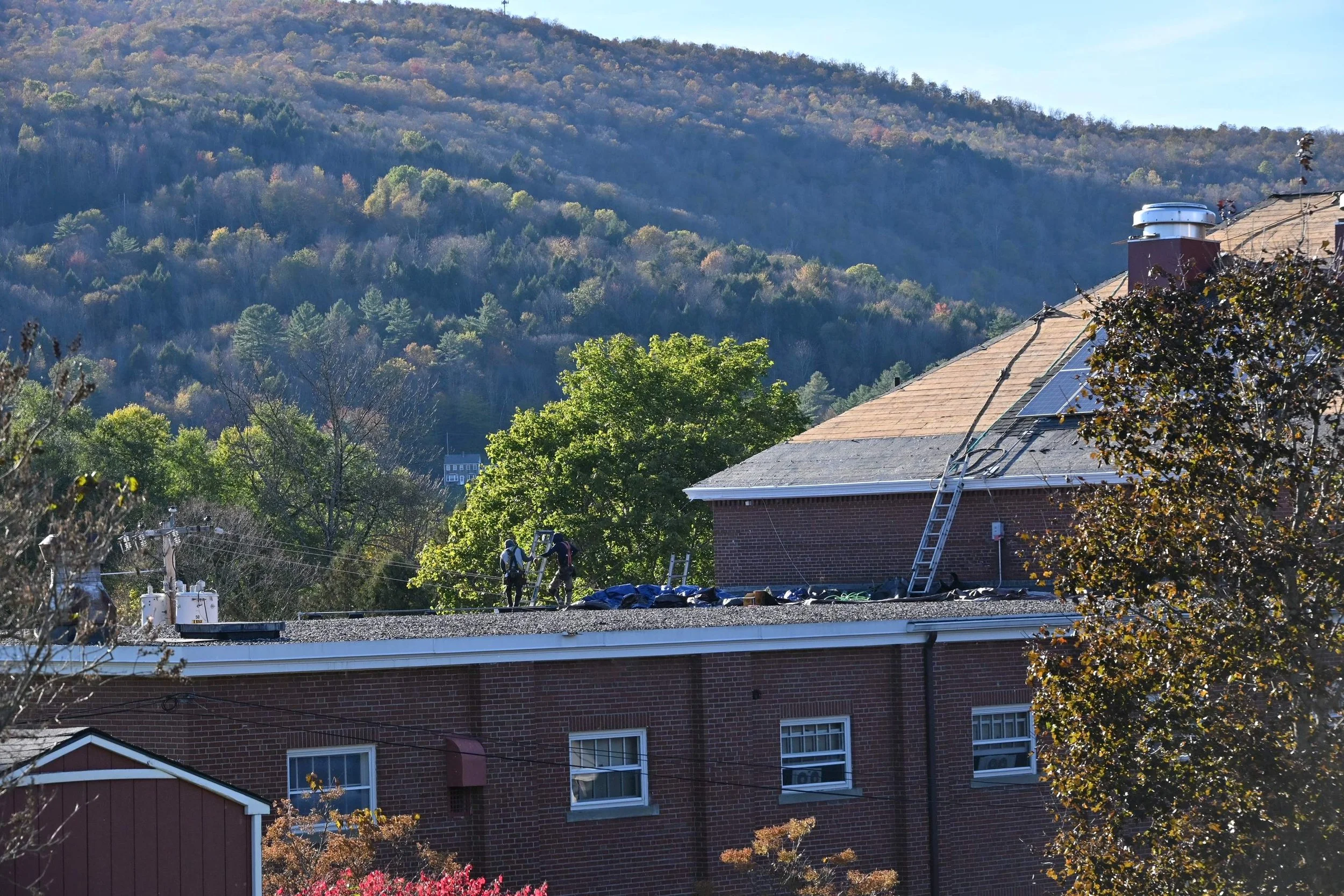
Workers install a new roof section at Brookside Primary School in October 2025. Photo by Gordon Miller
At its most recent meeting, the Harwood Unified Union School District School Board approved a budget of $1,036,000 for building maintenance projects in 2026-27 that school officials deemed most critical for safety, code compliance and overdue replacement of equipment.
“Trying to maintain an available budget in case of emergency is more of a challenge this year than ever,” Facilities Director Ray Daigle told the school board. “We’re just picking what we think is most critical at this time and we just keep our fingers crossed that something else doesn’t fail.”
Daigle and Finance Director Lisa Estler reviewed the items on the buildings to-do list for the school year beginning July 1, explaining that the maintenance fund’s dwindling balance makes it particularly challenging to prioritize the most critical upgrade and repair needs for each school.
“This is bare minimum. This is safety. We still have over $100 million of deferred maintenance,” Estler said. “I’m extremely concerned with the amount of money that’s in our maintenance reserve. It’s never been this low.”
The list for the coming fiscal year focuses mainly on projects at Harwood Union High School and Crossett Brook Middle School. Items include HVAC work, lighting fixture upgrades, septic tank replacement, new fire alarms and new gymnasium bleachers. Four elementary schools each have one project on the list. For example, at Brookside Primary School, gymnasium windows are scheduled to be replaced. Waitsfield Elementary has no projects listed.
In addition to the proposed 2026-27 school budget, a second question on the Harwood ballot for Tuesday’s Town Meeting Day asks voters to approve adding $500,000 to the Maintenance Reserve Fund to pay for repairs and upkeep to the district’s seven schools. The request is made each year as school officials look to allocate unspent funds from the prior budget year to the maintenance account.
Estler noted that in past years, the district had larger budget fluctuations year-to-year, resulting in larger fund balances available to commit to facility upkeep. “We used to carry over well over $1 million and do a transfer every year. It has been less and less and less every year,” she explained. “We’re budgeting tighter.”
Ideally, Estler said, the district should aim to budget about 8% of its operating budget to maintenance annually to avoid falling behind. That’s never been the case in the district, and the result is the current deferred maintenance list.
Several times in recent years, school leaders have begun to take steps towards large-scale renovations and repairs, particularly for Harwood Union High School, which has the lion’s share of deferred upgrades. Voters rejected a $59 million bond in 2021, and a more recent effort to address Harwood’s building needs with a renovation bond was halted in 2024 when voters rejected the school budget.
In the Feb. 18 maintenance presentation, Estler shared a breakdown of the reserve fund, which currently has a balance of $1.9 million. She factored in a $500,000 transfer into the fund during this school year that voters approved in 2025, as well as a transfer next school year that voters are being asked to approve on the upcoming Town Meeting Day ballot. Once work planned through June 2027 is completed, the fund will have just under $640,000, Estler’s figures show.
It’s possible that this year, several of the smaller projects could be paid for from the general budget, making it possible tap the reserve for perhaps just under $1 million, Estler suggested. “I’m trying to project the maintenance reserve,” she said.
Looking to lawmakers for answers
The discussion and vote on the FY27 building maintenance projects came later in the board’s meeting, which opened with a visit from Washington County’s three state senators. Sens. Ann Cummings, Andrew Perchlik and Anne Watson attended to both update the school board on education issues at the State House — mainly school budgets, state funding and ongoing work to implement Act 73 that calls for school district consolidation — and to hear from the local school district leaders.
Each senator shared comments as board members prompted with questions. Paying for school construction was a key topic that the Harwood board members raised. The state of Vermont in 2007 ended its program of contributing to school construction and facility projects. Since then, school districts have had to shoulder those costs, and that’s led to a growing list of deferred maintenance projects for schools across the state. In the discussion with the state senators, the Harwood board members pointed to the role school construction costs play in the formula the state uses to assess school spending.
“If we want to issue a bond to do maintenance — put that burden on our communities — the debt we incur counts against our per-pupil cost,” Moretown board member Steve Rosenberg pointed out. “So there's kind of a double whammy where the state can’t help us, and we get penalized if we try to do it ourselves. It’s kind of an untenable situation. Any help anybody in the legislature can give? We really need it.”
School Board Chair Ashley Woods from Warren added, “It feels vindictive.”
Watson, in response, said that aspect of the state education formula “was news to me.”
Woods said that including construction debt in the calculation was added back several years ago when the state adjusted its formula regarding a spending threshold to penalize districts exceed it.
“Why is this still law?” asked board member Macon Phillips from Warren. “Is this a known issue, or is this new?”
“This is a known issue,” Cummings replied.
Perchlik said there is some interest among lawmakers to address school construction this session, including potentially providing some state funding for school districts. Superintendent Mike Leichliter agreed, noting that he’s given testimony on the topic of funding for school projects to legislative committees. “They're not sure yet,” he said, “but I’m told there is kind of a bipartisan commitment that they have to start funding this. So, that was good to hear.”
Watson said the formula element that calculates capital debt in per-pupil education costs bears some attention. “I wonder if there is some work that can be done on that front,” she said, urging the local officials to stay in touch with lawmakers to advocate for policy changes.
Woods told the legislators that the school board had a letter drafted to send to them and members of legislative committees working on education policy changes this session to ask for attention to two big cost drivers — building repairs and maintenance and health premium expenses for staff, both of which are included in calculating per-pupil education costs. The board several days later sent the letter and shared it with local news media. (See that letter in full here.)
“Together, these structural cost pressures — capital debt service embedded in operating budgets and climbing health care expenditures — can drive per-pupil spending higher, even when boards exercise fiscal discipline and make difficult reductions in programming and staffing,” the letter states. “Remove unavoidable debt and health care costs from the excess spending formula and restore a credible state role in school construction funding. These changes would allow districts like ours to act responsibly without being trapped by structural penalties beyond our control.”
Later in the meeting during the school facilities discussion, district Facilities Manager Daigle urged the school board and administrators to look beyond possible solutions from Montpelier to address school building needs.
“We’ve got to figure something out and not wait for the state to try to do it for us. Watching these representatives today say that they’re talking and considering—we could be years before we see anything come out of there that’s going to be meaningful for us,” Daigle said. “We have to take control of our own destiny.”
See the full list of school maintenance projects for 2026-27 below.
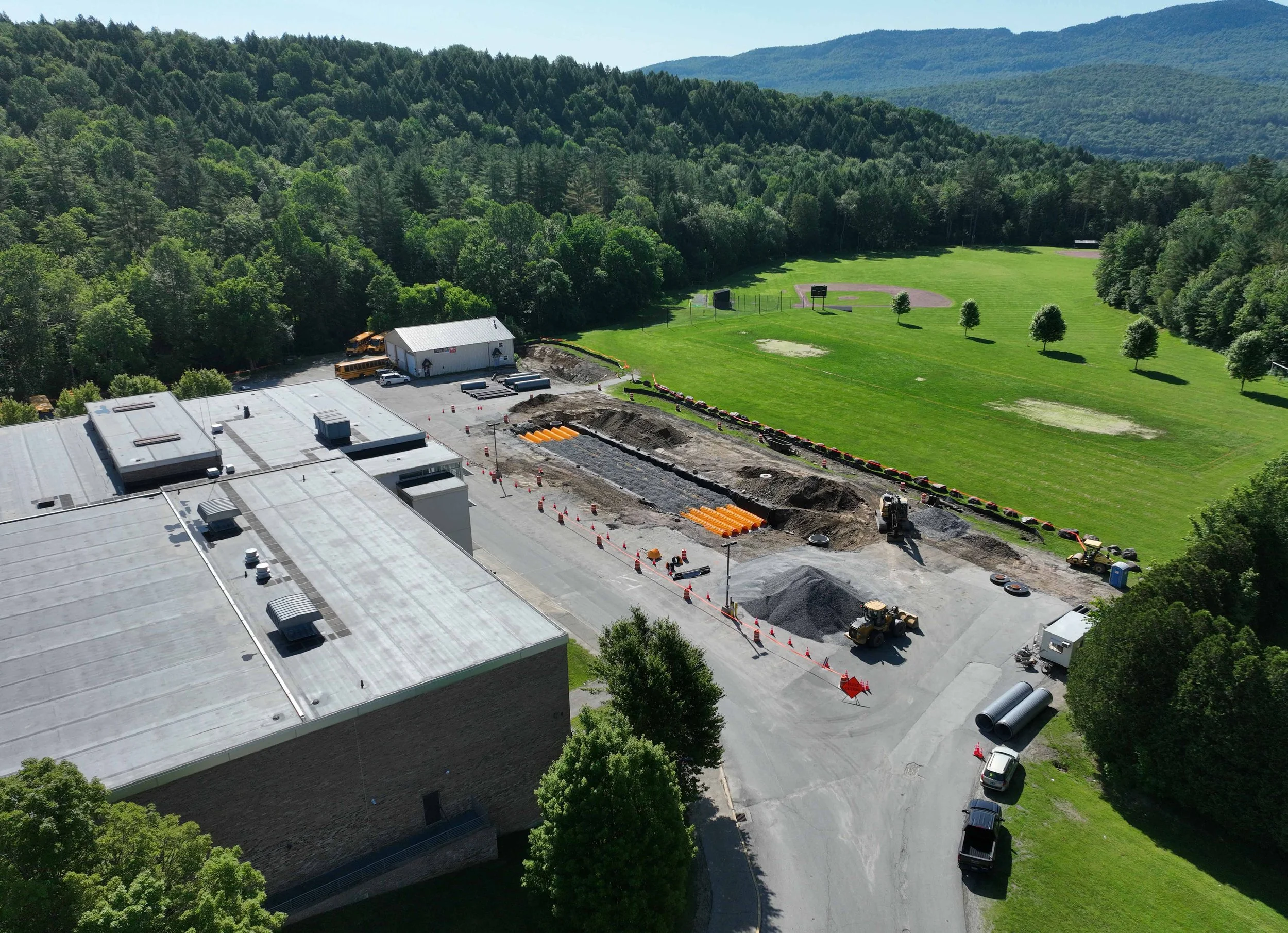
A major summer project at Harwood Union Middle/High School involved installing new stormwater drainage systems under the parking lot. Photo by Gordon Miller
School maintenance projects approved for the 2026-27 school year
Harwood Union Middle/High School has seven projects totaling $419,000:
$100,000 to begin lighting conversion from fluorescent lighting to energy-efficient LED systems. Harwood is the final building in the district to complete this switch that will reduce energy consumption, improve lighting quality and lower ongoing maintenance costs. This will be done in increments over multiple years. Harwood has received nearly $10,000 in energy rebates from Efficiency Vermont for some hallway lighting in the building.
$97,000 to replace septic tanks which, during an inspection in 2025, were found to have large roots from a nearby maple tree growing into them. Approximately 2 cubic yards of roots were removed from one tank. “Replacement is necessary to prevent system failure, potential environmental contamination, and emergency repair costs,” according to the maintenance report.
$80,000 for HVAC improvements to address several sections of the building to improve indoor air quality and meet current ventilation standards.
$47,000 for flooring replacement in the corridor connecting the main lobby to the cafeteria, also in the school’s lower-level hallway near the south entrance and new rubber flooring in the upstairs gym where a fitness room is being created.
$45,000 to replace the main entrance doors, which were installed in 1996 and have exceeded their expected functional life. The doors regularly experience mechanical failures, including deteriorating hinges and mounting hardware. The replacements will improve building security, energy efficiency and long-term maintenance.
$30,000 for engineering and design for an air handler, for which total replacement was scheduled for fiscal year 2022-23, but was deferred due to an estimated cost of $1.6 million. A recent review that would include system modifications suggests that the replacement cost could be lowered to closer to $1 million. Engineering and design is necessary to be prepared for full replacement in anticipation of unit failure.
$20,000 for parking lot repairs that represent an incremental approach, working toward fully repaving the entire parking lot.
Crossett Brook Middle School’s list has four projects for a total cost of $429,000:
$20,000 for classroom flooring replacement to replace original carpeting in three classrooms that has exceeded its useful life and poses cleaning challenges and indoor air quality concerns.
$36,000 for bathroom floor replacement would cover installation of epoxy floor coating in 15 bathrooms to replace original worn flooring, providing a more durable surface than what is currently in place.
$135,000 to replace the original gymnasium bleachers. The existing bleachers are manually operated and now pose safety risks during opening and closing. Increased community use of the facility has amplified this concern, leading to facilities staff to be in attendance for community use.
$235,000 to replace fire alarms given that the system is outdated and replacement parts are no longer readily available. The new system will bring the building into compliance with current code and improve reliability and safety.
Warren Elementary School: $100,000 to upgrade the gymnasium HVAC system to comply with current air-quality and ventilation standards and improve air circulation.
Fayston Elementary School: $50,000 for roof repairs on a section of roof that has experienced leaks over several years. The work aims to prevent further interior damage, insulation deterioration, and avoid possible mold concerns.
Brookside Primary School: $31,000 to replace windows in the gym. Original windows in place are in poor condition, difficult to operate, and provide inadequate energy performance. Replacements will improve energy efficiency and comfort and reduce maintenance.
Moretown Elementary School: $10,000 to repair and replace sections of rotted or damaged siding to avoid moisture infiltration and structural damage.
There are no projects listed for Waitsfield Elementary School.
Find the school district’s Capital Maintenance Plan for 2026-27 linked to the Feb. 18 Harwood School Board meeting agenda. The meeting recording, including the discussion with the state senators, is on the Harwood district’s YouTube channel here.
Read the Harwood School Board’s letter to state lawmakers about reconsidering the calculation of school construction costs and health insurance premiums in per-pupil education costs.