
New state rules ban wakesports from Waterbury Reservoir
May 27, 2026 | By Lisa ScagliottiThis story was updated on May 29 with more from Green Mountain Adaptive Sports.
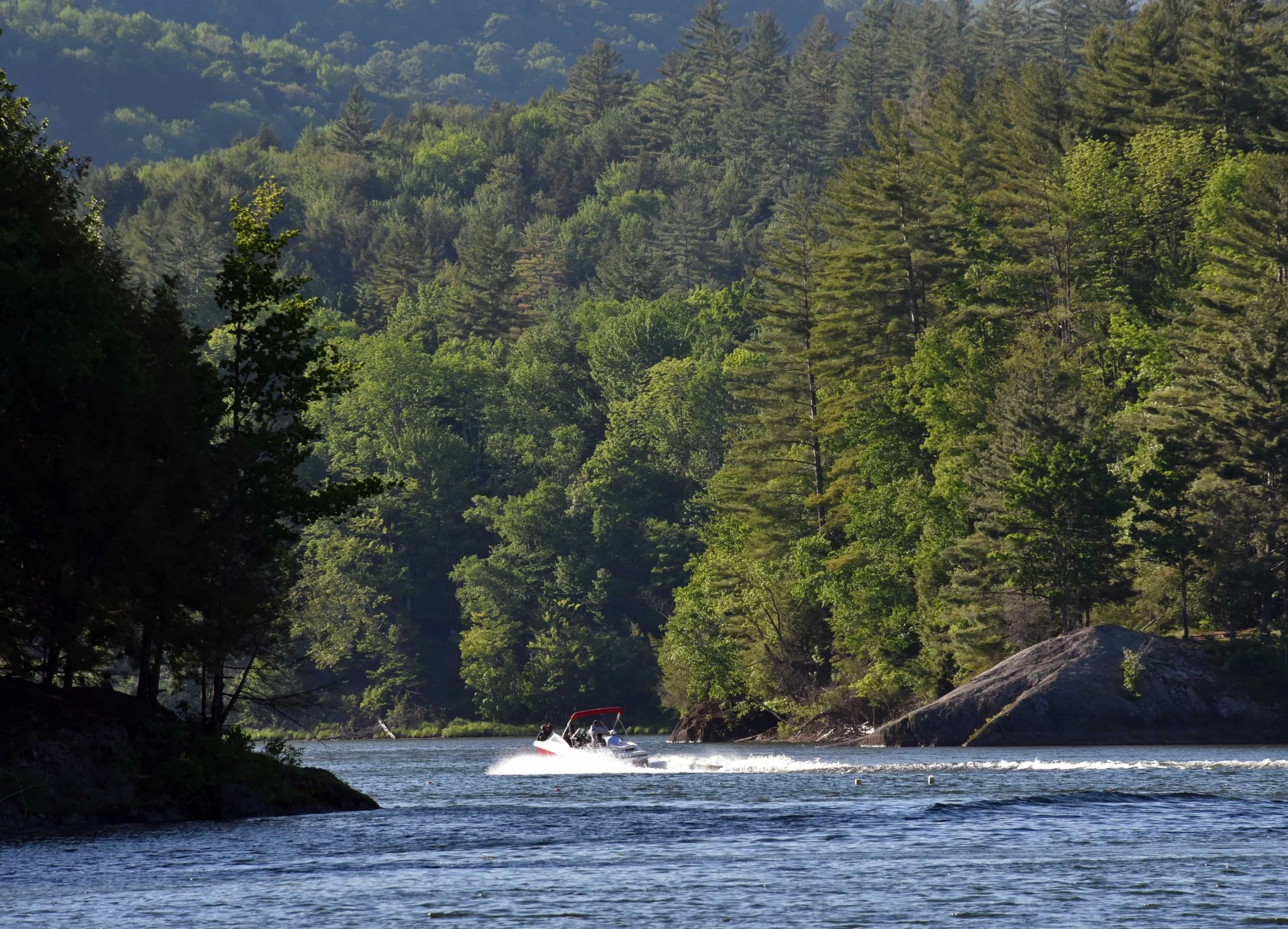
A small motorboat travels on the Waterbury Reservoir. File photo by Gordon Miller
A state legislative committee last week reached a much-awaited decision to further limit which lakes in Vermont may support wakesports and the Waterbury Reservoir now falls into the category where wake boating is banned.
On May 21, the Legislative Committee on Administrative Rules voted to adopt amendments to the Use of Public Waters Rules proposed by the Agency of Natural Resources. The rule amendments further restrict where wakesports can take place on Vermont’s lakes. Under these new rules, wakesports will no longer be permitted on Waterbury Reservoir and 11 other lakes where wakesports were previously permitted, explained Laura Dlugolecki, the state’s Lakes and Ponds Policy and Outreach coordinator.
The decision was welcome news to the Friends of Waterbury Reservoir, the local nonprofit community organization dedicated to the protection of the reservoir’s environment for recreation, wildlife, conservation, and its historical significance.
“These rule changes will improve user safety, protect wildlife, and reduce environmental impacts from wakes,” said Friends President Eric Chittenden in a letter to the community.
The friends group has been active on the wakesports issue for several years. Members advocated against allowing wakesports on the reservoir ahead of the state’s April 2024 decision to adopt wakesports regulations for Vermont lakes and ponds. To the friends’ disappointment, the Waterbury Reservoir was included on the list of 30 approved water bodies for wake boats.
Wake boats are not everyday motor boats. They are specifically designed to displace large amounts of water. They have V-shaped hulls, special wave-shaping plates, and large ballast systems that can hold many gallons of water to weigh the boat down in order to create particularly big waves for wakeboarders or surfers.
The 2024 regulations specified dimensions for wakesport zones on water bodies as well as rules for depths and distance from shorelines for wakesports.
There was strong public reaction to the new rules, with many concerns regarding the impacts of operating wakeboats on some of Vermont’s smaller lakes and ponds. Environmental and conservation organizations, lake user groups and others filed formal requests to the state asking regulators to reconsider the inclusion of more than a dozen of the water bodies in the group with approved wakesports zones.
They cited concerns for safety that could arise with wakesports joining a wide variety of users on Vermont’s smaller lakes and ponds, such as anglers, swimmers, those in non-motorized craft like canoes and kayaks, as well as those in small and conventional motorboats. They warned of impacts on shorelines such as erosion and damage to wildlife habitat, including bird nesting areas; they cautioned that wakeboats could easily transport contamination, such as invasive species, from lake to lake.
Chittenden pointed out that in this second go-round to amend the wakesports rules, state regulators listened to concerns from members of the public who wrote letters and attended public hearings earlier this year.
“Vermont citizens contributed significantly to this process. The last public comments held this winter generated over 1,500 responses. Of these, over 80% voiced support for addressing safety concerns, creating additional safeguards to control the spread of aquatic invasive species, concerns over damage to shorelines, and enhancing quality lake experiences for users,” Chittenden detailed.
As a result, the amendments approved last week now reduce the number of lakes and ponds where wake boats may operate, allowing the activity on only the state’s largest water bodies. “They require larger, safer zones for wakesports activities, they mandate decontamination for all ballasted boats, which includes wake boats moving between lakes, and they strengthen protections for loons and other wildlife who share these water bodies with us,” Chittenden said.
He also thanked individual lake users, other organizations, and local town government boards in Waterbury, Stowe and Duxbury for supporting the friends’ call for tighter restrictions.
Cynthia Needham is president of the board of directors for Green Mountain Adaptive Sports, one of the organizations that supported keeping wakesports off of the Waterbury Reservoir. Members work with the Northeast Disabled Athletic Association to provide adaptive kayaking outings on the reservoir during the summer. Last year, more than 70 individuals with disabilities got out onto the water through the groups’ efforts, she said.
Needham said her organization is pleased that wake boats won’t be a factor this summer on the reservoir.
“Many of the participants require significant modification of kayaks and paddles to take part in the sport,” she explained. “Being faced with the types of waves created by wake sports would have placed the adaptive kayakers at significantly increased risk of capsizing, a prospect that we work very hard to prevent. Negotiating large wakes would be virtually impossible for most of our paddlers.”
She said the state’s decision to restrict wakesports from the Waterbury Reservoir “will guarantee that our many athletes with disabilities who kayak there can enjoy the waters safely and joyfully.”
Dlugolecki explained that the final rule is not yet in effect. The process requires that the amended rules be filed with the Secretary of State, after which they will become effective within 15 days, which should be in early June, she said.
The list of lakes and ponds, indicating which now allow wakesports and which do not under the new amendments, is available online here.
Some key provisions in the new rule amendments are:
The removal of 12 lakes from the previous list of wakesport-allowed lakes and ponds (Holland Pond, Joe’s Pond, Lake Fairlee, Lake Hortonia, Lake Iroquois, Lake Parker, Miles Pond, Molly’s Falls Reservoir, Peacham Pond, Shadow Lake in Glover, Sunset Lake, Waterbury Reservoir). The list now has 18 lakes and ponds where wakesports are allowed.
Where allowed, a wakesports zone must be at least 3,000 feet in length.
Wakesports zones now must cover at least 100 contiguous acres of lake (previously 50), be located at least 500 feet from shore, and be at least 20 feet in depth throughout. The new rules also increase the distance of wake zones from loon nesting areas.
Prior to entering a new lake or pond from where it previously launched, wakeboats now will be expected to have a hot-water decontamination to prevent the spread of invasive species.
The state website with wakesports regulations will be updated to reflect the new details for the public to follow. Information about the lakes and ponds rulemaking process is online here.