
Researchers to explore Vermont’s robust bear population
September 6, 2025 | By Waterbury Roundabout If it seems like Vermont has a lot of black bears, it’s because it does.

A mature black bear. National Park Service photo
New data from the Vermont Department of Fish & Wildlife bears that out, and wildlife biologists are launching new research to understand how the bear population is thriving.
The Vermont Department of Fish & Wildlife last week shared its latest data on Vermont’s bear population that show a robust population exceeding state wildlife biologists’ expectations.
The 2024 data indicate that the state’s black bear population is estimated between 6,800 to 8,000 bears, according to the department. This is the fourth consecutive year that the bear population estimate exceeds the state’s objective of 3,500 to 5,500 bears, based on the department’s population model.
“Our model shows the bear population has remained above our goal of 3,500 to 5,500 bears since 2021, and that matches up with other indicators of population size that we track,” said Jaclyn Comeau, the department’s lead bear biologist. “High rates of hunter harvest, growing numbers of bears killed by vehicles, and increasing conflict between bears and people over the past several years all support that our model is reflecting real population growth.”
To understand what is driving this apparent growth, the department launched a new research study this past summer. The research will “ground-truth” model results by gauging how successful Vermont’s bears are at raising their young safely to independence, the announcement said.
“Anecdotally, we are hearing about more bears with large litters of three or four cubs,” Comeau said. “And in our hunter harvest data, we are seeing a larger proportion of young adult bears in the 2- or 3-year range. We think this is a result of several years of healthy bears having many cubs, coupled with the resources for those bears to help their cubs survive until they can fend for themselves. Our next step is to see if that explanation – which we think is likely – lines up with conditions on the ground.”
The new study will test the department’s hypothesis by following 18 adult female bears who were fitted with GPS collars this summer. The bears also were measured for baseline data such as size, weight and age. Biologists will visit the collared bears’ dens during the winter to confirm litter size and will then track the family units through the cubs’ first year.
“Then over the next year, we’ll follow the GPS-collared adult bear and her cubs to see how the family unit does and specifically how many cubs make it to being able to fend for themselves,” the department explained in a social media post.
The results will strengthen the department’s understanding of bear reproductive success and whether it might be driving population growth.
Because this is a field study, wildlife biologists say it will give them the chance to look at variables at play regarding bears’ reproductive success, such as how bears in the mountains who mostly forage on beech nuts in the fall fare compared to bears in the valleys who also feed on acorns and some human food sources like corn. Overall, the effort will take a little time.
“We expect to have some takeaways from this study at the 3- to 5-year mark,” Comeau said. “In the meantime, we ask Vermonters to keep up all the best practices of living alongside our plentiful black bears. Keeping trash secured where bears cannot get it, protecting backyard chickens with an electric fence, and keeping birdfeeders down until there is consistent snow on the ground are the basic responsibilities of living in bear country.”
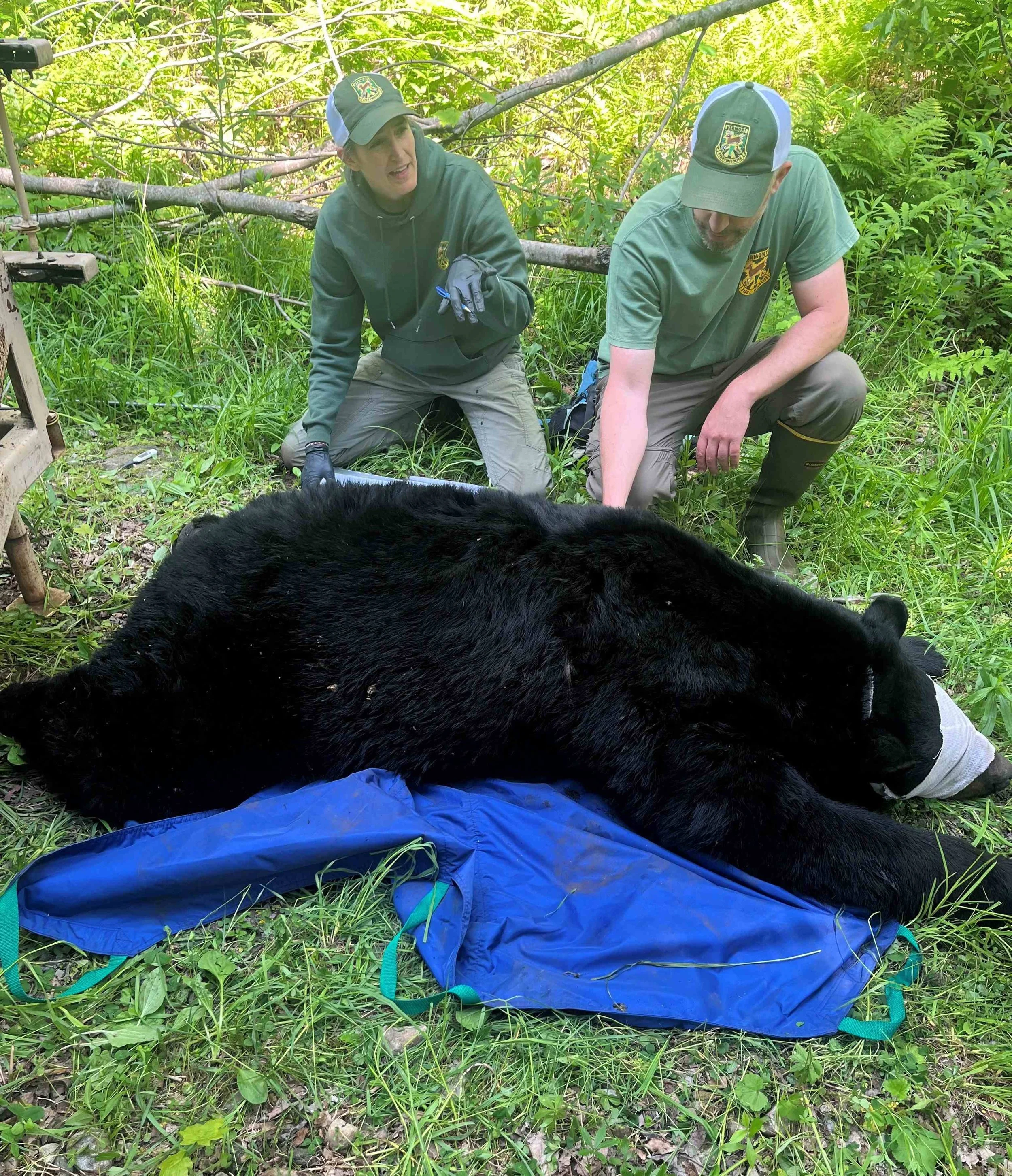
Biologists take measurements from a black bear captured and released during fieldwork for Vermont’s new bear reproduction study. Vt. Fish & Wildlife Department photo
Vermont’s bear hunting season runs from Sept. 1 through Nov. 14 this year. Hunters are allowed to harvest bears that have been collared for this study. If they do so, hunters are asked to contact the department and to treat the GPS collars with care until they can be returned to a state biologist. Hunters are reminded to pay close attention before taking a shot to avoid harvesting a bear accompanied by cubs.
“We ask the hunting community to keep up their good track record of bringing harvested bears to a biological checking station, and sending in a tooth sample from their harvest for analysis as is required by law,” Comeau said. “Hunters’ support is essential for us to keep building our population model on good data. By the same token, in the unlikely event that a hunter harvests one of the bears collared for this study, we’ll depend on that hunter’s cooperation to retrieve the bear’s collar and the data it contains.”