
Smell of spring: End of winter spreading ban allows farmers to start applying manure to fields
April 22, 2026 | By Isabel Sykora | Community News Service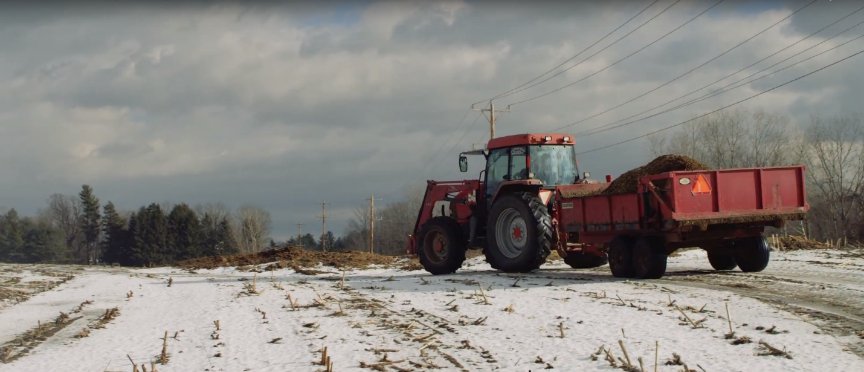
Farmer spreading manure on a Vermont field. Photo courtesy Vermont Agency of Agriculture, Food and Markets
Vermont’s winter manure spreading ban officially ended on April 1, marking a seasonal shift for farmers and adding a whiff to the air that signals spring.
The law, which runs annually from December 15 to the beginning of April, is designed to protect water quality by prohibiting the spreading of manure and other agricultural waste through the winter.
“The ban is undoubtedly good for water quality, but now that it’s lifted, farms will for sure be out spreading manure as fast as they can,” said Kevin Haggerty, climate resilience specialist for the Northeast Organic Farming Association of Vermont. “They have a ton of manure stored after a winter of cows indoors and will want to get that onto the field as a primary nitrogen fertility source before planting.”
Spreading manure on frozen ground can have significant environmental consequences. Because the soil cannot absorb nutrients under these conditions, manure builds up on the frozen ground and turns to runoff with melting snow, ice and spring rain, carrying pollutants into nearby rivers and streams and ultimately flowing into Lake Champlain.
This runoff leads to eutrophication, or an excessive amount of nutrients — mainly phosphorus and nitrogen — which fuels harmful algal blooms in the lake. The blooms degrade the quality of the lake, sometimes making it unsafe for recreation and leading to periodic beach closures in summer.
Nevertheless, spreading is an important practice for farmers as it acts as a natural fertilizer that enriches the soil and amplifies crop yields.
“Spreading manure on grassland generally improves the tonnage and quality, like higher protein in the grass,” said Jim Maille, owner of Maille Dairy in Shelburne. This means the grass has greater nutritional value for the livestock consuming it.
Recent weather conditions have delayed fieldwork at Maille Dairy, where clay soils have led to especially muddy conditions.
There are currently 465 registered dairy farms in Vermont, according to Ian Wilson, dairy administrator for the Vermont Agency of Agriculture, Food and Markets. The dairy industry is deeply embedded in the state’s history and its rural image, but the number of dairy farms and cows in Vermont has been declining. As noted in Vermont’s latest Census of Agriculture done in 2022, the number of dairy cows stood at 105,514, which was an 18% decrease since the last census in 2017.
Still, those cows produce vast amounts of manure. The U.S. Department of Agriculture Natural Resources Conservation Service estimates that the average 1,400-pound dairy cow will produce roughly 112 pounds of manure daily. Based on the number of dairy cows in Vermont, that could translate to an estimated 11.8 million pounds of manure produced in the state each day, although various factors could affect that total.
For decades, farmers, agriculture leaders and environmentalists have studied different solutions to Vermont’s manure problem. A more sustainable alternative to traditional spreading is manure injection, said Kate Longfield, executive director of the Champlain Valley Farmer Coalition.
Manure injection is a method of applying liquid manure directly into the soil rather than spreading it on the surface. Using specialized equipment — such as coulters or chisel plows — the ground is sliced open and manure is injected about 4 to 6 inches deep, where plant roots can easily access it.
Instead of sitting exposed on the surface, the nutrients are delivered directly into the root zone, where crops can use them more efficiently. This not only boosts nutrient uptake and reduces waste, but also helps prevent runoff into nearby streams and lakes. As an added benefit, burying the manure greatly minimizes the strong odors often associated with traditional surface spreading.
“If it does rain, the manure is already in the ground. There would be very little runoff,” Longfield said. “You are injecting it directly into the ground where the roots are.”
Still, experts say manure management is a complex issue.
Haggerty, at NOFA, said that manure management will likely continue to pose challenges for water quality.
“We need to think systemically about how we can encourage good husbandry and land stewardship and support dairies in the process,” he said.
For smaller dairy farms, adopting more sustainable practices can be financially challenging. Maille said his farm takes steps to reduce environmental impact where possible.
“We pile in our cornfields in the winter, and we spread in the summer when weather allows. We try to stay away from small streams if it has been raining a lot. We also have a no-till planter and try to put a cover crop in the fall to minimize any runoff,” Maille said.
No-till planting helps preserve soil structure and improves water absorption, reducing runoff. Similarly, cover crops limit soil erosion and keep nutrients in place.
Manure can be beneficial when managed carefully, said Scott Sanderson, director of the Food & Farm Initiative at the Conservation Law Foundation, an environmental group that works to improve water quality.
“Manure can be a valuable fertilizer when it’s applied carefully. Everything depends on attention to detail,” Sanderson said. “Factors like the amount of manure applied, the crop, the condition of the soil, the application’s timing, and the proximity of waterways, wells and other sensitive resources all matter.”
As Vermont’s fields reopen for spring spreading, the seasonal shift highlights both the importance of agriculture and the ongoing need for more sustainable practices.
“There’s no simple rule,” Sanderson said. “It takes expertise to use manure productively and responsibly.”