
Waterbury residents weigh in on 90-unit housing proposal
October 8, 2025 | By Lisa Scagliotti The Waterbury Select Board meets on Oct. 6 at the Main Street fire station to discuss a 90-unit housing proposal for the former Stanley-Wasson property at the State Office Complex. At center, Park Row homeowner Peter Martel comments to the board. Photo by Gordon Miller
About 70 people turned out on Monday to weigh in on a proposal that envisions building a 90-unit housing development on the edge of the State Office Complex in a neighborhood that’s seen multiple floods in recent years.
The Waterbury Select Board met at the Main Street fire station anticipating a crowd, and about 50 people attended in person, with about 20 others tuned into the livestream.
None of those asking questions or offering comments voiced opposition to building new housing in general, but many expressed concern about the location with regard to future flooding and the impacts a large development could have on traffic and public safety.
“Can we all admit that this is in the special hazard flood zone?” asked Peter Martel, who lives adjacent to the Stanley-Wasson property. He reminded the select board members of their responsibility for public safety and community well-being in their roles. “I’m asking that you take that responsibility to heart before you put projects forward that might put the property, the neighborhood in danger of additional flooding. I think that’s one of the fears we have is that any disruption to this area will cause greater harm in the future.”
Other speakers touted the opportunity to grow the town’s population.
“I want to see more people in the town – more children running around my yard laughing and yelling. More kids playing baseball. More adults volunteering to be coaches,” said longtime Randall Street resident Bob Finucane, who broke some of the tension in the room. “We simply don’t have enough people … how are we ever going to develop the ballplayers we need to beat the Yankees?”
Manager’s overview
Town Manager Tom Leitz. Photo by Gordon Miller
The meeting opened with Municipal Manager Tom Leitz giving a brief overview of the recent history of the property that’s located near the intersection of Randall Street and Park Row.
Now in use as a temporary park and ride lot, the property formerly was the site of Stanley and Wasson Halls, two three-story brick buildings that contained state offices, including the headquarters of the state college system. In 2011, the buildings were damaged by flooding from Tropical Storm Irene and vacated; the state put the buildings on a list of property it was willing to divest itself of. After sitting vacant for a decade, the structures were demolished in 2021.
Leitz noted that the town created a volunteer Housing Task Force in 2022, and the Stanley-Wasson site was identified as a potential location for new housing. In 2023, the state legislature approved selling the vacant lot to the town of Waterbury, and town and state officials formalized the purchase option agreement in April. Although town officials hoped the state might simply transfer the property, a purchase price of $400,000 was set.
In August, the town put out a call to potential developers for proposal ideas that would put housing on the property. The request included purchasing the property from the town so taxpayers would recoup their cost.
The deadline for proposals was at the end of September, and the town received just one submission from DEW Construction in Williston.
Leitz has posted most of DEW’s proposal on the town website, but it did not share DEW’s proposed purchase price, preliminary sketches, or any design details.
Leitz said it calls for building 90 total units with a mixture of one-, two- and three-bedroom units and a mix of affordability levels, including “market rate, workforce housing, and affordable housing.” He said there were “multiple options for discussion related to building layout and site design,” but did not say whether DEW envisions one or more buildings on the 2.9-acre site. “Those [details] are not public and would be considered a trade secret at this point,” he told the audience.
Leitz expressed some disappointment in having just one proposal to review, but he said the town’s requirement that the developer purchase the property likely deterred some builders. He walked through a general timeline of the development process ahead, stressing the uniqueness of this endeavor and that the town has made no commitments yet.
“We’re under no obligation to go further,” he said, noting that the select board could reopen the call for proposals, or further planning could reveal issues that might be deal-breakers.
A development of this size would likely involve an investment by the developer of about $50 million, Leitz noted. And it would be a boon to the community in the form of new municipal and education taxes. He estimated the project would boost the town grand list by about $120,000 in annual tax revenue, or 1.5%; his estimated impact on school taxes was $475,000 per year, an increase of 2.9% for Waterbury’s share in the Harwood school district. The project would also be served by municipal water and sewer. Those connections would mean about $200,000 in new revenue to the Edward Farrar Utility District, Leitz said.
Building on this site would follow the town’s updated zoning regulations that were revised in 2024 to encourage more and denser housing development, Leitz noted. The location has a height limit of 60 feet with no lot coverage limits. It would be subject to design review by the town Development Review Board and state historic district review, Leitz noted, adding that he was not certain whether state land-use review under Act 250 would be required.
Another potential benefit might be a new state Community Housing Infrastructure Program that will allow municipalities to finance public infrastructure for new housing developments by using future property tax revenue. That was just passed earlier this year and specific rules for that program are not completed yet, Leitz said.
It may be the case that tax revenue from such a project could be directed to help spur additional housing development or even be put toward flood mitigation efforts. The town has applied for several state and federal grants for funding for a major excavation project in Randall Meadow, which is adjacent to the state office property and the Randall Street neighborhood. The state has agreed to transfer that land to the town to manage flood mitigation efforts on the site with the aim to reduce the impact of future flooding on the nearby neighborhood and downtown Waterbury.
Leitz stressed that much still needs to be explored. “This is really, really rare for a town to be in this position to work directly with a developer on a 90-unit proposal. There is just no exact roadmap for us,” he said. “Just like you, we have more questions than answers at this point, and you’re all going to have to bear with us as we work through this in a public process which is always messy, especially when there is no roadmap.”
Leitz added that the town may need to hire consultants of its own “to make sure we’re asking the right questions.”
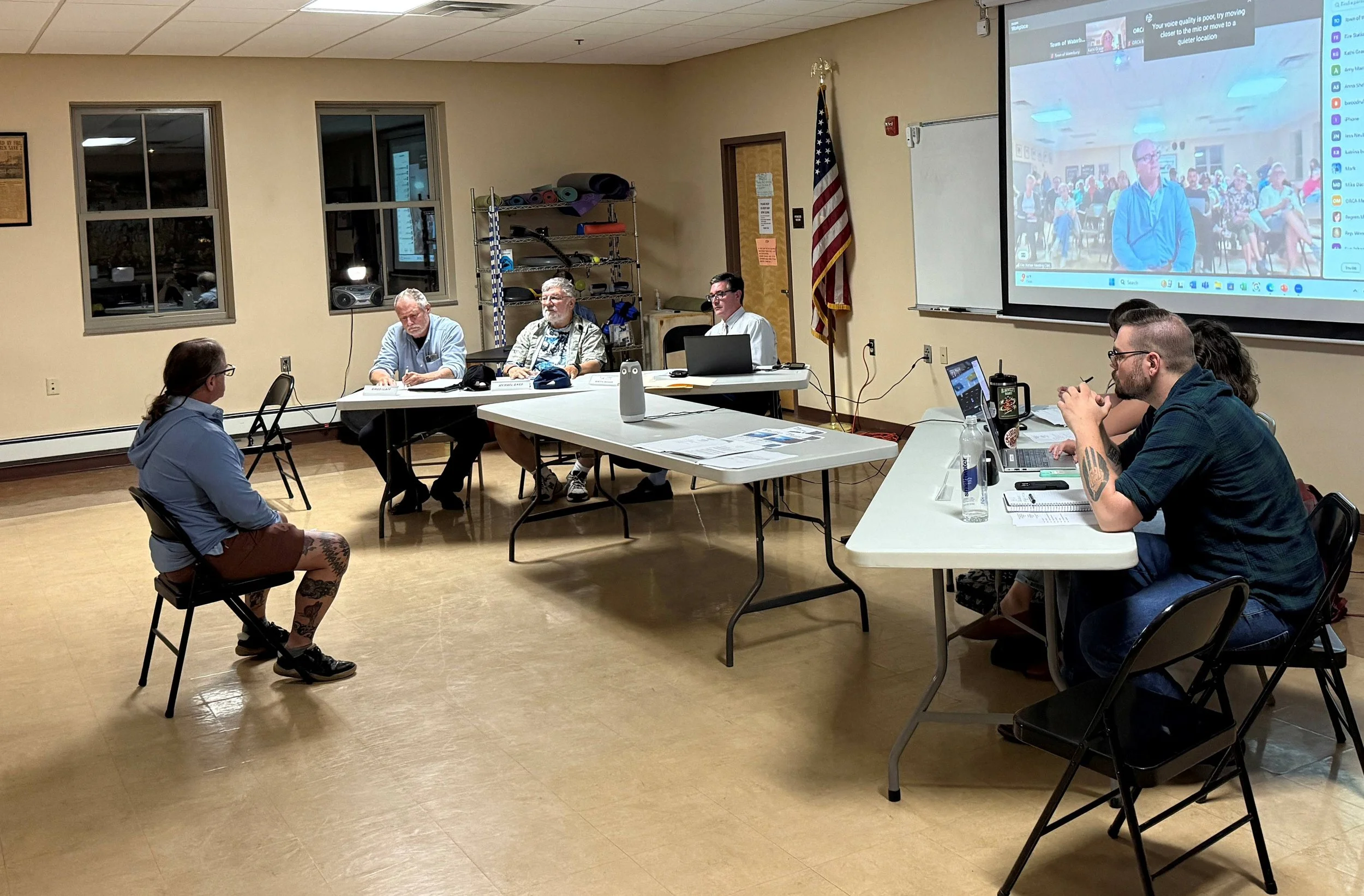
Randall Street homeowner Brian Kravitz comments to the board. Photo by Gordon Miller
Faith and caution
Members of the public took the opportunity to ask many questions and share their opinions.
Randall Street homeowner Brian Kravitz voiced support for the project adding new housing and tax revenue. “I do have faith that you’re going to make sure that it’s not going to do any more harm,” Kravitz said, asking about the timing given pending plans for flood mitigation work in Randall Meadow.
“That’s a great question,” Leitz replied, explaining that timing is very unclear as both efforts are at the start of what could be years-long processes.
Harry Shepard, a member of the town Development Review Board, said he thought it was noteworthy that the town received only one project proposal. “Permitting a project of this size in a flood zone is extremely onerous,” he said, suggesting that one estimate of 18 months was overly optimistic and instead may take years. “It can be done, but don’t kid yourself. I’d be very cautious about what the town ultimately commits to this process because it’s going to be really challenging to pull it off,” he said.
Multiple speakers raised the topic of how adding a large new building in the floodplain would displace future floodwaters. Al Lewis suggested ensuring enough land is excavated in the meadow to offset the footprint of the housing development; Em Lamson asked town officials to explore adding river dredging to the flood mitigation plan.
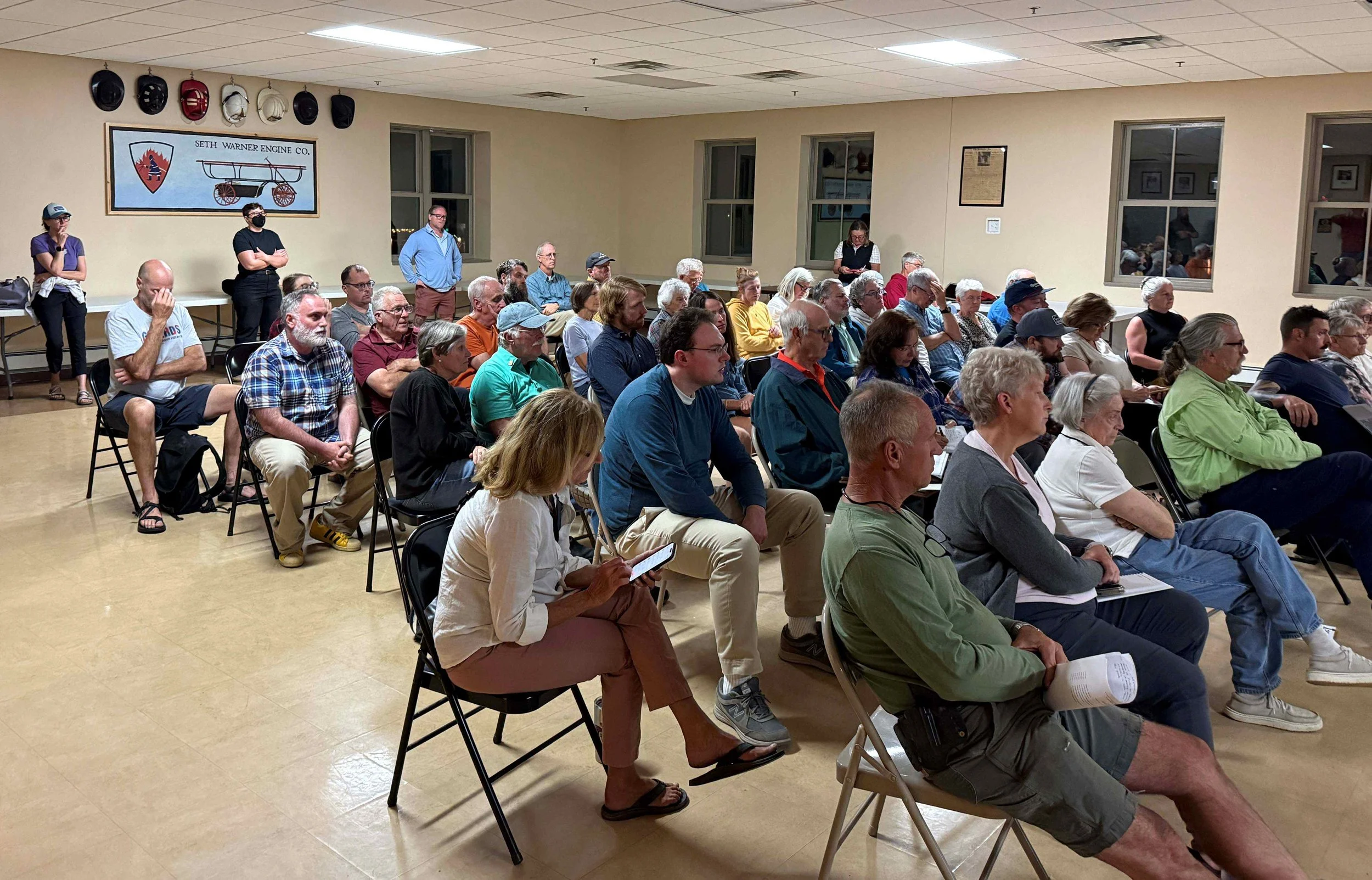
Community members at the Main Street fire station. Photo by Gordon Miller
“I appreciate the terror the people in that area have,” said Sue Minter, a longtime former state and local public official who served on the town Planning Commission prior to being elected as a state representative and later serving as state Transportation Secretary and Irene Recovery Officer. Minter touted major public investment in the town’s growth in the past several decades, saying she supports new investment to grow the grand list, especially if it will support new families living in Waterbury and “children to fill our schools.”
Several speakers suggested that growing the town’s population will create new demands, such as a need for more police services than the two Vermont State Police officers that the town contracts with the state for now. “There’s going to come a time when it’s not adequate,” Alec Tuscany said.
Cheryl Gloor added transportation and other infrastructure to the list of ripple effects of developing large-scale housing. “This is a long-term decision that will affect the town for a long time,” she said.
Former select board member Chris Viens cautioned against “trying to solve the so-called housing crisis and in turn creating another housing crisis, and that is driving the people that are here now out of their homes for the sake of people who perhaps want to come here to live. People who have been here for a fairly lengthy part of their life, if not all of their life, deserve the right to stay here and we should be focusing on that first.”
Viens said more growth will bring with it “more drug problems and outside crime problems” that are costly to address. “We need to be careful what we wish for,” he said.
Resident Anna Shelly disagreed with that assessment. “I don’t think that sort of us-versus-them mentality is productive,” she said. “I absolutely think both of those things can happen at the same time. And in fact, one could argue that one couldn’t happen without the other.”
Mal Culbertson pointed to residential building since Tropical Storm Irene that’s withstood more recent flooding, and pointed out the benefits of adding new residents to the town.
“I think about seeing struggles to fill school board seats and commission seats and different boards that don’t get enough people, and the farmers market closing because there weren’t people to take on that effort,” Culbertson said. “This isn’t going to be just more burden on our town – these are new community members and neighbors who are going to want to get involved. This is a really exciting opportunity to not only add a lot of very needed housing, but it would make Waterbury more liveable for more people, and that means more people to volunteer and get involved in everything that makes our community special.”
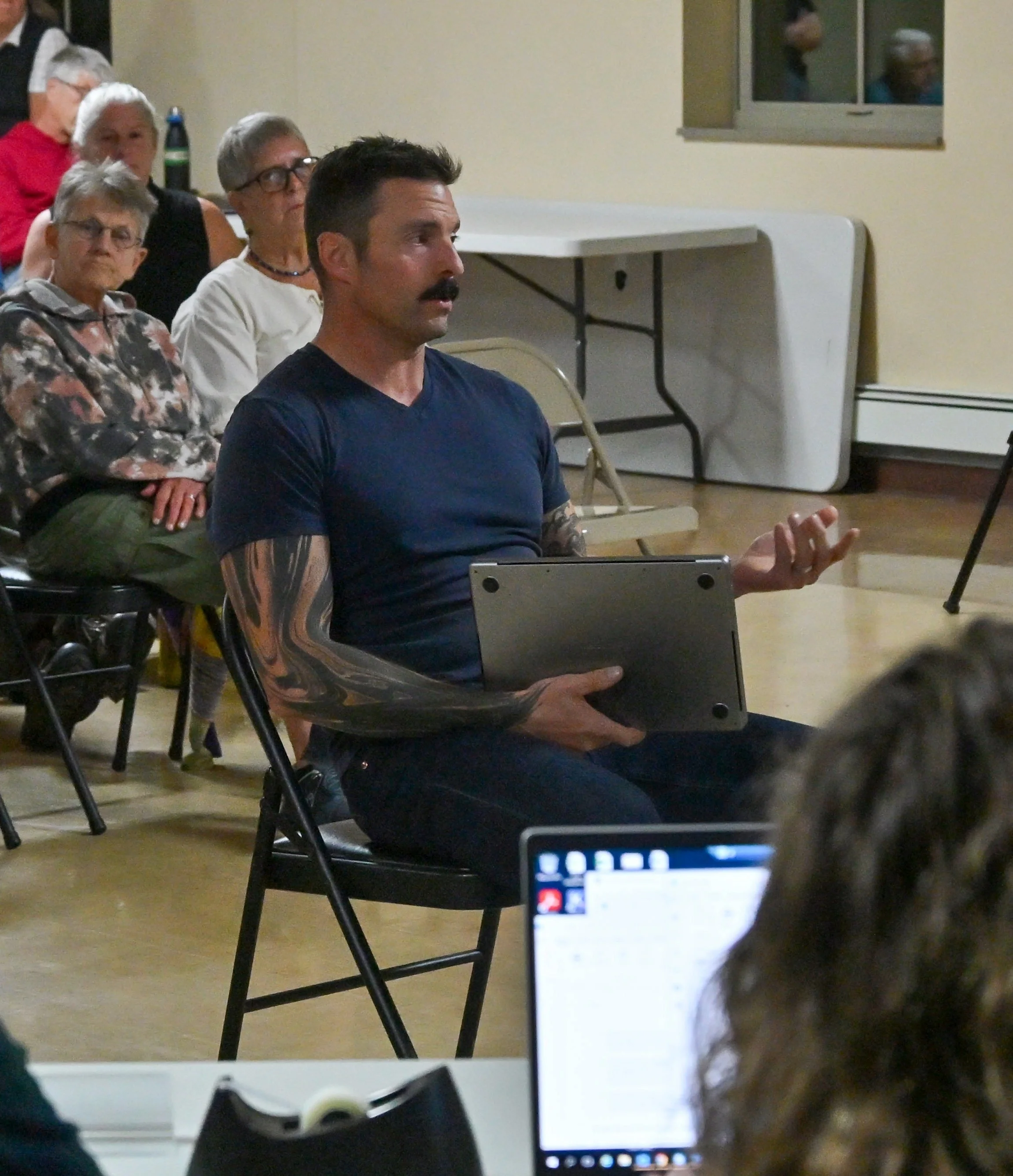
Planning Commission Vice Chair and consultant Dana Allen addresses the board about zoning updates that address housing and ongoing flood mitigation projects. Photo by Gordon Miller
Waterbury Housing Task Force member Jess Neubelt stressed that the state’s housing shortage is real, citing a state assessment that pegged the need for 26,000 to 30,000 new housing units by 2029 to maintain a 2% vacancy rate. She also noted that a UVM study found 60% of Vermont downtowns lie in flood-prone areas.
“So if we’re going to solve our housing crisis, we need to figure out building on lots like this that are on town water and sewer and in a flood zone. It can be done,” she said.
Select Board member Mike Bard, who is retired after a career working in federal housing financing, agreed with Neubelt, saying development in floodplains is possible. Entire communities and even counties across the U.S. lie in floodplains, he said. “I don’t want to develop and create other flood problems. But I think with studies, proper engineering, things can be done in a proper way to develop this property for a housing project,” he said.
Former town manager Bill Shepeluk reminded the audience that Waterbury is fortunate to be working on developing this site with a prospective builder and future owner. “If there’s going to be a project there, having the town in the seat right beside the developer to ensure there are answers to the legitimate questions being asked – I think that’s the best place that the town can be in.”
Select Board Vice Chair Kane Sweeney said the town should make the most of that opportunity. “The housing crisis is not getting any better, and it’s drawing economic vitality away from Waterbury at a time when we need to increase it,” Sweeney said. "We either get a say on what’s going to happen on this property or we don’t.”
Leitz said that DEW Construction has asked that if the town would like to pursue the project further, the next step would be to enter a contract promising the town is working with their firm exclusively. From there, DEW would move on to the next planning stages, such as doing a market study, site soil testing, geo-engineering, and architectural design work. “No developer will make that investment unless they can guarantee that at this stage they are not competing with someone else,” Leitz said.
The Waterbury Select Board’s next meeting is at 6:30 p.m. on Oct. 20 at the municipal offices. Chair Alyssa Johnson said the board will likely continue its discussion of the Stanley-Wasson proposal and its next steps with the developer.
The Oct. 6 meeting was recorded, and a video will be posted on ORCA Media.