
A rare winter flicker of red and yellow
January 26, 2026 | By Colby Galliher | The Outside Story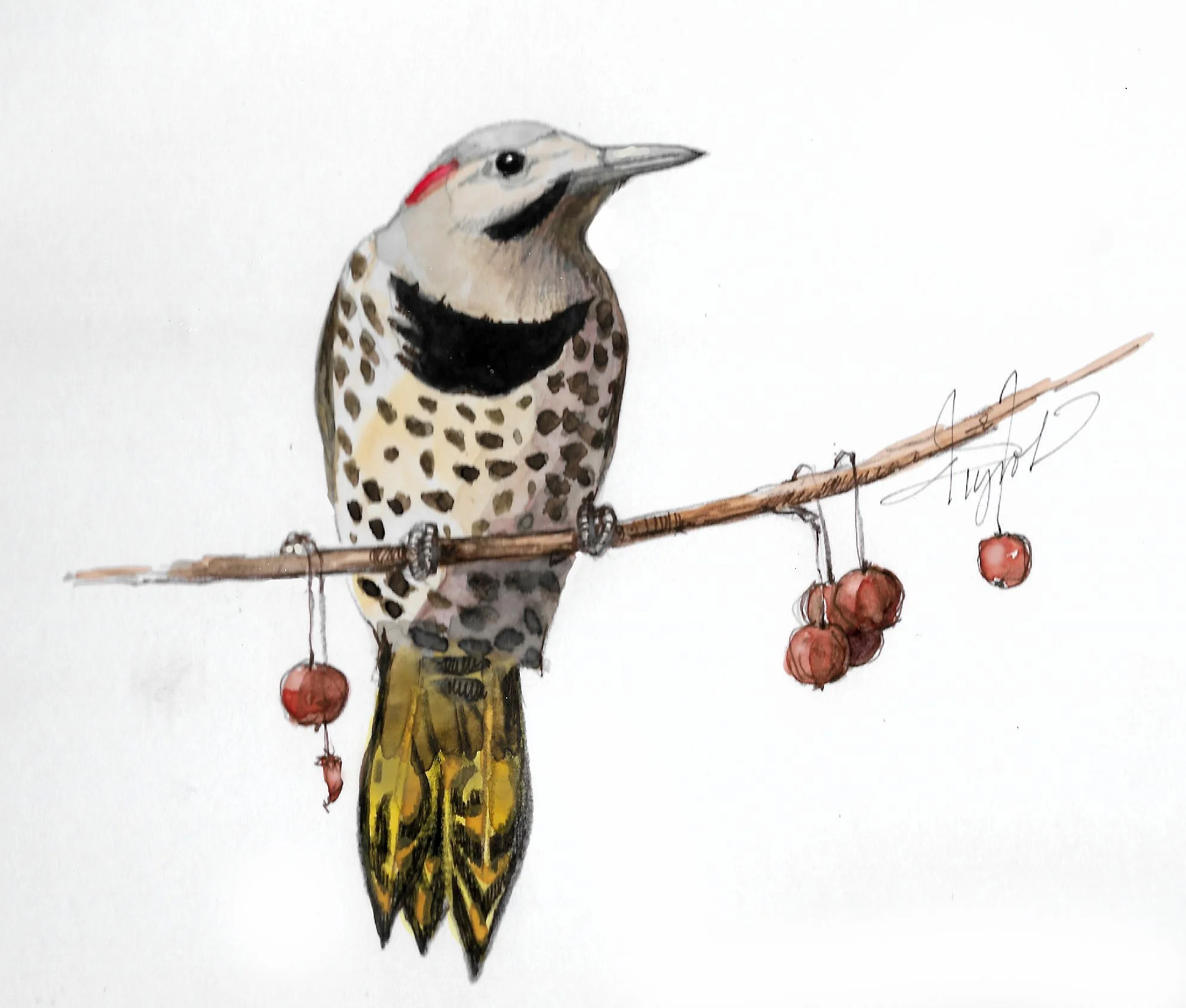
Illustration by Adelaide Murphy Tyrol
While many of our region’s colorful birds fly south for the cold months, resident woodpeckers offer a reliable contrast to this season’s monochrome palette.
A pileated woodpecker’s blazing crest and the miniature red cap of a hairy woodpecker brighten the gray-and-white doldrums. But few avian winter wardrobes match the brilliance of the northern flicker (Colaptes auratus), a mostly migratory bird that every so often toughs out the snow and ice in northern New England.
Northern flickers sport a combination of mottled and speckled brown-and-black plumage that camouflages the birds effectively, so look for the eye-catching red nape of their necks and their white behinds.
You might also pay close attention when they take flight: Perhaps their most dazzling feature is the lightning-yellow underside of their wings and tail. Out west, these feathers are primarily red. There are two recognized subspecies in the United States: yellow-shafted and red-shafted.
Flickers’ migratory pattern is unorthodox for woodpeckers of the northern forest. Just one of our eight woodpecker species, the yellow-bellied sapsucker, summers here and winters farther south. The other six find no need to travel even as the weather turns: their invertebrate prey remains accessible in the crevices of tree trunks and under their bark.
But winter tends to put a damper on flickers’ usual diet. Stalwart contrarians among their kin, the species most often feeds not clinging to tree trunks in forests but on the ground in open areas, including urban and suburban environments, where their choice dish lives: ants.
Flickers can reportedly devour up to 5,000 of the little bugs in a sitting with the aid of their long, barbed tongues, which they can extend up to two inches beyond their beaks directly into anthills and tunnels. Deep and persistent snow cuts off the birds’ access to these buffets and other ground-dwelling insects like beetles, leading most flickers to fly south in the fall in search of suitable feeding grounds.
Not all decamp for warmer climes, however. The occasional flicker braves the northern New England winter, seeking out areas of exposed grass and dirt on which to forage. I have spied them feeding at pond edges, along plowed roadsides, and in fields where wind has scoured the snow from patches of soil, particularly during thaws. They also resort to eating seeds and fruit when snow cover persists for long stretches and visit bird feeders if suet is available, offering opportunities to notch a rare winter flicker sighting.
But could changing winters lead more flickers to remain in northern New England year-round, downgrading these sightings from brag-worthy to commonplace? Rising temperatures decrease snowpack and increase insect activity, which may open up previously buried feeding areas and provide flickers with a steadier supply of invertebrates.
One need only look to other familiar bird species to see how climate change facilitates range expansions and shapes migratory behavior. Carolina wrens, tufted titmice, and red-bellied woodpeckers, once unable to endure punishing northern winters, can all now be found in northern New England at any time of year. Given an improvement in foraging conditions, flickers may well buck the dangerous trip south in favor of permanent residency.
Weighing against the likelihood of greater winter flicker abundance is the species’ overall population trend. Flicker numbers in all seasons have steadily declined across the birds’ range, with the Cornell Lab reporting a 49% decrease since 1966. The woes are no different in New Hampshire and Vermont; in the former, according to New Hampshire Audubon, there are now just a quarter of the flickers there were 50 years ago.
Factors driving this slide include a shortage of dead trees in which flickers nest and competition for these dwindling nest sites with European starlings. Because flickers live near and within human-dominated settings, they are also vulnerable to pesticide applications on lawns and golf courses, which both eliminate insects and can directly poison individuals.
Seeing a flicker in winter, then, is an unusual delight. Keep your eyes on open ground, and if that far-off flock of ground-feeding white-throated sparrows or dark-eyed juncos seems to include one unlike the others, look closer.
You might spot a handsome woodpecker pecking for its breakfast, dreaming of the buggier days of spring.
Colby Galliher writes about conservation, ecology, and environmental policy. The Outside Story is assigned and edited by Northern Woodlands magazine and sponsored by the Wellborn Ecology Fund of New Hampshire Charitable Foundation.