
November 11, 2026Editor’s note: The letter below was written to the Harwood Unified Union School District School Board and read by Cheryl Joslin at Monday’s community meeting at Waitsfield Elementary School. She shares it here with the community.
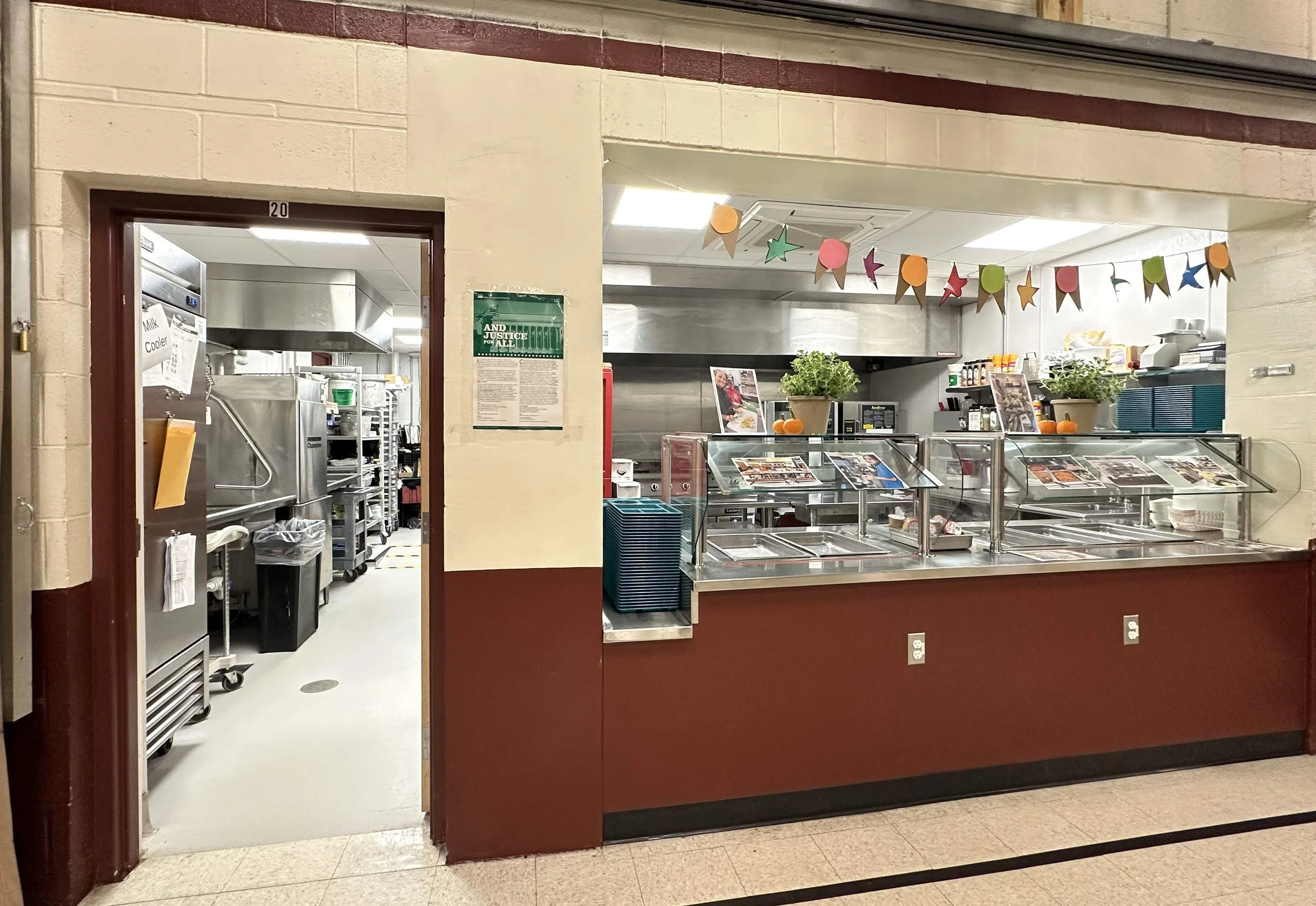
The kitchen at Waitsfield Elementary School sits at the far end of the gym. Photo by Lisa Scagliotti
To the Community:
I am writing to share why the future of the Waitsfield kitchen matters so much to me.
I am a local property and business taxpayer and the parent of three daughters who all attended Warren Elementary School. Two went on to Harwood Union High School, while my youngest attended high school elsewhere. I have also been a school lunch lady for 24 years, working at both Waitsfield and Fayston. That experience has given me a clear understanding of what a functioning kitchen makes possible.
I recognize that these are incredibly difficult decisions, and I certainly don’t pretend to have all the answers. I don’t know that there is a perfect solution, or that any of us can know with certainty what will be best for our schools and communities in the years ahead. I respect the time and effort that has gone into this process. My hope is simply that the board will carefully consider the value of what we already have at Waitsfield before making a final decision.
For years, we transported food from Fayston to Waitsfield. The food was good when it left, but quality began to decline once it was transported. Temperature, texture, freshness, and presentation all suffered. When Waitsfield’s new kitchen opened and Fayston began receiving meals, Fayston experienced those same problems. After finding the right staff, we now have two fully functioning kitchens.
Today, with a trained chef in each school and two functioning kitchens, we prepare meals where children eat them. We rarely transport prepared food. We have gone from roughly four trips a day to perhaps two or three trips a month.
One of the primary goals of building the new Waitsfield kitchen was to eliminate the need to transport prepared meals between schools. We already knew what transporting food cost us in quality, time, and labor. And I can tell you firsthand: repeatedly loading and unloading food carriers is back-breaking work. We invested in this kitchen to solve those problems — and it worked. Now we are considering a decision that could put us right back into the very situation we invested $1.1 million to get away from. I believe that deserves serious consideration.
The Spring 2026 HUUSD Food & Nutrition Survey included responses from 416 families and 104 staff members across the district. Respondents valued fresh and homemade food, local ingredients, salad bars, and kitchen staff. Some staff also reported better food quality compared with transported meals. All in support of cooking on site.
Waitsfield has the highest meal participation in the district, based on the figures I work with, and I believe the new kitchen plays a major role. We can offer fresh meals, introduce new foods, and respond to what students need.
Think about what happens when students walk into school and smell fresh marinara sauce simmering on the stove, or warm muffins coming out of the oven. Those aromas spark curiosity. Students ask questions: What are you making? What goes into it? When can we try it?
The other morning, a pile of fresh kale caught their attention at breakfast. Students asked, “Are you making kale chips today?” They recognized the ingredient because they had seen us prepare it before. That is food education happening naturally.
Our food education also goes beyond the lunch line. Last year, students explored herbs, and this year our Rainbow Year is introducing them to colorful foods. Students also have opportunities to help in the kitchen, making that learning more hands-on.
A meal delivered in an insulated container cannot provide quite the same experience of seeing ingredients, smelling food cook, and asking questions about it.
There is also something that is easy to overlook: when the kitchen is right here, food is right here. If more children choose lunch than expected, or we think we might run short, we can make more. We can respond to students in real time. That flexibility is much harder when meals arrive from somewhere else. The district survey also included concerns about popular breakfast and lunch choices running out. A kitchen on site gives us a practical way to respond.
My goal is to educate more children throughout the district about where food comes from, how it is prepared, and why fresh meals matter.
I recognize that Waitsfield has challenges with its shared gymnasium and cafeteria. We serve three back-to-back, 30-minute lunch periods every day, sometimes while PE classes are happening.
Our PE teacher currently spends two days a week at Waitsfield and two at Moretown. If consolidation brought a full-time PE teacher to Waitsfield, could PE be scheduled across five days around our existing lunch periods?
More students would place additional demands on the space. I am not assuming scheduling will solve everything, but I hope the district will explore what is possible.
I also understand there is discussion of spending approximately $100,000 on a dishwasher at Moretown. I hope the board compares the full costs of improvements at each building, kitchen infrastructure, and any future food transportation.
Community members have asked why we cannot simply move the kitchen equipment from Waitsfield to Moretown. It is a fair question, but moving a commercial kitchen is not as simple as unplugging equipment and loading it onto a truck.
Major units have specific electrical requirements, often dedicated circuits, along with water feeds, drainage, ventilation hoods, and fire suppression systems. The receiving building would need the right infrastructure for the equipment to work safely.
Before assuming the equipment can be moved, we need to know what changes would be required and what they would cost. That infrastructure is already in place at Waitsfield.
To me, the kitchen is the heart of a school. It is where the school beats. It is where children gather, where relationships are built, where we nourish students, and where learning happens in ways that go far beyond the lunch tray.
We are already cooking fresh, nutritious meals in what I consider the most state-of-the-art school kitchen in the valley, while maintaining high food-safety standards, reflected in our recent 100% health inspection score. This is a functioning kitchen and an established program, not something we are still hoping to build.
We are not just feeding children. We are nourishing their bodies, inspiring their minds, and feeding their souls. The conversations and connections that happen around food are part of what makes this work meaningful.
I hope the board will recognize what is already working here. This kitchen is an asset we can continue to utilize to educate more children throughout the district for years to come. And I sincerely hope I can keep doing that work right here, in this kitchen.
Cheryl Joslin is School Nutrition Manager for Waitsfield and Fayston Elementary Schools.