
Sen. Watson: Reflections on the 2026 legislative session
June 15, 2026 | By Sen. Anne Watson
Now that the legislative session has ended, I want to share with you some of the most important bills passed out of the legislature and passed out of Senate Natural Resources and Energy, which I chaired, and then I want to highlight what I'm at least currently perceiving as priorities going into next session, but I'd love to hear more about your thoughts on what should come next.
Overall bill highlights
H.955 - Education and Property Tax Reform
This bill aims to reduce property taxes while preserving a quality education for all Vermont students. Here are some highlights:
It requires that all school districts be a part of a Cooperative Education Service Agency (CESA for short), which is a group of school districts that would collaboratively contract for services such as professional development, special education, information technology, etc. This should help save money simply from economies of scale. Maine, Mississippi, Montana and West Virginia all have similar structures.
This bill also requires that all districts be grouped into sets with neighboring districts to together discuss the feasibility, costs, and benefits of merging, keeping an emphasis on preserving small elementary schools and having more regional high schools.
This bill sets in motion a second-home property tax. Currently, in a third to a half of our towns, second homes pay a lower rate than primary residences because they are considered commercial property. This would help correct that.
This bill sets us on a path to have a foundation formula, which would provide a certain amount of money to a school district for each student, adjusted based on the needs of those students. I had a lot of concerns about this, as I don't want education funding to be a political football, but there is a board that would determine what the formula should be, so it should be somewhat insulated from political winds.
This bill ramps down the excess spending threshold from 118% to 112.5% of the statewide average per-pupil spending by the year 2032. I don't love this provision, as some school districts have done all of the belt-tightening that they can reasonably achieve without cutting staff or programs (some have already cut staff or programs), and may still be over the excess-spending threshold.
S.190 Healthcare Reform: Reference-Based Pricing
Reference-based pricing is a system that limits the amount a hospital can charge for a particular service to a percentage of the Medicare reimbursement rate. This has been a proven way to reduce healthcare costs in other states. We had already started down the path of reference-based pricing, but this bill speeds up the timeline and applies it particularly to the healthcare coverage for public school employees, as a means for lowering property taxes. Read more from Seven Days.
S.298 Vermont Voting Rights Act
Strengthens protections against voter intimidation and reduces barriers to participation while improving access for historically underrepresented communities.
S.209 Prohibits Civil Arrests at Sensitive Locations
Given the atrocious behavior of ICE, people are afraid to go about their daily lives -- going to the doctor, dropping their kids off at school, etc. This bill prohibits civil arrests in sensitive locations. Which locations? Here I think the bill says it best: “A person shall not be subject to civil arrest while:
(A) traveling to, entering, remaining at, or returning from a:
(i) court proceeding; or
(ii) educational institution; or
(B) on the premises of a:
(i) building owned and wholly controlled by the State or a political subdivision of the State where members of the public may enter in order to conduct governmental business;
(ii) office operated by the Department of Motor Vehicles that is open to the public;
(iii) public library;
(iv) polling place;
(v) social services establishment, which includes a crisis center, domestic violence shelter, victim services center, child advocacy center, supervised visitation center, family justice center, facility that serves disabled persons, homeless shelter, substance use disorder counseling and treatment facility, and food pantry or similar establishment that distributes food or other essentials of life to persons in need;
(vi) place of worship;
(vii) facility licensed as a children’s camp or that serves as a day camp; or
(viii) health care facility.
Two Constitutional Amendment proposals
In November, you will be asked to vote on these two measures.
Prop. 3 Right to Organize Amendment
Places a constitutional amendment before Vermont voters to enshrine the right to form a union and collectively bargain. Here is the language from this document:
“Article 23. [Right to collectively bargain] That employees have a right to organize or join a labor organization for the purpose of collectively bargaining with their employer through an exclusive representative of their choosing for the purpose of negotiating wages, hours, and working conditions and to protect their economic welfare and safety in the workplace. Therefore, no law shall be adopted that interferes with, negates, or diminishes the right of employees to collectively bargain with respect to wages, hours, and other terms and conditions of employment and workplace safety, or that prohibits the application or execution of an agreement between an employer and a labor organization representing the employer’s employees that requires membership in the labor organization as a condition of employment.”
Prop. 4 Equal Rights Amendment
Places a constitutional amendment before Vermont voters to strengthen equal rights protections in the Vermont Constitution. If approved, it will reaffirm Vermont's longstanding commitment to equality, dignity, and freedom from discrimination. Here is the language from this document:
“Article 23. [Equality of rights] That the people are guaranteed equal protection under the law. The State shall not deny equal treatment under the law on account of a person’s race, ethnicity, sex, religion, disability, sexual orientation, gender identity, gender expression, or national origin. Nothing in this Article shall be interpreted or applied to prevent the adoption or implementation of measures intended to provide equality of treatment and opportunity for members of groups that have historically been subject to discrimination.”
Bill highlights from Senate Natural Resources and Energy
H.915 The Bottle Bill
This bill transitions the structure of the bottle redemption system by creating a Producer Responsibility Organization, which will help modernize our redemption center sites, make them more financially and environmentally sustainable, and improve the redemption experience for Vermonters.
It temporarily increases the handling fee while the Producer Responsibility Organization is stood up so that we don't lose any more redemption centers in the meantime. Early on in this process, I recognized that this bill had bipartisan support, particularly if we included the temporary handling fee increase, so I was proud to have the Senate minority leader report this bill to the Senate.
H.727 Data Centers
Senate Natural Resources and Energy added valuable protections to this bill
ensure grid stability, reduce air pollution, blocking 24/7 fossil fuel-powered jet engines, require battery storage, and impact fees.
We strengthened the water regulations by prohibiting open-loop cooling systems. We also corrected language that came from the House that would have allowed additional costs and negative effects to be borne by Vermonters. The Senate ensured that that would not happen.
It was unanimous coming out of committee, passed the Senate 26-3, and I'm proud that every member of Senate Natural Resources took part in reporting this bill. Unfortunately, the governor thought it was too strict and vetoed it. An attempt to override his veto did not succeed.
S.202 Plug-In Solar
I worked hard to vet this bill ahead of the session with stakeholders to smooth the path and it fit well with my expertise, limited as it is. The main thing this bill does is cut red tape for these devices so that homeowners have an easier time going from purchase to plug-in.
Right now, a homeowner would have to go get an interconnection agreement from the Public Utility Commission before plugging one of these in (unless you're off-grid). This bill ensures that these devices are safe (compliant with UL3700 and National Electric Code).
The main safety concerns are available in this document from Clean Energy State Alliance, which I found very helpful.
The bill prevents condo associations or mobile home parks from prohibiting them, but it allows building owners to have reasonable restrictions for their tenants regarding these devices. It also makes it clear that the building owner is not obligated to do any wiring work for their tenant to have one of these. If you already have a net-metered system, you can't have one of these, because the electric meter can't distinguish between electricity generated through the net-metered system versus the portable solar device.
S.325 Updates to Act 181
This is one of the most important bills that came out of my committee and ultimately passed the legislature.
Most notably, this bill repealed Tier 3 of Act 181, which would have created extra regulations for critical natural resources, and it repealed the road rule, which would have created more regulations regarding forest blocks.
Because there needed to be a lot more vetting and conversation with landowners affected by this process, S.325 asks the Vermont Council on Rural Development and the Conservation Districts to come up with a plan for how to engage with the public on what may come next. How could we modernize the current use system to help protect critical natural resources? How could we incentivize and honor the stewardship work that landowners are doing? What are the main drivers of the loss of working lands?
Zooming out, I do think it's important for legislators to be reflective on how things are going and, if things are not going well, that we are humble enough to change course. This bill embodies that willingness. Democracy is an iterative process. I started the version of S.325 that passed specifically because I heard that the roll-out of Act 181 was not going well. The Senate started with a delay in implementation so that we could hear more feedback. And then we heard a lot of feedback in a hurry! And that was actually quite helpful.
I'm glad that this bill asks for a public engagement plan for the future so that we can engage, especially rural Vermonters, in crafting whatever comes next.
S.218 Salt Contamination Reduction
This bill would have set up a voluntary program for private commercial salt applicators to learn best practices about salt-spreading. If these salt applicators keep sufficient records of their best management practices and a slip-and-fall type accident occurs, they would be provided with some liability protection. This is modeled after a very successful program in New Hampshire, the Green Sno Pro certification. And like New Hampshire, we would have offered this to municipalities as well. This is all in an effort to reduce the amount of salt on our roads, parking lots, and sidewalks, while still salting to a safe level.
Unfortunately, the governor vetoed this bill, for reasons that I find... questionable. I'll probably have more to say on this later.
Priorities for next year
There are bills that I wish had not been vetoed (salt and data centers) or that I wish had gotten across the finish line, including S.208, requiring that federal law enforcement not hide their identity, and H.740, which would have created a climate pollution inventory from fuel sales, broken out by municipality or zip code.
Looking forward, though, we must find ways to:
1. Protect our democracy, our elections, and our neighbors
2. Take action on climate change
3. Build more housing (in general), but especially housing for working, disabled, homeless, and senior Vermonters.
4. Reduce the cost of healthcare, and make Vermont a more affordable place to live.
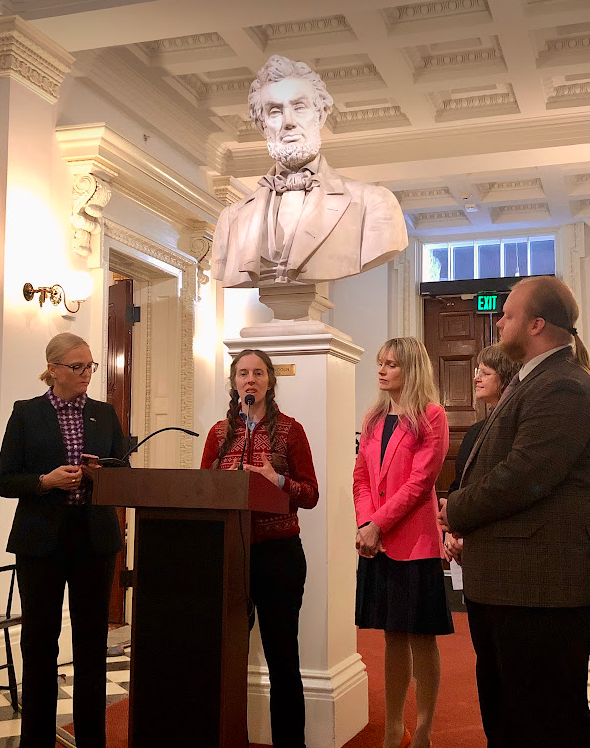
Sen. Anne Watson, D-Washington, (center) speaks at the State House. Courtesy photo
There are many more issues of course. These listed here are some that rise to the top as a place to start. I'd love to know what you think I should be working toward next session! What makes your list to work on for next year?
I'd love to hear from you.
Sen. Anne Watson is a Democrat/Progressive who lives in Barre and represents the Washington District in the Vermont Senate. She is running for re-election this year for a third term. Email: awatson@leg.state.vt.us