Town Meeting Day: Explaining Waterbury’s Randall Meadow flood resiliency bond vote
February 2, 2026 | Submitted by the Waterbury Select Board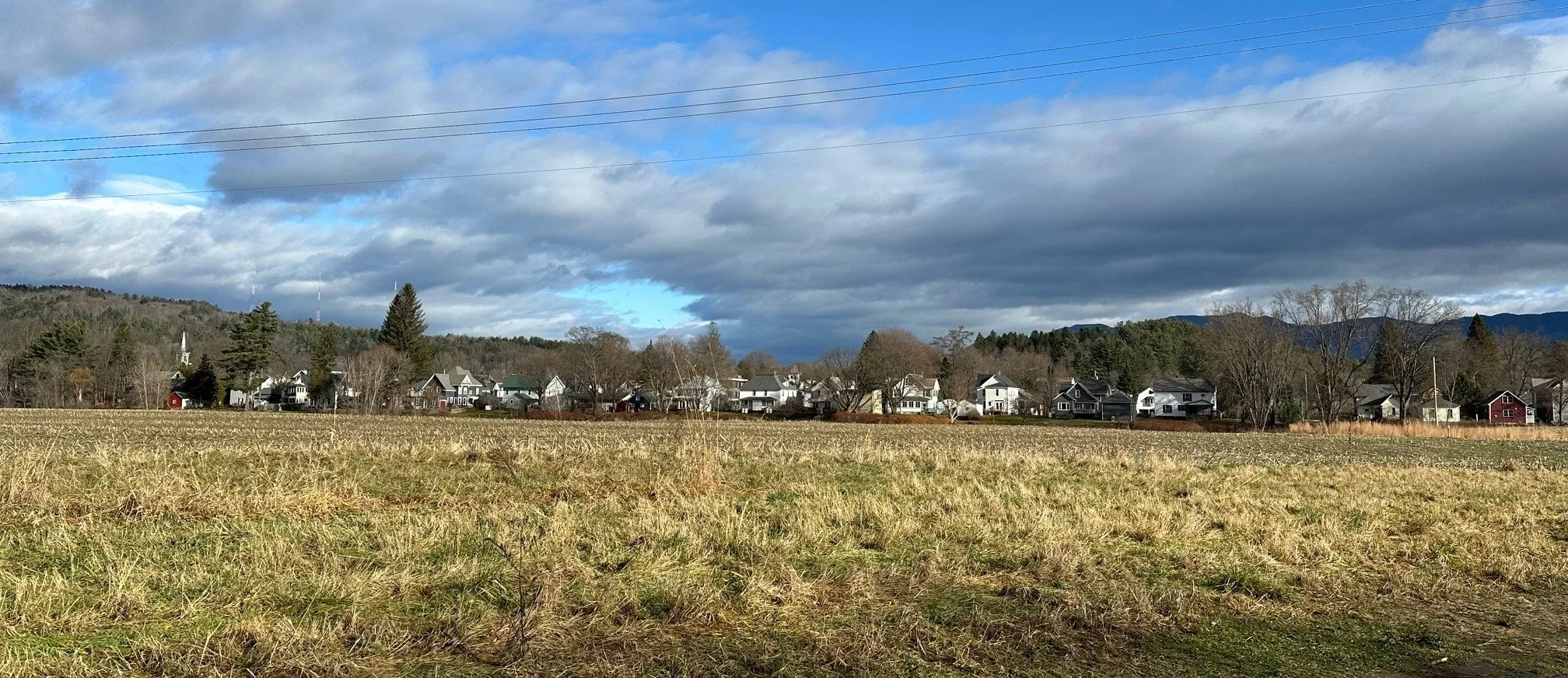
Looking across Randall Meadow at Randall Street. Photo by Lisa Scagliotti
On Town Meeting Day, there will be an Australian ballot article pertaining to a $4.3 million bond vote for the Randall Meadow project. Because this project has several moving parts, we wanted to provide a clear explanation of the project and the need for the bond vote.
Background
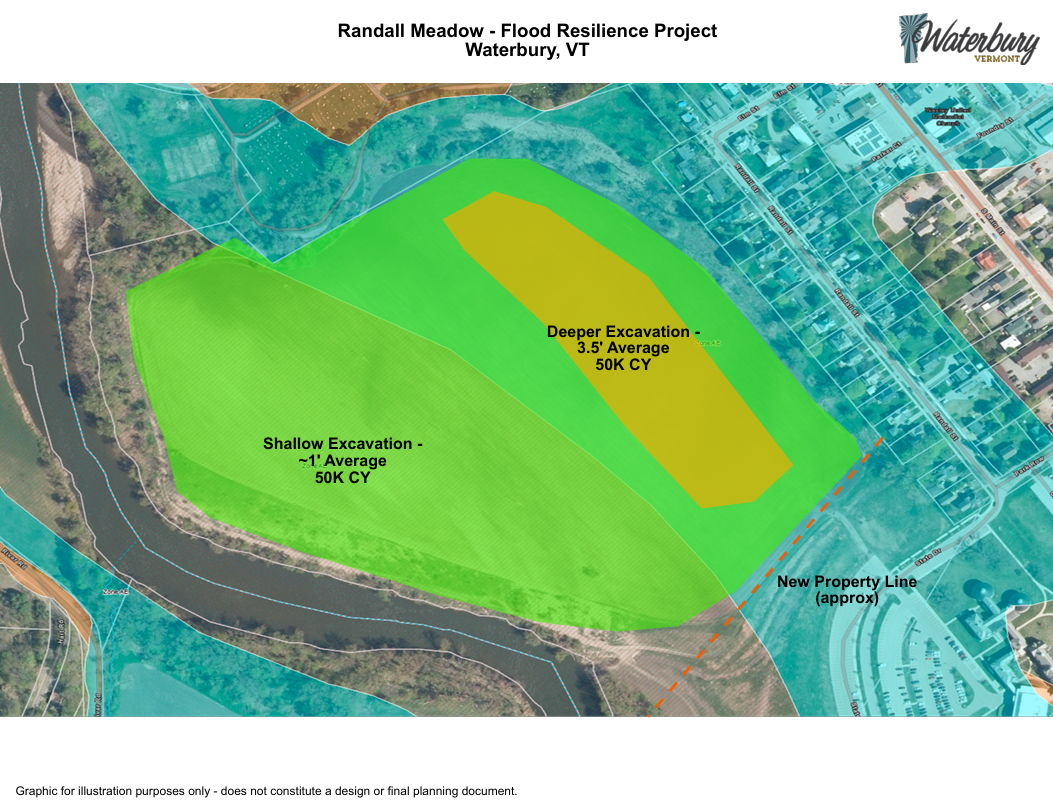
For those not familiar, Randall Meadow is the large agricultural field between the State Office Complex, Randall Street, Hope Cemetery and the Winooski River. (see map) The land is owned by the State of Vermont and is currently being surveyed, and the future plan is for the land to be transferred at no cost to the town. The amount of land is about 45 acres. Please see the picture for an outline of the site and the areas slated for excavation.
The town has contracted with SLR Consulting, a firm with a specific practice in hydrology modeling, to analyze the possibility of lowering the land to reduce the impact of a future flood. The resulting analysis suggests there would be between four inches and up to one foot of flood relief (during a 50-year flood) for not just the Randall and Elm street neighborhoods, but for the entire area of South Main Street that sits in the floodplain.
After years of analysis, planning, and grant writing, this is the town’s best option for providing some relief from future floods. Indeed, it is our only meaningful option at this juncture.
The project is expensive and complex. In short, a total of 100,000 cubic yards of soil would need to be moved. To provide some context, the town’s largest dump trucks can haul 16 yards. Thousands of truck trips would need to be made to move the soil, and the town needs to find local sites where the soil can be repurposed. Prior to taking ownership of the land, the town would conduct significant soil sampling to ensure there is no pollution that would derail the project. Obviously, we have no intent to own land that creates a major liability for taxpayers.
Why a bond vote now?
This past fall, the town submitted a grant application to the state’s Community Development Block Grant Disaster Relief program. The estimated budget for the entire project is $4.3 million, and we were awarded a total of $2 million. As a condition of the grant award, the town needs to prove it can complete the full project as envisioned, or revise the scope of the project to limit the expenditures to the amount of the grant award.
The only way to meet the conditions of the grant and to complete the full project is to hold a public bond vote, which ensures the town has the legal authority to borrow the funds needed to complete the project. Without that legal authority, the state will not provide us with a grant agreement, which means any funds we spend on the project will not be paid by the grant.
In short, the project does not move forward without this vote.
Why $4.3 million?
The $2 million CDBG-DR grant is a federal grant. Our attorney advises it is prudent and traditional to request authority to borrow the full project amount, in the odd event the grant funds are later withdrawn. This would be a very unlikely possibility, and the select board would most certainly pause the project if that were to happen. For all intents and purposes, the plan is to borrow no more than $2.3 million due to our $2 million grant award.
We are also well-positioned to receive another significant grant. However, that grant application will be far stronger when the project is fully designed and engineered. In the final analysis, we hope to have a net cost between $1.3 and $1.8 million.
When will the town need the money?
Not for some time. Provided the bond vote is approved on Town Meeting Day, we can move forward quickly with a grant agreement. The grant funds can be utilized before we use local funds. We anticipate that engineering and design will be a 12- to 18-month process, and that will be paid entirely by the grant. We don’t anticipate needing the bond funds for 18-24 months.
How and when will it impact my taxes?
In the worst-case scenario, the town would borrow the net cost of $2.3 million. Using our current tax rate for purposes of comparison, this would increase your taxes by an estimated 3.7% if the town issued a 20-year bond. Fortunately, because we don’t anticipate issuing the bond for 18-24 months, the debt payments would not impact the budget for several years – likely 2028 at the earliest. Further, the debt payments can be phased in over several years, and
the town may be able to service the debt, or a portion of the debt, using the local option tax, which would not result in any increase in your property taxes.
Why should we consider this project?
Every time it floods, all town taxpayers share in the expenses. Every time it floods, the select board chooses to abate taxes for some of the properties impacted. And a substantial portion of our tax base is at risk when it floods. What impacts one impacts all.
Also, remember that floods impact more than the downtown. The storm of 2024 resulted in over $500,000 in town expenses – nearly all of that was damage to infrastructure in Waterbury Center. As part of that recovery, we upgraded a number of culverts that proved to be too small to handle the floodwater, which protected a number of roads. In this instance, we are lowering portions of a field to protect homes and businesses. The town’s lister estimated the project would provide flood protection to properties with a value on our grand list of $240 million.
What will not be improved
Every time it floods, a number of properties experience sewer backups. This is because our sewer system, like any, receives substantial infiltration when ground and surface water are very high. The system is simply unable to cope with the sheer volume of water infiltration. This project will not improve this problem. Residents and business owners in areas impacted by past floods should expect this challenge to remain.
We also need to acknowledge the amount of flood relief that is expected – between four inches and one foot. While this will certainly lessen the impact of future floods, we certainly do not mean to imply that there will not be an impact.
Are there risks and downsides?
In short, yes to both.
First, the town has already done environmental testing to determine if the soil is polluted. That testing identified some contamination, but this was expected. The types and levels of contamination identified would not stop the project from happening. However, if future testing identifies more serious contamination, the project could indeed be at risk of occurring.
Also, we anticipate that 5,000 truck trips will be required to complete this project. We are actively looking for places that will take the large quantity of material needed to complete this project. We know this number of truck trips will lead to some early deterioration of our roads, and this will have a cost. Before proceeding with the final project, a close analysis will be done to ensure the road damages and construction period are minimized, and to ensure the town has sufficient funds to make repairs.
For additional information about the Randall Meadow project visit the town website here.