
Gobbling and strutting through wild turkey mating season
March 13, 2026 | By Emily Haynes | The Outside Story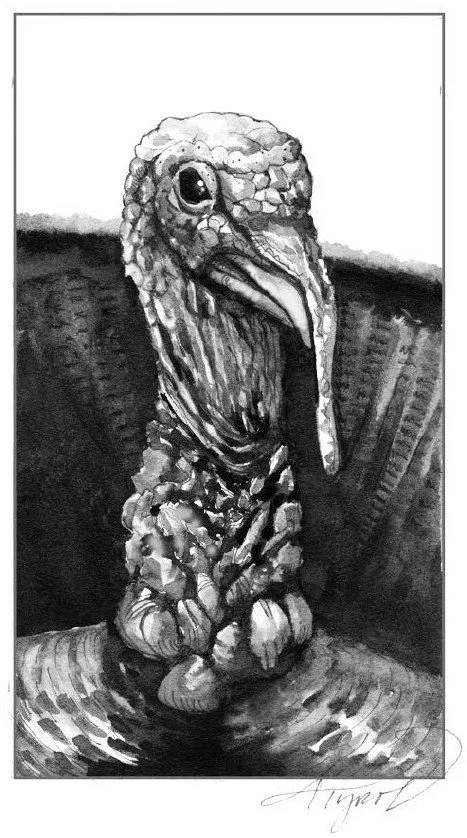
Illustration by Adelaide Murphy Tyrol
As the days get longer and warmer, wild turkeys start feeling the urge to begin the spring shuffle, wandering in search of breeding opportunities and nesting sites.
At this time of year, wild eastern turkeys are still congregated in the flocks of 20 or so birds with which they spend the winter.
Groups of hens, mature female turkeys, will generally winter with the broods they raised the previous summer. Toms, mature male turkeys, spend the colder months apart from hens and immature birds, in what biologists call “bachelor groups,” though males and females are sometimes seen congregating around food resources in winter.
The spring shuffle kicks off turkey mating season and generally begins in mid- to late March. The timing is affected by temperature, with heavy snows delaying its start and early spring thaws speeding it up.
Turkeys move seasonally because the resources they need from the landscape change as their focus shifts from surviving winter to raising the next generation.
When selecting wintering grounds, male and female turkeys look for shelter from the elements and access to food resources, such as bird feeders, silage, or waste corn, to supplement their foraged diet. But by early spring, food is less scarce, and hens begin assessing the landscape for sunken places where they can build their nests, ideally hidden from predators by fallen logs or dense vegetation. Toms, meanwhile, roam the landscape in small groups, searching for hens to mate with.
A key strategy males use to locate females is gobbling, the male turkey’s trademark loud and squabbling call.
“There are vocalizations that occur that bring males and females together: males broadcasting where they are, females responding when they’re preparing to breed,” said Dan Ellingwood, turkey project leader at the New Hampshire Department of Fish and Game. “That allows the two to make connections.”
During mating season, which generally occurs throughout April and May in New England, toms often begin gobbling from their roosts at dawn, listening for yelping responses from nearby hens. Once toms and hens find each other, male turkeys flaunt their showy sprays of tail feathers, puff up their plumage, and sashay for female turkeys in a mating display called “strutting.”
“Gobbling’s kind of a long-range advertising of their presence and then strutting’s kind of the short-range signaling of soliciting a breeding opportunity,” Ellingwood said.
While jakes – immature male turkeys – may gobble and strut for hens, breeding typically occurs only between toms and hens that are at least two years old. Hens may mate with multiple toms during breeding season, but they tend to only raise one brood per year.
At nesting sites, hens select depressions in the landscape or scratch out shallow basins, which they line with leaf litter. Turkey nests measure about a foot in width and length and typically hold 10 to 12 eggs, though sometimes a hen will lay as few as four eggs. Turkey eggs are beige with brown speckles and slightly bigger than a chicken egg.
While hens start laying a couple of days after breeding, they only lay one egg each day on average and the laying process can stretch on for two weeks. “They’ll start incubating after their entire clutch has been laid so that the embryos develop all at the same time – so that they all hatch at the same time,” Ellingwood said.
Raising a turkey brood is no easy task, as their in-ground nests are susceptible to predation by raccoons, opossums, foxes and other predators. Cold snaps and very wet weather can also threaten young turkeys’ survival.
“In cases where there is a nest failure, a nest loss, hens will re-nest, but they won’t nest multiple times in a year. They might attempt to re-nest once or twice through that breeding period, through the month of May,” Ellingwood said. “If things fail, they end up linking up with other adult hens – some with and some without poults.”
Wild turkeys were extirpated from both New Hampshire and Vermont for more than a century. They were successfully reintroduced to Vermont in 1969 and to New Hampshire in 1975, and both states now have healthy populations.
So, when you see toms strutting their stuff this spring, give thanks for all the biologists who helped bring these most magnificent of birds back to New England.
Emily Haynes is a writer currently living in Washington, D.C. An avid birder and hiker, she loves exploring the forests of the Northeast. The Outside Story is assigned and edited by Northern Woodlands magazine and sponsored by the Wellborn Ecology Fund of New Hampshire Charitable Foundation.