
The American coot: Easy to spot, but a rare visitor in Vermont
October 16, 2026 | By Jenna O’del | The Outside Story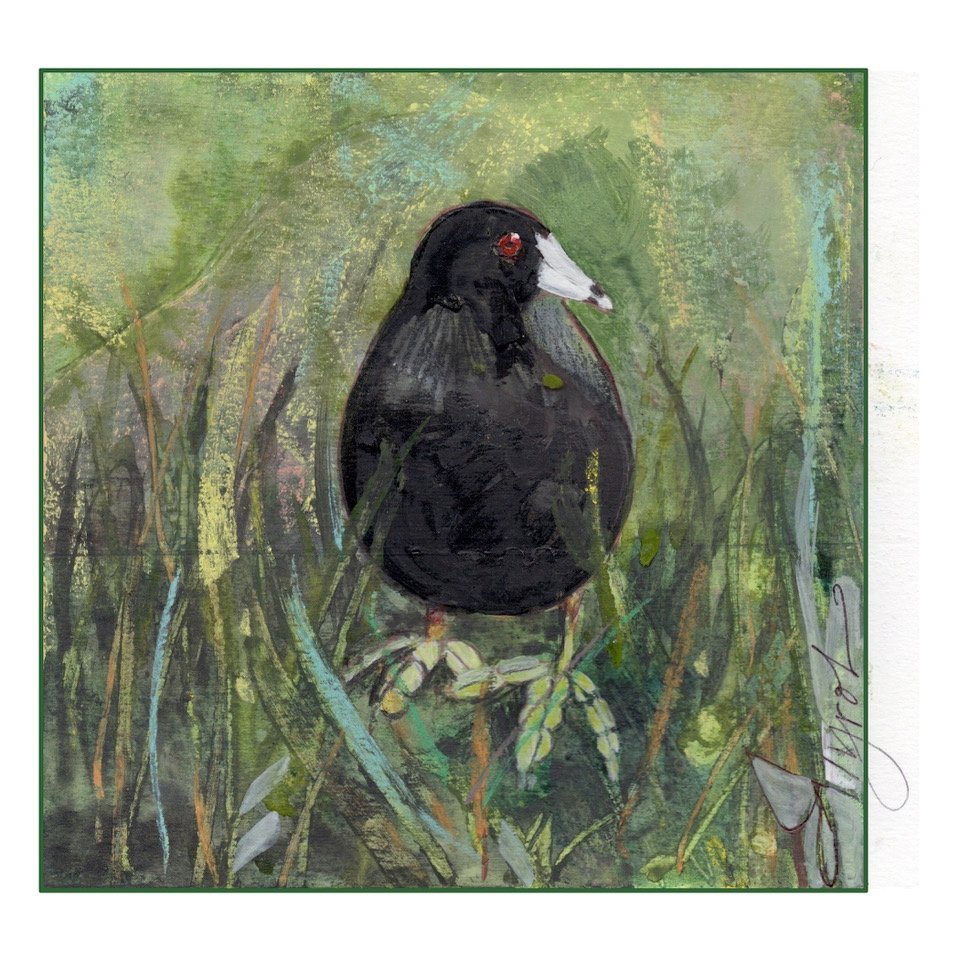
Illustration by Adelaide Murphy Tyrol
By mid-October, many birds have migrated south, but some lucky birders may still be able to spot an American coot, an uncommon bird in New Hampshire and Vermont. American coots can be found swimming in lakes, ponds, or rivers, anywhere there is aquatic vegetation for them to eat. They are usually floating among other waterfowl or foraging on shore.
American coots (Fulica americana) are easy to identify, with black chicken-shaped bodies and ghostly white beaks that droop slightly. A black band rings the end of the beak. The beak appears to continue up onto the coot’s face, covering some of its forehead; this structure is called a facial (or frontal) shield.
The facial shields of all adults swell for two purposes: to indicate the bird is ready for breeding and to indicate the bird is defending territory with its mate. Also on the facial shield is a red spot, called a callus, which is about the size of a thumbnail and made of keratin. The callus size varies among birds and helps birds recognize each other.
American coots are in the rail family, which includes king rails and soras. Members of the rail family are semi-aquatic birds, often described as secretive due to their elusive nature. Yet unlike other rails, American coots are rather easy to spot looking for food on the water or along the shore.
Found mostly east of the Mississippi River during the nonbreeding season, these birds head west of the river for nesting season. I first saw one on an Idaho prairie in May of this year and knew immediately what it was from seeing it in field guides, though I had never seen one closer to home in the Northeast before.
Their range extends from the Caribbean up into northern Canada, making them one of the most widely distributed rail species in North America, though they are typically only seen in the Northeast during fall migration, and occasionally during spring.
Despite their broad ranges, American coots are uncommon in many places, like northern New England, parts of New York, and several other states. Bruce Lyon, an expert in coots at the University of California Santa Cruz, noted that biologists don’t have a full understanding of why this is.
As a semi-aquatic bird, the American coot needs to be agile on land and in the water. Its feet look like a hybrid between the feet of a chicken and a duck; its muscled, greenish-yellow legs extend into wide feet that appear too big for its body. The feet are not webbed, and the toes, which are lobed (grebes have the same kind of feet), can move independently. These lobes help coots swim gracefully by extending outward, giving their feet greater surface area, which helps propel them through the water. On land, the lobes fold against their toes, allowing them to walk along shores without the awkwardness of birds with webbed toes.
They eat everything from grasses to algae and supplement their diet with invertebrates, such as crayfish or snails, and sometimes tadpoles.
Like the adults, chicks have distinct appearances. The tops of their heads are bald and pink, their bodies are dark gray and black, and their beaks are red. Chicks have small facial shields. Around their necks and extending onto the body are feathers that are red, orange, and yellow, resembling a sunset. These precocial chicks can swim shortly after they hatch and soon transform into juveniles with gray upper plumage and a white chest and belly. Later-hatching chicks typically are more vibrant, Lyon has found.
If you’d like to see an American coot, explore rivers and lakes in the coming weeks. Northeastern sightings on eBird, a birdwatching platform run by Cornell University, peak during October and November, though they have been recorded at other times of year, particularly in April and May.
Grace McCullogh and Pam Hunt of New Hampshire Audubon advised that for the best chance of seeing one during fall migration, head to the Connecticut River valley or Lake Champlain. Smaller lakes and ponds with shallow water can also provide good stopover habitat.
Jenna O’del is a biologist and science writer based in Rhode Island. The Outside Story is assigned and edited by Northern Woodlands magazine and sponsored by the Wellborn Ecology Fund of New Hampshire Charitable Foundation.