
The handsome, but often-overlooked ovenbird
August 13, 2026 | By Laurie D. Morrissey | The Outside Story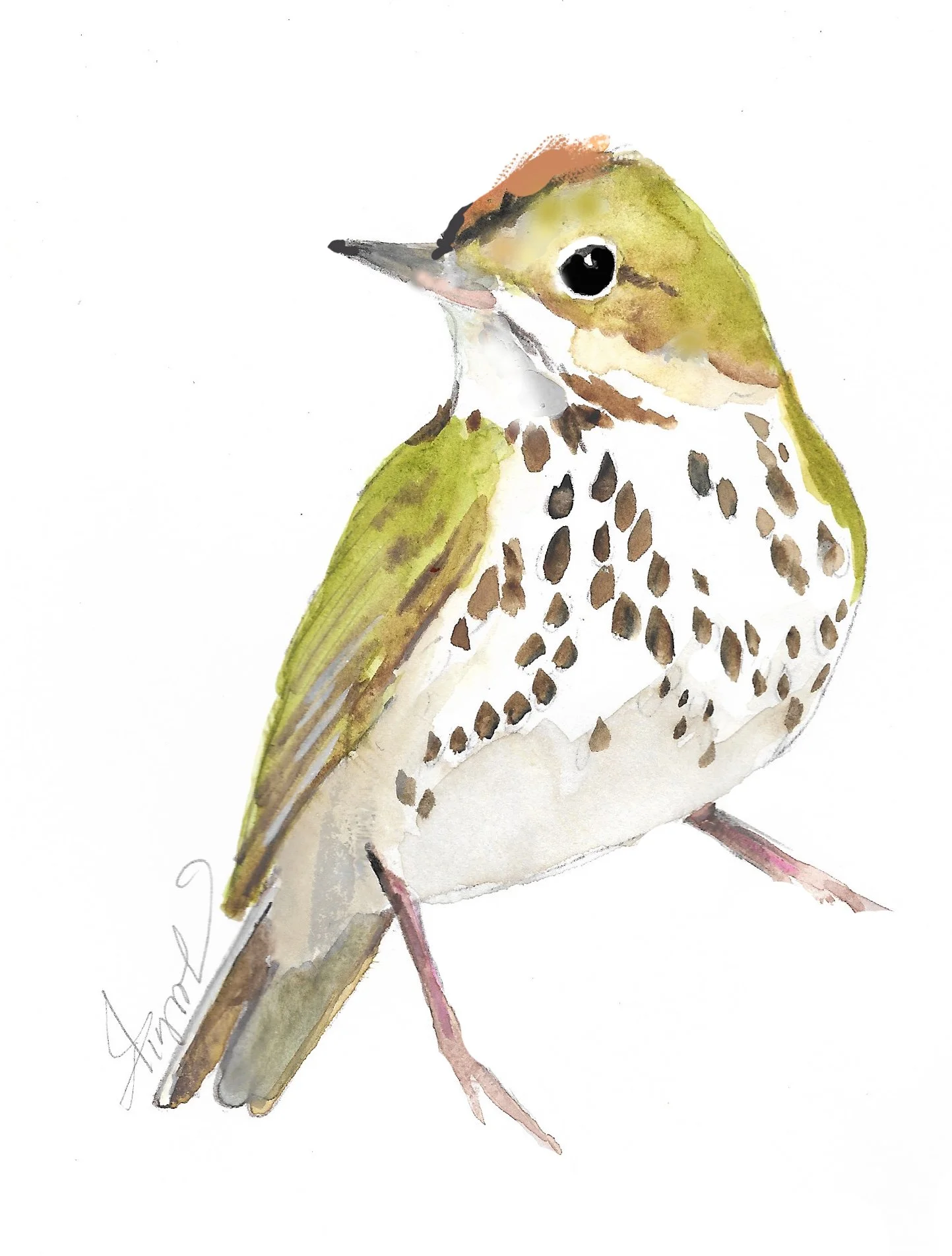
Illustration by Adelaide Murphy Tyrol
“There is a singer everyone has heard,
Loud, a mid-summer and mid-wood bird…”
Heard, yes, but maybe not seen. This bird keeps me company on summer walks, calling out tea-CHER tea-CHER tea-CHER in loud, ringing tones. When I hear it, I imagine Robert Frost pausing in his New Hampshire sugarbush to pen his ode to “the oven bird.”
Though their song is an iconic feature of northern woodlands, this handsome warbler stays well-hidden. Even when I hear more than one on a short stretch of trail, I rarely catch more than a glimpse. Ovenbirds feed and nest on the ground, where they blend in with leaf litter.
Even though its coloration and habits are similar to those of a thrush, the ovenbird is a member of the wood warbler family. Like a thrush, the ovenbird has a brown back and a white breast with black markings. But several characteristics set ovenbirds apart from thrushes. They’re smaller and have lighter bills, and their backs are more olive colored. If you can get a look at the top of an ovenbird’s head, you’ll see an orange crown bordered by black. (John James Audubon called this bird an orange-crowned thrush.
While thrushes and ovenbirds both forage on the ground, their movement differs. Thrushes tend to hop along on the forest floor, while ovenbirds strut. They jerk their heads and scratch at the leaf litter, tossing leaves aside with their bills in the hunt for insects, spiders and caterpillars.
In spite of its distinctive physical characteristics, this bird wound up with a common name that has nothing to do with its looks, but rather the appearance of its nest. The female clears a circular spot on the ground, creates a small cup-shaped nest, and covers it with leaves, grasses, and sticks, building a dome-shaped structure resembling a five-inch-high beehive oven.
If it had been up to me, I’d have named this warbler “teacher bird.” Its signature song phrase is repeated up to a dozen times in each call, with increasing volume. Although it sounds like two syllables to our ears, each teacher is actually composed of three to five separate notes. Ovenbirds hear every one of them. Males recognize each other’s songs by the pitch, speed, and emphasis of syllables, according to world-renowned birdsong expert Donald Kroodsma.
Ovenbirds sing their song late in the day as well as in the morning, and they continue singing later into the summer than most warblers. They even sing during the twilight hours and at night.
“Listen through the night in the dead silence of the forest and you’ll be treated, on occasion, to a most extraordinary song,” Kroodsma and Bruce Byers write in their forthcoming book “The Singing Lives of Warblers: Understanding the Songs of All 50 Species in the USA and Canada.”
“Grant the singer some human emotions and one hears a wild and spontaneous outpouring of ecstasy. It’s a flood of chips and warbles and slurs and twitters, the pitch changing abruptly up and down, often enriched with recognizable mimicked call notes of a few species… all so mysterious until one hears a few TEACHER phrases embedded in the outburst.”
When Henry David Thoreau wrote, “I heard the night warbler, breaking out as in his dreams,” he may have been hearing an ovenbird.
This warbler is believed to be holding its own, although like most songbirds, it faces challenges. “Ovenbird populations are fortunately stable,” said behavioral ecologist Miranda Zammarelli, who monitors ovenbirds as part of a decades-long study at Hubbard Brook Experimental Forest in New Hampshire. She noted that they require large forest tracts for breeding and raising young. “Forest fragmentation reduces food availability for these ground-foraging birds, and males are less likely to find a mate in fragmented forests,” Zammarelli said. She also shared that forest fragmentation can lead to an increase in cowbird populations, a brood parasite for ovenbirds.
While the ovenbird’s resounding song may be repetitive, I love to hear this “loud, mid-summer and mid-wood bird.” I can’t imagine the northern woodlands without it.
Laurie D. Morrissey is a writer who lives in Hopkinton, New Hampshire.The Outside Story is assigned and edited by Northern Woodlands magazine and sponsored by the Wellborn Ecology Fund of New Hampshire Charitable Foundation.