Vermont’s school redistricting task force proposes voluntary mergers instead of new district map
November 13, 2025 | Corey McDonald | VTDigger.orgEditor’s note: See a Nov. 14 follow-up report to this story from Gov. Phil Scott’s news conference. ‘They failed: Gov. Phil Scott admonishes school redistricting task force on VTDigger.org.
The majority of Vermont school redistricting task force members endorsed a proposal on Monday that would incentivize voluntary mergers of the state’s 119 school districts. Most of the committee also opposed a new school district map based around centers for career and technical education.
The nearly 170-page proposal approved by the body is a more detailed plan than the rejected career and technical education map, developed by Sen. Scott Beck, R-Caledonia, and Dave Wolk, Gov. Phil Scott’s appointee to the task force. That plan adhered more closely to the guidelines around Act 73 — that is, to draw a map of borders for new school districts.
But the approved proposal, in a way, flouts Act 73’s directive that the task force deliver at least one and no more than three new maps by Dec. 1 for the Vermont Legislature to consider in the upcoming legislative session, which starts in early January. Members of the task force who supported the proposal said it was the only responsible way forward, and argued that plans to reform the public education system would not work if school districts were forced to merge.
“We’re speculating in thinking that large scale district consolidation is going to somehow save money,” said Jay Badams, a task force member and former superintendent. “The research that we’ve consulted indicates, at best, that it might and it might not. To put the system through that much radical change for the possibility that there might be savings sure seems like a lot to ask of our communities.”
The proposal, developed by task force members Badams; Jennifer Botzojorns, a retired superintendent for the Kingdom East School District; and Rep. Rebecca Holcombe, D-Norwich, lays out a 10-year plan where districts would be incentivized to merge to access state construction aid, and to coordinate on developing regional high schools.
The proposal is a synthesis of two previous plans, one that centered redistricting around regional high schools, and another that emphasized using regional BOCES, or a board of cooperative educational services, which are used in other rural states to help school districts collaborate on services.
Five regional cooperative service agencies would be layered over the state’s existing 119 school districts and 52 supervisory districts and supervisory unions to help those entities share services like transportation and special education.
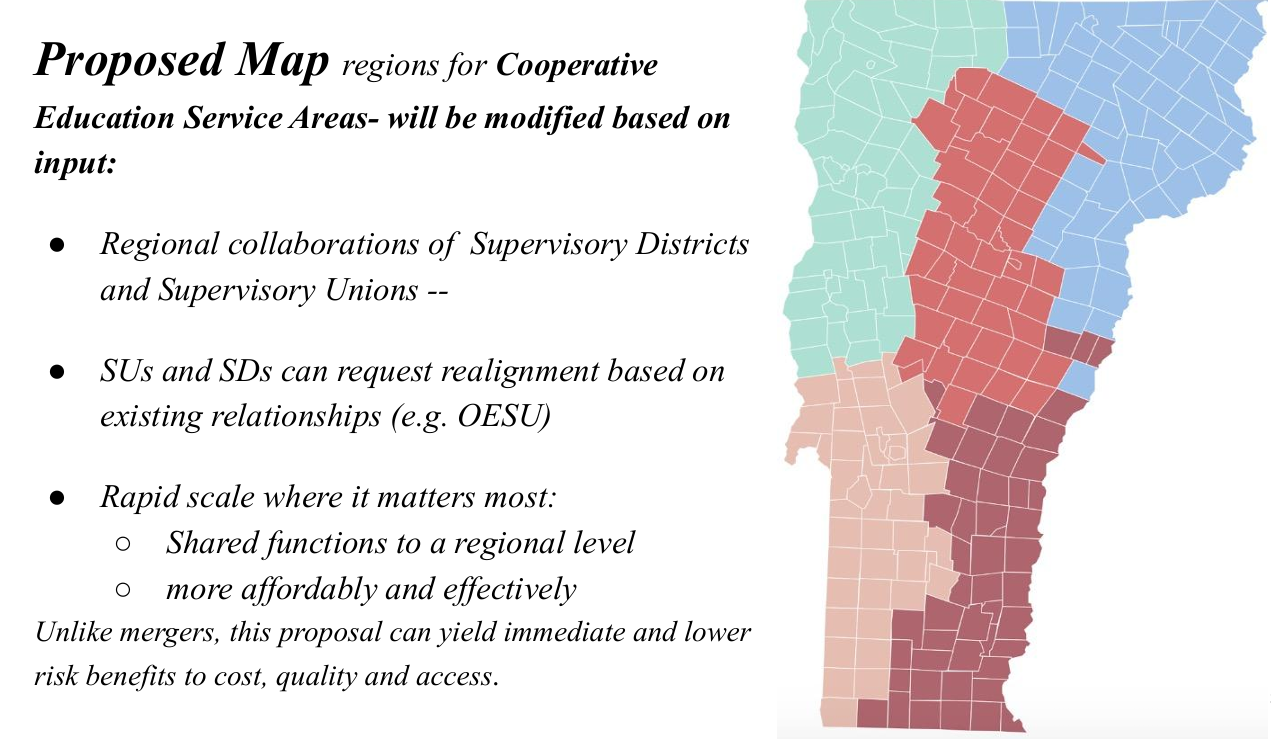
Slide via School Redistricting Task Force
“The key to this is voluntary participation,” Badams said. “Our feeling is that if we force this level and degree of change on our districts and our (supervisory unions), it simply won’t work.”
Wolk questioned whether their proposal meets the directives set out by Act 73.
“What’s been presented is some kind of voluntary collaboration, which I’m sure could and would and should happen,” he said. “But is it a map as directed to us by the Legislature?”
Holcombe replied that the “responsible thing is to say, that’s actually not responsible, but here’s some other things you could do instead.”
Deep disagreements
The votes taken on Monday, and the discussion around the two proposals, highlight deep disagreements among policymakers around the intent of Act 73 and foreshadow a difficult Legislative session to come.
Task force members throughout their seven meetings thus far have pointed to the lack of time to thoroughly develop plans for the kind of systemwide transformation that Act 73 envisions.
“If I had to give my advice to the Legislature, it would be, ‘It’s not ready,’” Badams said on Monday. “If we gave them a map just to give them a map, we just wasted a lot of our own time doing this stuff.”
He continued, “I think that’s the recommendation: Here’s the best we could do, this gets us started and lets us start making some headway.”
But Vermont Education Secretary Zoie Saunders did not appear to support that approach.
During a presentation to the task force on Monday, Saunders said their plan for voluntary mergers did not align with the intent of Act 73 “because it does not recommend a specific map that would satisfy the parameters of your charge as the redistricting task force.”
Also, she said adding regional service areas on top of the education system’s existing structure would create “an additional layer of bureaucracy and also cost.”
“Given that we have challenges hiring for the critical roles we have now within our system, and then maintaining the central office, and on top of that building in another layer of a BOCES, I think it does create some additional complexity for the system,” she said.
Task force members pushed back against this, and pointed to research from other rural states that show the mechanism would help the state save money.
Rep. Edye Graning, D-Jericho, the co-chair of the task force, said she was “incredibly distraught when the secretary came in and said misinformation about having our cooperative service agencies being an extra layer of bureaucracy.”
“That’s not what they are, and that’s not what they do, and I don’t want that to derail the process,” Graning said.
‘Hard to stomach’
Wolk and Beck’s proposal was the first proposal to be floated, at the task force’s halfway mark.
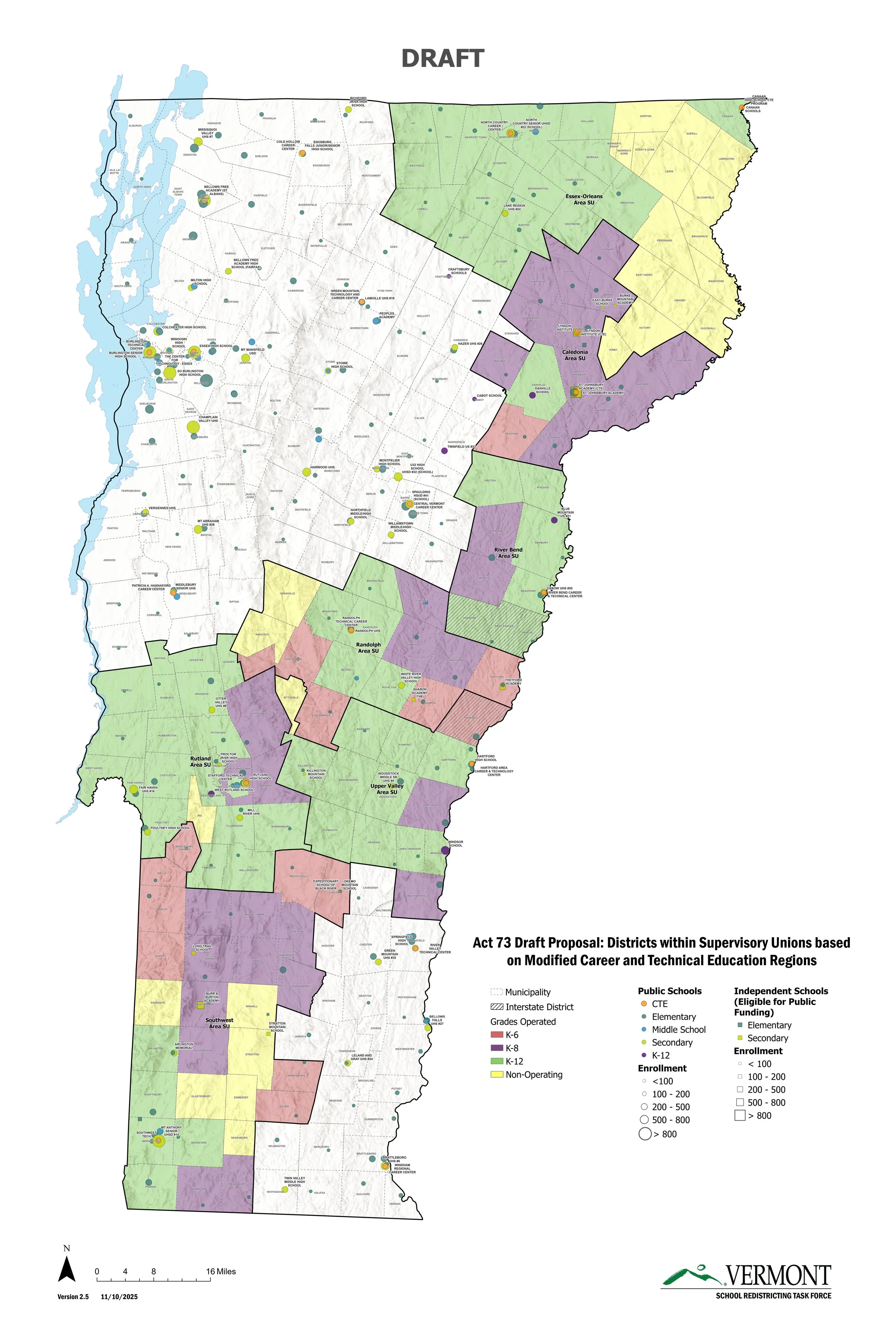
The map — now discontinued, at least as far as the task force is concerned — used career and technical education regions as an organizing principle.
That plan would create seven supervisory districts, concentrated in the northwest and southeast regions of the state, and seven supervisory unions with 21 school districts contained within them in southern Vermont and in the Northeast Kingdom.
The proposal would increase access to career and technical education opportunities, while “respecting historical patterns” in school choice, Beck said on Monday.
“The map is not perfect,” Wolk said. “I doubt any map that we came up with, given the timeline, would be perfect. The Legislature, understandably, will have their way, as they should.”
In her presentation, Saunders said theirs was the “only proposal that aligns with the intent of Act 73.”
But members of the task force raised a number of concerns, specifically around the size of the map’s proposed district in Chittenden County. Nearly 22,000 students would be consolidated into a single district there under the plan.
Several members questioned why much of the state was being asked to merge into single supervisory districts, while other areas retained the supervisory union structure.
“I’m trying to figure out the logic behind why some regions should do mass mergers, and some regions are going to be asked to do absolutely nothing, really,” Holcombe said.
Other members further criticized the proposal, arguing it preserved school choice in areas with prominent private schools, called independent schools in state law.
“I think the care taken to preserve tuitioning choice in some regions, and the lack of care taken in larger school districts … is really hard to stomach,” Graning said on Monday.
The majority of task force members voted against sending the proposal to the Legislature for consideration, with only Beck, Wolk and Rep. Beth Quimby, Caledonia-3, voting in favor.
Badams, in a strong rebuke, said he didn’t “want to hand the Legislature a map that gives that pathway after hearing what I heard today from the secretary.”
“If that ends up being used as the way to chop up the state and force the mergers,” he said, “I don’t want to personally vote to put that forward.”
With a final report due in December, the task force will meet for the last time on Nov. 20 to refine the report and its proposal before submitting it to the Legislature.
This story was originally published by VTDigger on November 11, 2025. It is republished with permission from VTDigger, which offers its reporting at no cost to local news organizations through its Community News Sharing Project. To support this work, visit vtdigger.org/donate.