
State redistricting panel hears Harwood community survey feedback
November 14, 2025 | By Lisa ScagliottiWhen the state panel charged with reconfiguring Vermont’s school districts met this week, Harwood’s school board chair was among the many people who offered public comments critical of the state’s plan.
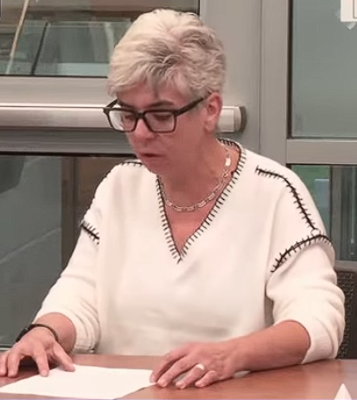
Harwood School Board Chair Ashley Woods comments at the state task force meeting on Nov. 10. Screenshot
Ashley Woods shared the conclusions of an October public opinion survey that the Harwood board conducted, asking the community about Act 73, the law passed earlier this year by the state legislature calling for sweeping changes to public school district configuration and governance.
The school board this week released a report with the survey findings based on 720 responses to questions about Act 73, which sets in motion a process to consolidate Vermont school districts from more than 100 to fewer than 20. Formed after the 2025 legislative session, the state School District Redistricting Task Force has been meeting for several months with the assignment to generate several proposed scenarios with fewer school districts statewide.
The task force meetings are public and recorded. Monday’s meeting was in Waterbury at the State Office Complex.
The conclusions from the Harwood community survey that Woods shared show that residents of the district share key concerns that the state task force is hearing from many corners of Vermont: skepticism that consolidation will curb education costs and school property taxes; questions about how to pay for badly needed school facility repairs; and worries that school closures will result in longer bus rides for students.
The main message the Harwood board heard through the survey “was the overwhelming interest our communities have in redistricting,” Woods said, noting that participation the recent survey was more than triple the number of responses the board received in 2024 regarding the school budget. The 720 participants represent about 6% of the school district’s population over the age of 16, she noted.
That interest reflects widespread worries about the impacts the state’s district consolidation might have, the survey found. “The main takeaway is that our people are deeply skeptical that consolidation will result in either improved education or significant cost savings. Many of our residents are worried about the future of our schools and, frankly, the survival of what makes our state and our schools unique,” Woods told the task force on Monday.
When asked what advantages consolidating school districts might bring, 49% of the survey respondents said they expected little or no cost savings while 35% indicated they saw potential for reducing costs.
“This indicates that the finances of creating large districts are very unclear,” Woods said.
The survey was structured with several open-ended questions that solicited respondents to write in some of their answers. Some questions offered multiple-choice answers. The result was a lengthy process by members of the school board’s Outreach Committee to read through the replies and organize them around particular issues and themes. For example, those opposed to consolidation voiced concern about the potential loss of community if schools are closed, and the loss of local input into the educational process.
“To many, it feels like our democratic system will vanish here in Vermont if we let go of local control of our schools,” Woods told the task force.
In the survey results report, the Outreach Committee explains its process in evaluating and tabulating the survey responses, noting that the group made use of several artificial intelligence platforms to help collate and categorize responses. “All answers were looked over by a human to identify main themes in the open-ended response questions,” the report noted. “To obtain statistics, the survey was uploaded by report authors to DeepSeek, ChatGPT, and Gemini.”
Some highlights from the survey:
58% of respondents were parents/caregivers of current students; 24% identified themselves as simply “community members”; 5% were teachers; 4.7% were students.
Waterbury and Moretown had the most responses, with nearly 33% and 18% respectively.
The majority of respondents said an ideal one-way school bus ride is 30 minutes or less.
In addition to longer bus rides and losing local control, other top risks/concerns of consolidation include snow-day issues, larger class sizes, loss of parent input, less individual attention for students and teachers losing jobs.
Those who saw benefits to consolidating school districts suggested that those might include reduced administration costs, greater variety in some course offerings, sports and activity opportunities, and some social benefits.
Woods suggested to the task force that state leaders need to do more to grow public support for the consolidation process. “If the legislature wants to get the people of Vermont on board, they are going to have to do more than just talk about that savings,” Woods said. “Our communities are asking decision-makers for clarity, transparency and fairness in funding decisions. They don’t just want to hear that it will work; they want to see that it will work.”
Harwood’s leaders suggested that the task force include the status quo as one of the school-district maps it proposes to reflect that “our citizens want to hear realistic solutions on the true cost drivers – particularly health care, unfunded mandates, and school upkeep – before we decide to make a drastic change.”
Woods’ comments to the task force included several other specific recommendations. “In the next legislative session, we need to see transparent cost tables for proposed facility work and long-term maintenance on our school buildings, as well as ideas for phased and cost-efficient approaches before those for large-scale spending,” Woods said.
Overall, the survey responses give the Harwood school leaders confidence that community members “care deeply about education in our district and are paying attention,” Woods said. “The range of their opinions highlighted the complexity of the issues we face.”
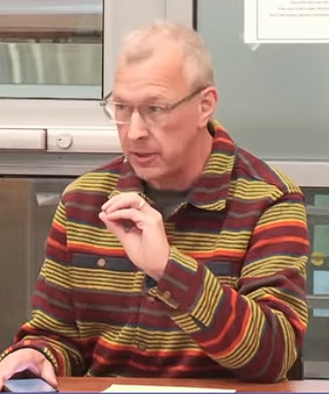
Harwood Superintendent Mike Leichliter addresses the state task force. Screenshot
In addition to Woods, Harwood Superintendent Mike Leichliter also commented briefly to the state task force on Monday. Leichliter read from his resignation letter in July when he stepped down from another state panel created in 2024 to study the future of public education in Vermont. Leichliter said he resigned from that role where he was the group’s representative for school superintendents because, “I felt we were going in more of a route of a political solution rather than good public policy.”
He then quoted from his resignation letter from the education future committee: “One thing is clear from my experience: Consolidating districts into arbitrary size ranges unsupported by research is not a silver bullet. Structural change without a deep understanding of local context, capital needs, unresolved cost drivers, and system complexity will not solve the challenges we face,” he said. He added that he appreciates the work that the task force has done so far. “I would encourage you to also send a message that we need a long and thoughtful approach before we arbitrarily consolidate school districts,” he said.
The state task force now is moving toward not producing reconfiguration maps for legislative review. It is instead voted 8-3 in favor of a plan advocating for school districts to voluntarily merge and devising incentives for such moves. Gov. Phil Scott on Nov. 14 admonished the task force for that decision saying the group failed its assignment outlined by Act. 73.
The state School District Redistricting Task Force meets next on Nov. 20.
The report on the school board’s survey results can be found here. See Ashley Woods’ full comments to the state task force in the Roundabout Opinion section here.