
November 12, 2026 | By Lisa Loomis and Lisa ScagliottiWAITSFIELD—About 150 people filled the gym at Waitsfield Elementary School Monday night to hear about plans for school consolidation, with many telling their school board members why the Waitsfield school should not be one of two Valley schools to close next fall.
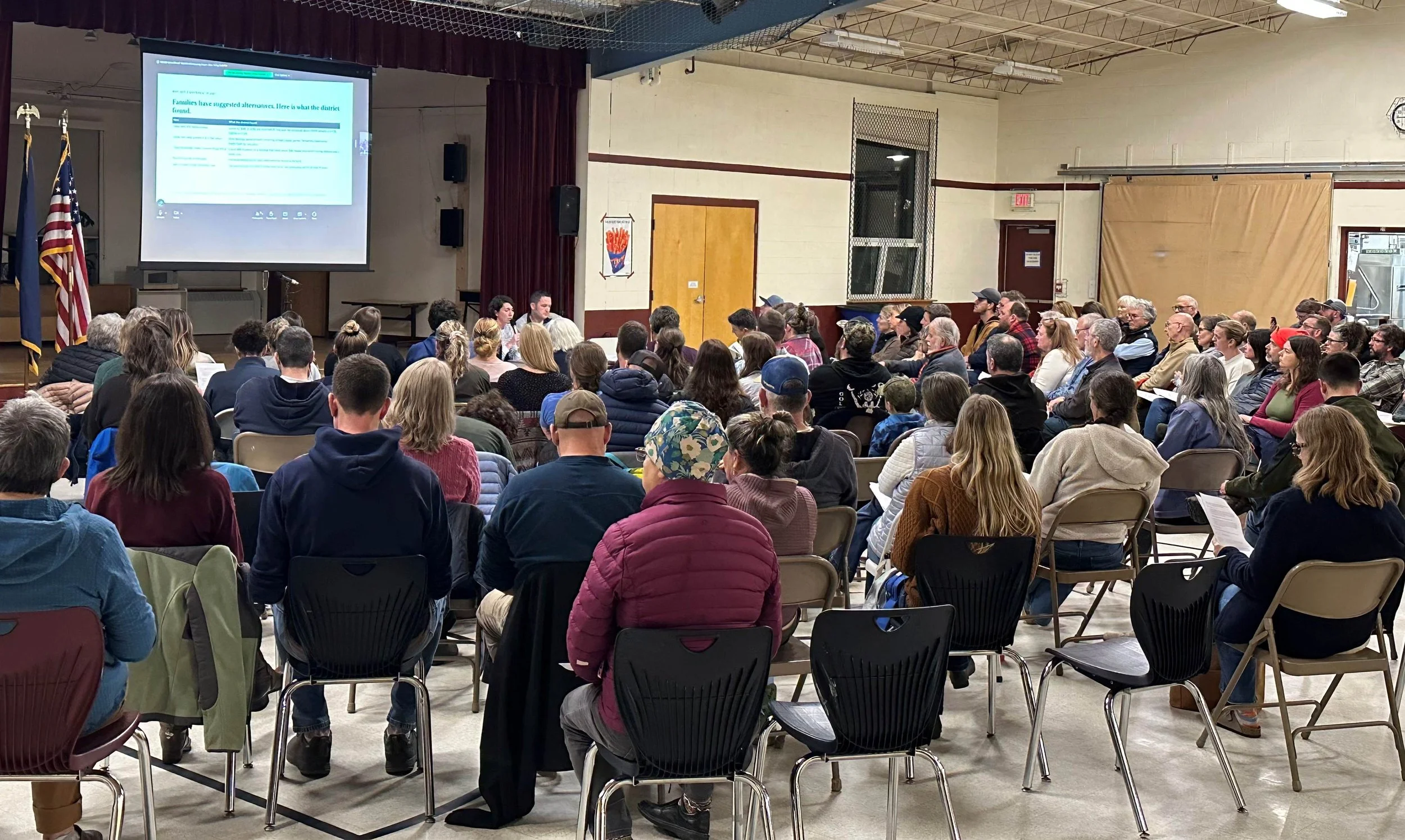
About 150 people attended Monday’s community meeting with Harwood School Board members at Waitsfield Elementary School. Photo by Lisa Scagliotti
Those reasons included the school’s access to public infrastructure including water and wastewater, its walkable village location out of the floodplain, potential for expansion, and its 3-year-old $1.1 million commercial kitchen.
The meeting was part of a series of community sessions organized by the Harwood Unified School District School Board’s Outreach Committee. It followed the full board’s Nov. 4 straw poll, in which 9 of 14 members voted in favor of closing Waitsfield and Fayston schools and keeping Moretown and Warren open next year. Board chair Ashley Woods did not vote.
Following the straw poll, Waitsfield’s board members called on the full board to reconsider the choice. They pointed to the exercise the board did to rank schools on a number of objective criteria that ranked the combination of Waitsfield and Warren schools remaining open highest. The Moretown and Warren combination that the board chose ranked second.
Lowering the threshold
Waitsfield school board representatives Alexina Cather and JB Weir opened by outlining the financial pressures behind the proposed changes, the timeline for a decision, and factors the board is weighing as it considers which schools to keep open. The district has already cut about $7 million and eliminated 53 full-time positions since fiscal year 2023-24.
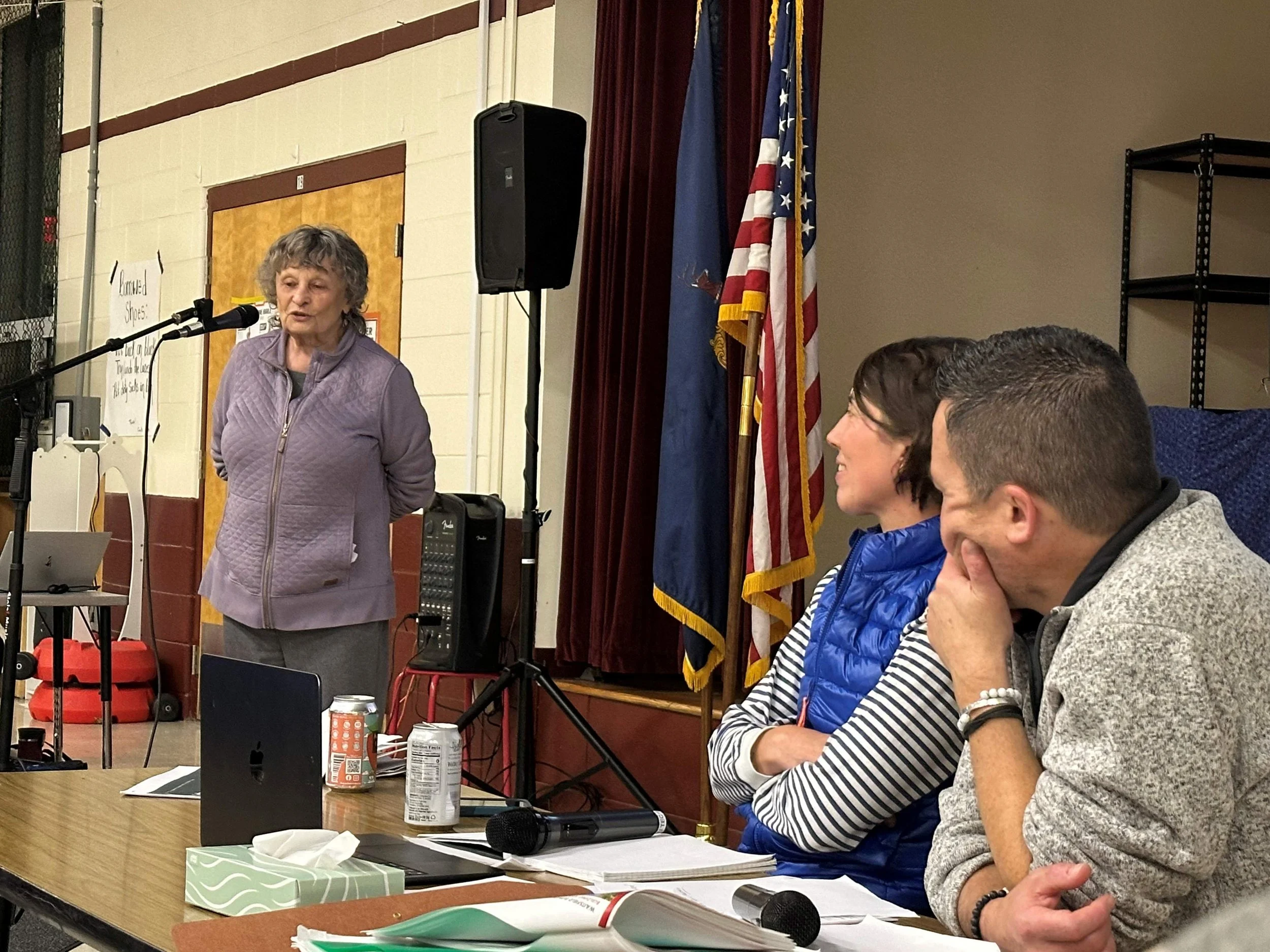
Waitsfield members of the Harwood School Board, Alexina Cather and JB Weir, listen as former school principal and teacher Carol Hosford comments. Photo by Lisa Scagliotti
The pressure for more cuts continues as state excess-spending thresholds enacted this year have lowered per-pupil spending caps. To operate similarly in 2027-28 as it is now, the school district would face an estimated $2.5 million state penalty, school officials have outlined.
Continuing to run seven schools under the tighter spending restrictions would force deep cuts to school programs and services, such as eliminating most busing and preschool classes, and greatly scaling back student support staff and athletics.
Instead, the board has directed the administration to move ahead with shrinking the district’s footprint.
Closing two elementary schools and moving all 5th and 6th graders to Crossett Brook and all 7th and 8th graders to Harwood would save $3.8 million and avoid a state penalty. These steps can be enacted for the 2027-28 school year without construction, according to administrators.
School-closing process
The process to close schools would involve only a school board vote, Weir explained. District policy requires at least three public hearings, including one in each town whose school is proposed for closure, at least 10 days’ notice before a board vote, and approval by a two-thirds majority of the board. Those steps would need to happen before the end of January, to give the board time to finalize a budget for a March 2 vote.
The board is weighing building conditions and capacity, enrollment data, transportation times, building wastewater capacity, emergency services, traffic, housing and economic impacts, among other factors. Not all of these factors were part of a previous school scorecard that board members completed in advance of its Nov. 4 meeting.
Cather said the district has not yet determined bus routes, pre-kindergarten locations, teacher assignments or the programs that would be offered at the remaining schools.
The million-dollar kitchen
After their introduction, audience members took turns commenting for about 90 minutes.
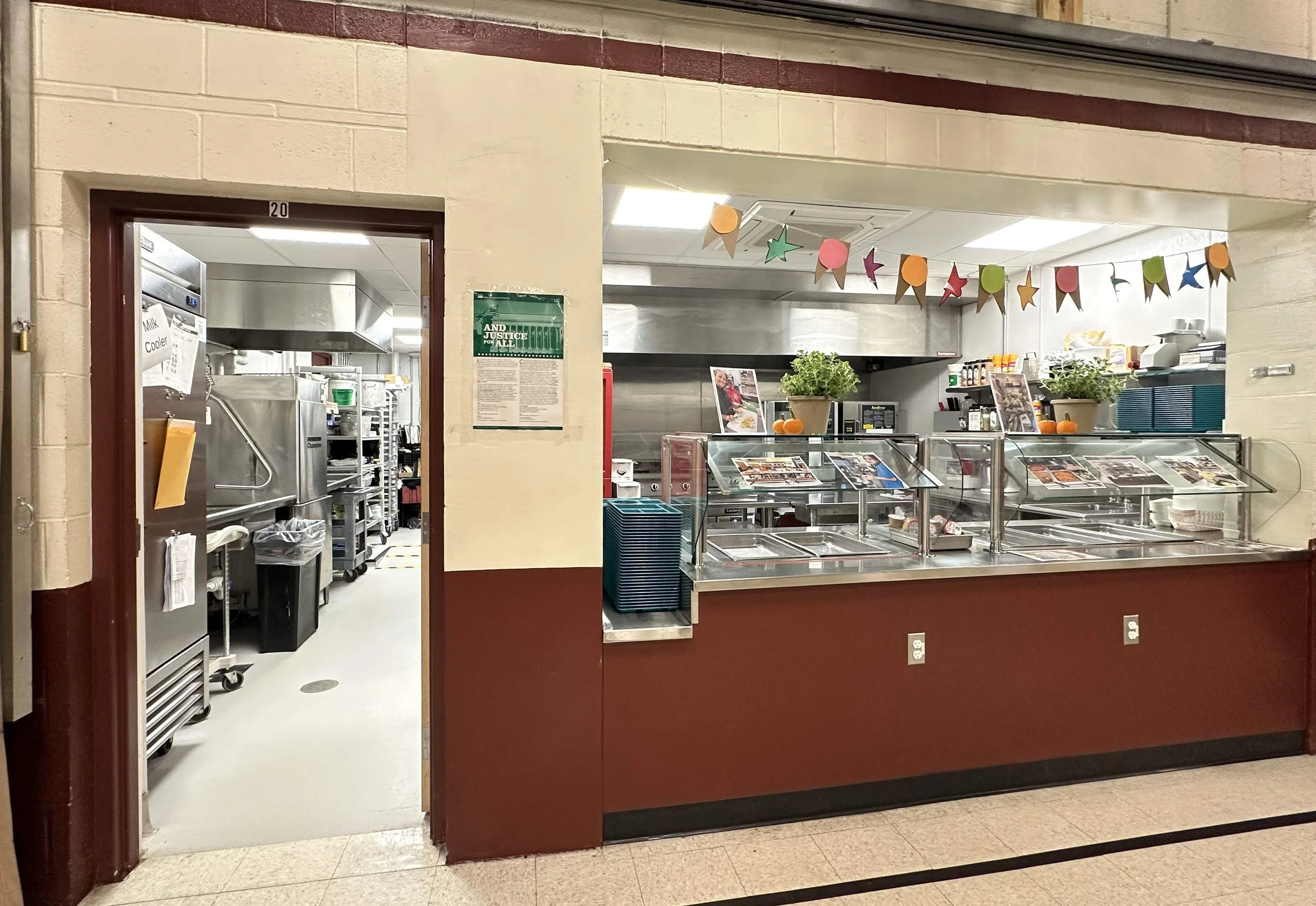
Long-postponed upgrades to Waitsfield Elementary School’s kitchen were completed in 2023 at a cost of close to $1.2 million. The kitchen staff now prepare meals on-site for school students and staff. Photo by Lisa Scagliotti
Cheryl Joslin, a Warren resident and longtime Fayston/Waitsfield kitchen manager, urged the board to consider the value of Waitsfield Elementary’s commercial kitchen before making a decision.
“That’s essentially my $1.2 million kitchen over there,” she said, pointing to the school’s kitchen at one end of the gym.
It was upgraded to eliminate transporting meals from Fayston, which affected food temperature, freshness and quality. With trained kitchen staff preparing meals on site, she said, students have access to fresher food that they can see being prepared.
“The kitchen is the heart of the school,” Joslin said.
She also pointed out that the Moretown school relies on transporting meals from Harwood, which may not be practical if attendance there were to increase. A similar kitchen upgrade in Moretown would likely be costly in terms of equipment, the supporting electrical, ventilation and other infrastructure, she said.
Cather added that Waitsfield has an 80% student participation rate in school meals, describing access to nutritious food as an equity issue for children who may depend on school meals.
‘We agreed to save education’
Waitsfield resident Beth Cook urged the board to follow a transparent, consistent process in evaluating which schools to keep open and which to close and the district also should clearly explain how objective data and community input factor into the decision. “We may not all agree on the outcome, but we should all be able to trust the process that gets us there,” Cook said.
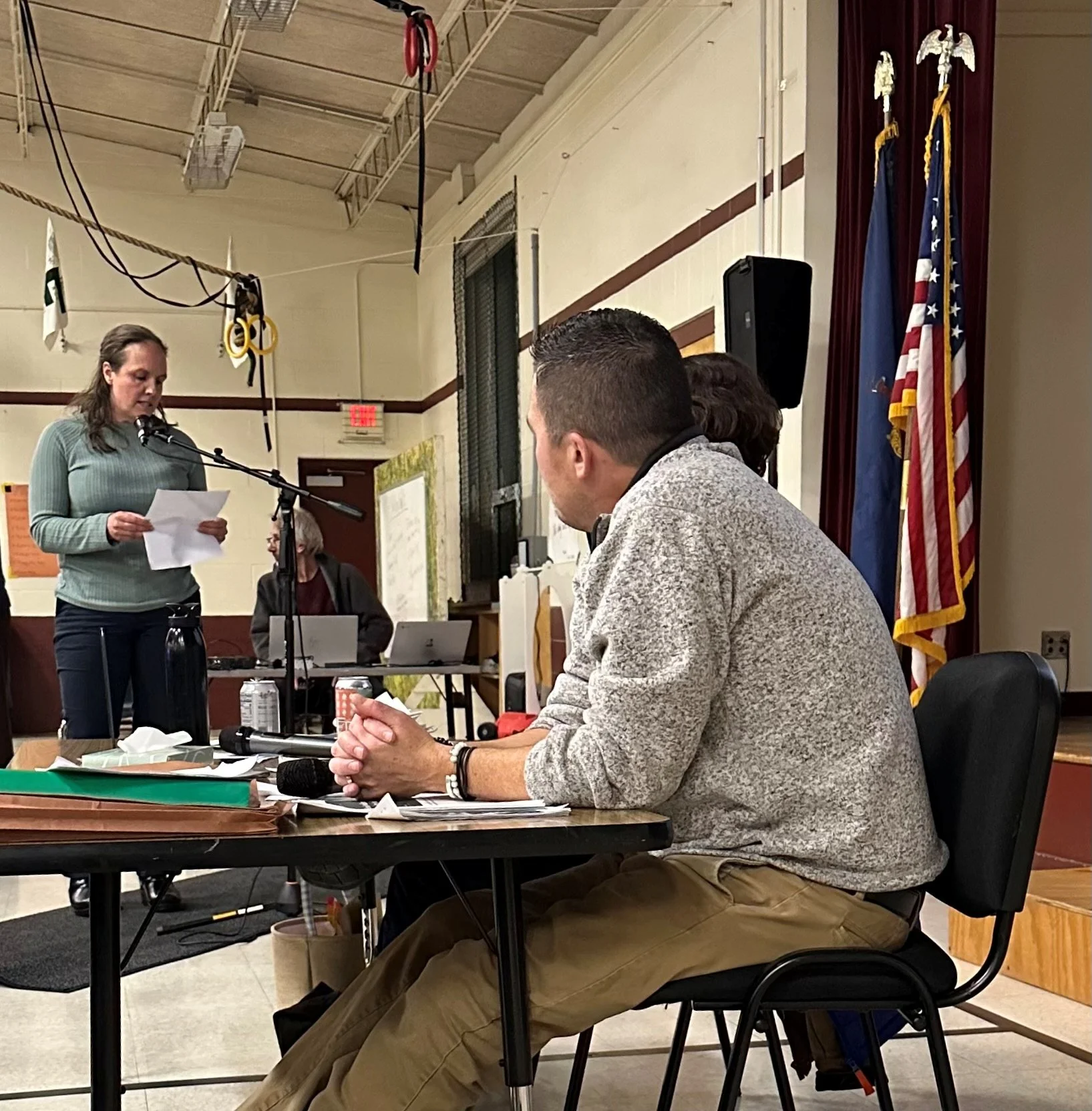
Beth Cook reads from prepared comments. Photo by Lisa Scagliotti
Emma Hanson asked the board to consider closing just one of the valley’s four elementary schools rather than two and asked if the board could present a budget with a significantly smaller state penalty to voters.
Weir replied that the board does not want to risk a budget failing at Town Meeting because that would lead to a second version with draconian cuts.
Cather agreed. “We agreed to save education, not just a particular building. We all have our attachment to our school, but I think what we all need to be more committed to is saving the education for every kid in this district,” she said.
The board also is mindful to not ask taxpayers to pay more than necessary, so considering a budget that would include a state penalty is a non-starter, Cather said.
“I or some of you might feel comfortable paying more taxes for education; not everybody in this town is in a position to do so. We have a lot of people who are living on a fixed income, a lot of people already having to make tough decisions about whether or not to eat or pay their rent or pay their mortgage. And so these are really, really important factors that we’re also sitting with—not just which school to close.”
Waitsfield Principal Kaiya Korb addressed the notion of just closing one school next year, saying that would mean disrupting students and their school communities twice, when a second school closes later. She strongly advocated for closing two schools now.
Resident Nathaniel Vandal asked the board why a hybrid option of some programmatic cuts and one school closure was not an option.
“I’m pretty disappointed by this process. I feel like the scenarios presented to the board have not been very well scoped out or balanced,” he said. “It’s baffling to me that we have option A – which is all cuts – and option B – which is cut two schools and send an entire population halfway across the district – and we don't have some kind of hybrid option that’s close one school and save some money to make it work.” He also articulated the overarching challenge.
“It feels like it’s now Waitsfield against Moretown in a popularity contest of which squeaky wheel gets the proverbial grease, and you know to me that’s a really ugly situation,” he said.
Vandal said Waitsfield community members should stress the positive reasons to keep their school open. “I think that’s location, location, location,” he said. “We’re the only community with a grocery store. We’ve got athletic fields that kids go to for after-school sports.”
Larissa Ursprung, vice chair of the Waitsfield Select Board, agreed. “I just wanted to talk about something really cool, which is wastewater,” she said, referring to the impending addition of a public wastewater system that is a “huge pivotal point of inflection for this town.”
Ursprung asked whether the school board is accounting for the future public wastewater connection for Waitsfield’s school and that it’s already on the public water system. She also asked if the district is considering future maintenance of septic systems at other schools that might remain open.
Weir replied that the school board’s calculations did not factor in Waitsfield’s municipal wastewater project, which is funded in part by a grant to connect the school to the system. He asked the administration to clarify that point.
Future flood risk
Parent, coach and physical therapist Carter Peck said advantages of the Waitsfield school, in addition to its new kitchen, are its sturdy construction and accessibility.
Peck also brought up the multiple floods at the Moretown school in the past 15 years, which suggest it remains vulnerable to another major storm despite improvements to nearby culverts. He said he’s not reassured by claims that the school is in a 500-year floodplain.
“The biggest, most telling piece of the flooding issue for me is when I drive up and down 100B every day. I see that one house that's been lifted 10 feet in the air on a concrete foundation because the flood risk was such that that was what the homeowner decided to do. That is all I need to know to say, do we need to send our kids to this school?” he said. “If there weren’t another option, so be it. But there is another option, and that option does not entail that degree of flood risk.”
Waitsfield resident Rebecca Diehl, a fluvial geomorphologist by profession, commented about flooding, climate change and Moretown Elementary School.
“Most of the impacts that the school has been feeling are not from the Mad River. They’re from the tributaries draining the landscape around the school itself,” she said. “It’s not really well-documented.”
As a result, “we don’t actually have a good grasp on what the flood risk is for the Moretown School, and that is something that’s just going to increase,” she said.
Kicking the can
Waitsfield resident Laura Caffry criticized previous school boards for having “kicked the can down the road” on school consolidation and downsizing. This process today may seem rushed, but Caffry said she was reminded that it’s been a decade coming, as she recently has been burning old newspapers from 2017 and 2018 in her woodstove.
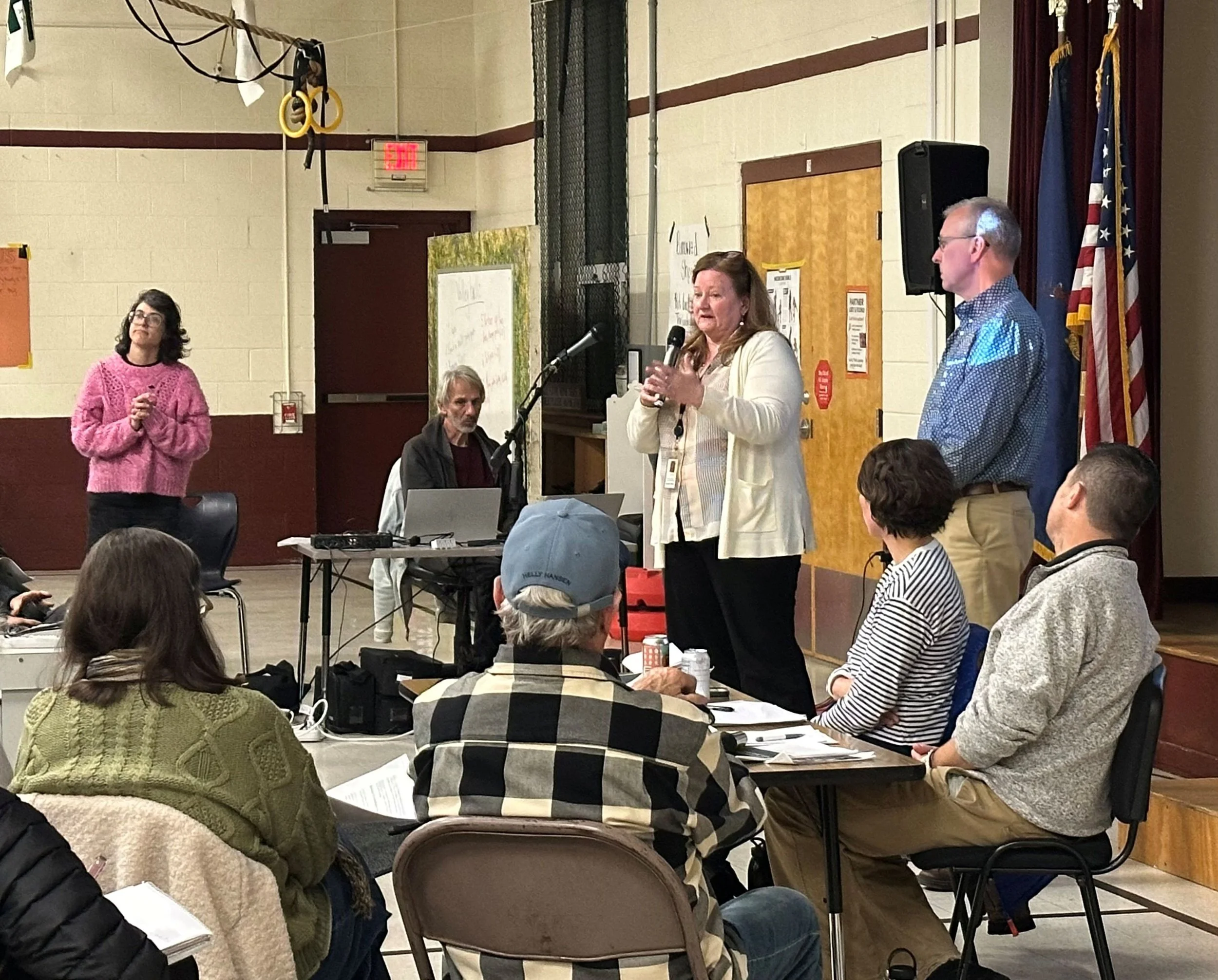
Harwood Finance Director Lisa Estler (standing center) answers a question. Standing behind her is Superintendent Mike Leichliter. Photo by Lisa Scagliotti
“There are all these articles about consolidating the schools. If we had closed even one elementary school then, and we had room to do it, we would have saved millions and millions and millions of dollars,” she said. “It would have helped our taxpayers. Our taxes are too high for what our kids are getting.”
Caffry, who works at Waitsfield Elementary, said she supports consolidating now because kids are resilient, they would manage longer bus rides, and they would thrive in larger peer groups.
Asked about property tax impacts of various closure scenarios, HUUSD Finance Director Lisa Estler said it is too early to estimate because key figures in that calculation are not yet available from the state. However, Superintendent Mike Leichliter cautioned that Vermonters in general should anticipate school-tax increases in 2027 due to one-time funding the legislature has used to pay for education that is not expected to be available next year.
One state legislator, Rep. Dara Torre, D-Moretown, was in attendance and spoke briefly. She praised the community for working through a difficult process and lamented the situation school districts are in to dramatically curb spending before next school year. Looking ahead to when the legislative session opens in January, Torre said she expects discussions such as the ones happening in the Harwood district will have lawmakers’ attention. “I don’t think it’s impossible that we’re not going to all reconvene in January with a lot of more insight about where we may have gone wrong and what we can do to actually make this process really work for our kids,” she said.
As the conversation neared its close, parent Emma Hansen asked about the prospect of the district ultimately creating a single Valley elementary school. The district has begun to explore that idea now that the Cabot Creamery headquarters in Waitsfield is for sale.
Weir cautioned that such a move will take years to come to fruition at best. “What we’ve come up with as a board is like five years minimum, probably,” he said, adding that he supports a single Valley elementary school. “We need to build a sustainable bridge to a school solution that will last five, 10, 15 [years], and who knows? Maybe the time will come when we realize we can’t pass that $70 million bond.”
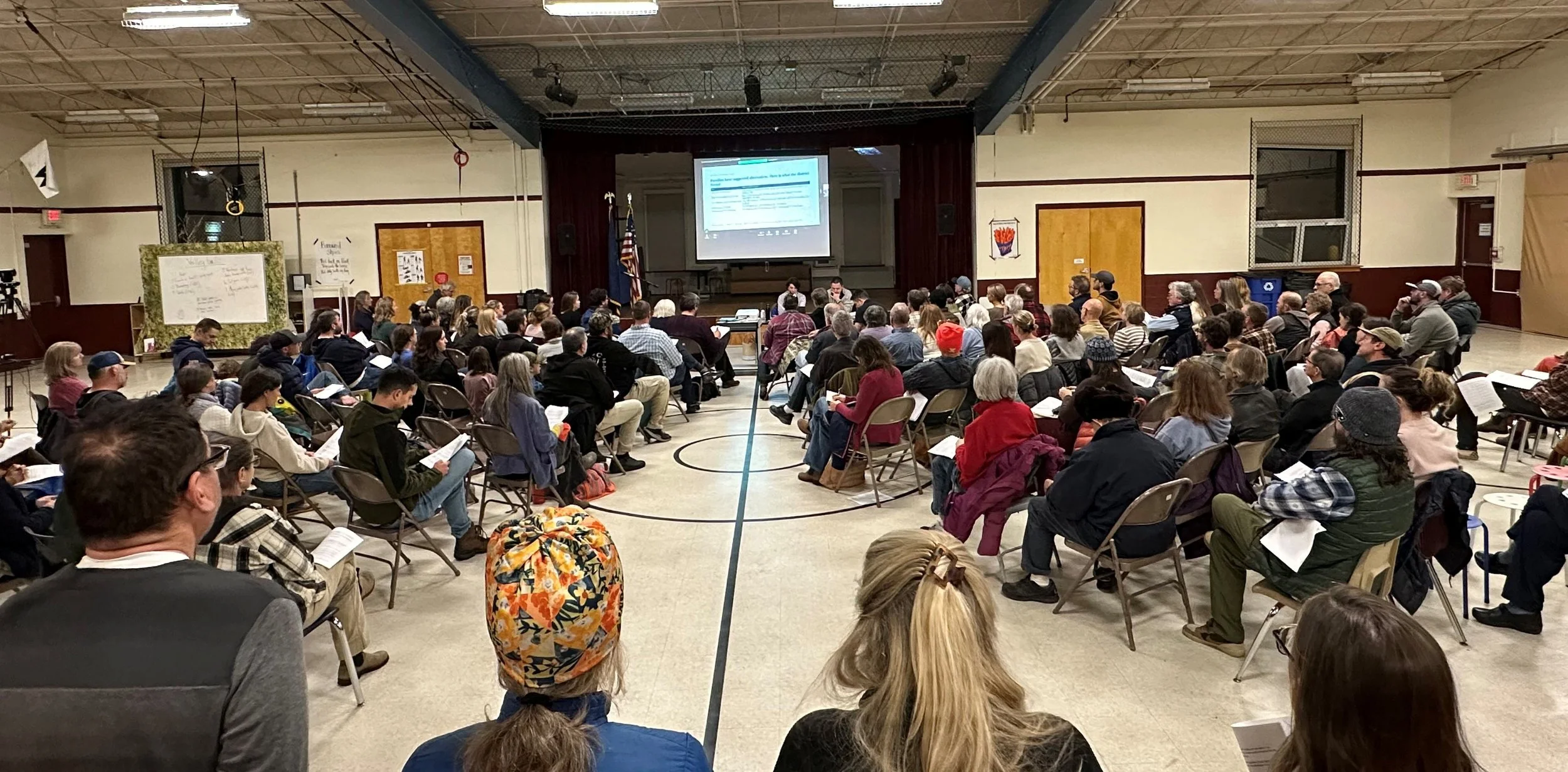
Photo by Lisa Scagliotti
Thanking school leaders
While the listening sessions have been organized by the board’s Outreach Committee, 10 of the School Board’s 14 members attended Monday’s meeting in Waitsfield. Similarly, board Chair Woods and others attended the previous community meetings in Moretown and Fayston. Aside from the Waitsfield board members facilitating the meeting, the other board members did not address the audience on Monday, instead listening and talking with audience members informally before and after the meeting.
But many of the attendees who went up to the microphone to comment at the meeting began by acknowledging the board members in the room, thanking them for their work and offering encouragement and empathy for the thorny task at hand.
“I’m sure none of you signed up for closing schools. It’s been tireless effort. You've had millions of emails, phone calls about this, and it’s really a challenging time,” said parent Carter Peck. He mentioned board members from Fayston, in particular, “who had to make a tough choice to choose two different schools [to keep open] even though it potentially will take a school out of their local community.”
Waitsfield teacher Tommy Young, who lives in Duxbury, said he and his colleagues are pleased to see a positive tone in the public discussion among board members who disagree, and that the board is putting in extra time to hear from community members. “It’s a very ungrateful job at times, and I really appreciate that so many of you are here tonight in a town that’s not necessarily your town, but it shows you care about the entire district,” he said.
Waitsfield resident Becca Newhall praised the audience members as well. “I’m really proud of this community for the way we’ve shown up tonight and everybody—I don’t care what town you’re from—having a discourse that was respectful of each other.”
Next up: Crossett Brook tonight; Warren Monday
The Harwood School Board’s Outreach Committee will hold its next community meeting at 6 p.m. tonight, Nov. 12, at Crossett Brook Middle School. For those who cannot attend in person, find YouTube and Zoom links here to watch livestreams or a recording.
Under the current School Board plan, neither Crossett Brook in Duxbury nor Brookside Primary School in Waterbury are being considered for closure in 2027. Crossett Brook students in grades 7-8 next year would instead go to Harwood Middle School to free up room for Valley students in grades 5-6 to attend Crossett Brook.
Brookside Primary has been suggested for future closure, but that would require multiple steps, including construction at Crossett Brook. That scenario is part of a longer-term district reconfiguration discussion that is in a very early stage.
The final community listening session is scheduled at Warren Elementary School on Monday, Nov. 16, at 6 p.m. In both top school-closure scenarios that the School Board is considering, Warren Elementary would be one of two Valley schools to remain open next year.
The full school board’s regular meeting is next Wednesday, Nov. 18, at 6 p.m. The board is expected to vote on which schools to hold formal public hearings on in anticipation of closure in 2027.
Watch a recording of Monday’s meeting in Waitsfield on the school district’s YouTube channel here.
Lisa Loomis is the editor of The Valley Reporter newspaper.