Naturalist Ethan Tapper speaks for the forests at land trust meeting
May 10, 2025 | By Kenrick Fischer | Correspondent 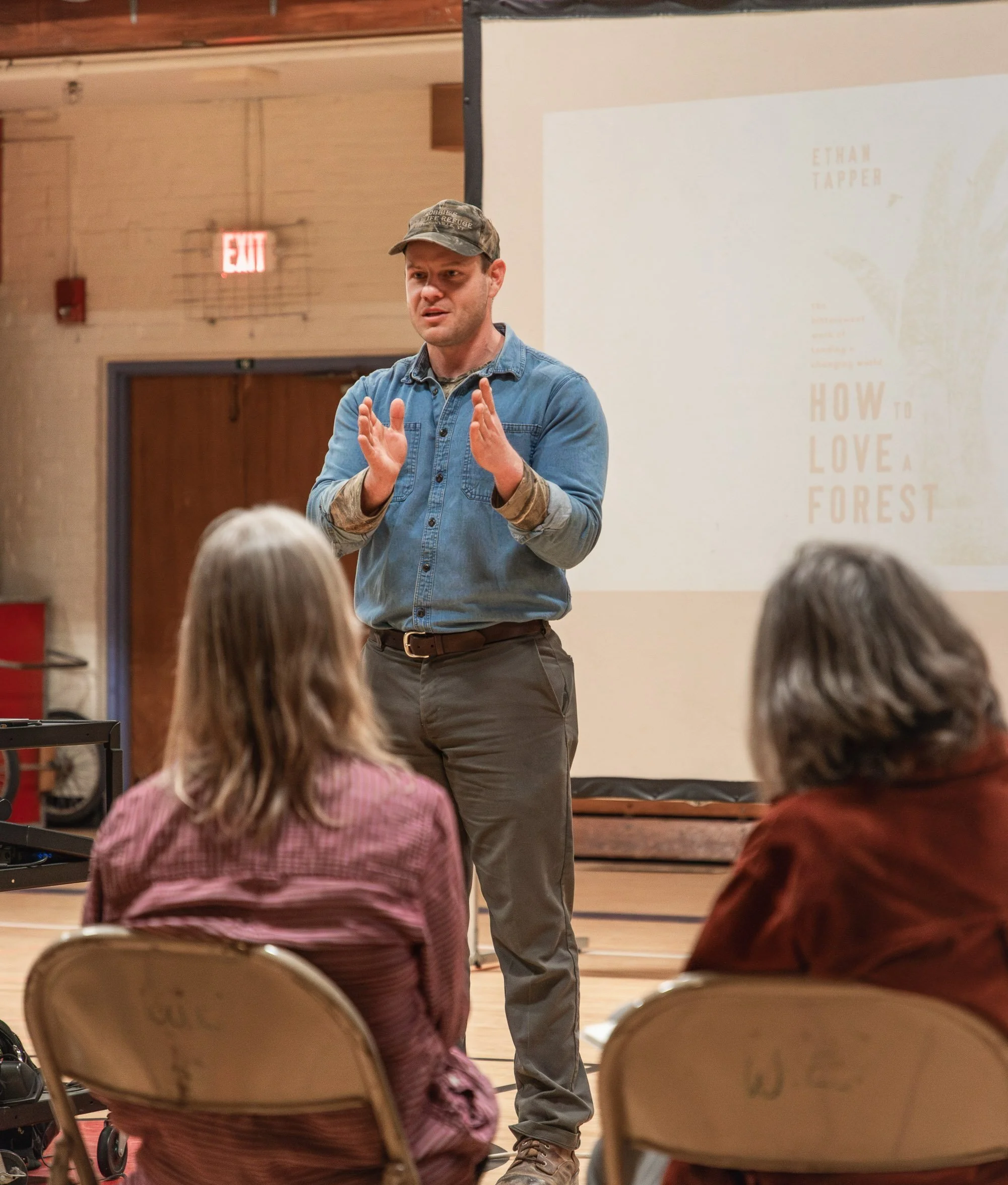
Forester and author Ethan Tapper speaks at the Duxbury Land Trust annual meeting at Brookside Primary School. Photo by Kenrick Fisher
On a recent Tuesday evening, about 60 people gathered in the gym at Brookside Primary School to listen to Ethan Tapper, a forester and author of “How to Love a Forest: The Bittersweet Work of Tending a Changing World.”
It was no coincidence that it was Earth Day and that Tapper started the day delivering the devotional address at the Vermont House of Representatives that morning.
Tapper was later the featured speaker in Waterbury at the annual meeting of the Duxbury Land Trust. When the formal meeting business was complete, the lights were dimmed for Tapper’s presentation.
He began with an overview of his background, covering his education at the University of Vermont and time as the Chittenden County Forester. Soon he moved to a discussion around three distinct forest variations that are commonly considered ‘old growth” defining them as Primary, Old, and Late Succession. Here he strove to dispel what is commonly thought of as “old growth” compared with what that really looks like.
“Old growth is defined by its irregularity and diversity,” Tapper said, and it’s “equally defined by the deadwood on the forest floor. It is common for deadwood to contain four times the biomass of a living tree, made up of fungi and insects.” These decomposing habitats are also a perfect home for salamanders. In fact, he pointed out that a healthy forest is home to thousands of living things!
An interesting point he drove home: Forests need to experience disturbances to thrive. Essentially, trees need to die to create the variety a healthy forest needs to flourish.
Tapper spoke about the Pisgah Forest in Western North Carolina, an area that was all but destroyed by a hurricane and displays none of the characteristics of an old-growth forest, but in his eyes, continues to be one.
Ethan Tapper’s 2024 book.
Tapper then discussed the history of landscapes, where he painted a picture much different from what we know today. Before non-indigenous peoples arrived to the land, beavers, or “The Beave” as he referred to the creatures, were once plentiful and an integral part of Vermont’s waterways.
However, due to large-scale trapping to send their pelts back to Europe, they were mostly wiped out. The passenger pigeon was another species that once was plentiful in Vermont, flocking in numbers so great they would have been the equivalent of a living storm, causing great disturbances to the forests of their day.
Likewise, the American beech tree was estimated to be about 60% of Vermont’s native forests at one time. However, by the early 1800s, Tapper explained that much of Vermont’s land had been cleared for the forest's resources and merino sheep pastures. But by the early 1900s, he continued, that began to reverse.
Most of Vermont’s forests today date back only to the 1960s. Since then, beavers have been reintroduced along with white-tailed deer and turkeys. Fishers were reintroduced to help manage the porcupine population. Coyotes and opossums were brought in the 1940s, and those lovely red cardinals arrived in the 1970s, Tapper listed.
“It’s a miracle that Vermont’s forests have recovered from the fields and pastures of just 100 years ago, but they are not what they once were,” he said.
Towards the end of his presentation, the discussion focused on what makes a forest a forest.
Tapper’s insights take in the natural community of the land – not only the trees that we typically think of as a forest, but also the wetlands and wildlife that exist there. All of these species live in natural harmony and within an ecological cycle, he said. And it was at this part of the discussion that Tapper explained that modern forests are missing a key component: the biodiversity of genetic makeup.
And while the notion of climate change and its impact on the environment is prevalent today, Tapper said he prefers the concept of “global change” – a larger idea that encompasses the climate and other forces at play. Some examples he offered included mitigating non-natural invasive species, managing overpopulation of animals that exist without natural predators, and deforestation to serve the growing demands of humans.

Ethan Tapper signs a copy of his children’s book at the recent Duxbury Land Trust meeting. Photo by Kenrick Fischer
As he concluded, Tapper turned to the theme of his book and asked, “What does it mean to love a forest?” His answer: To hold an appreciation and protection for old-growth forests’ natural diversity because, in doing so, they can once again discover their true capacity for life.
Tapper shared that he has moved on from his county forester role. He’s active, managing his own forest in Bolton where he lives, consulting for other forest landowners through his Bear Island consulting business, producing naturalist-focused videos for social media and public speaking.
In addition to his “How to Love a Forest” title, he released a children’s book earlier this year called, “Willow and the Storm,” in which the concept of forest regeneration and ecology is seen through a child’s eyes. And you may also catch him around the region playing in his punk band, The Bubs. Find more and follow his writing and projects on his website.
Land trust business
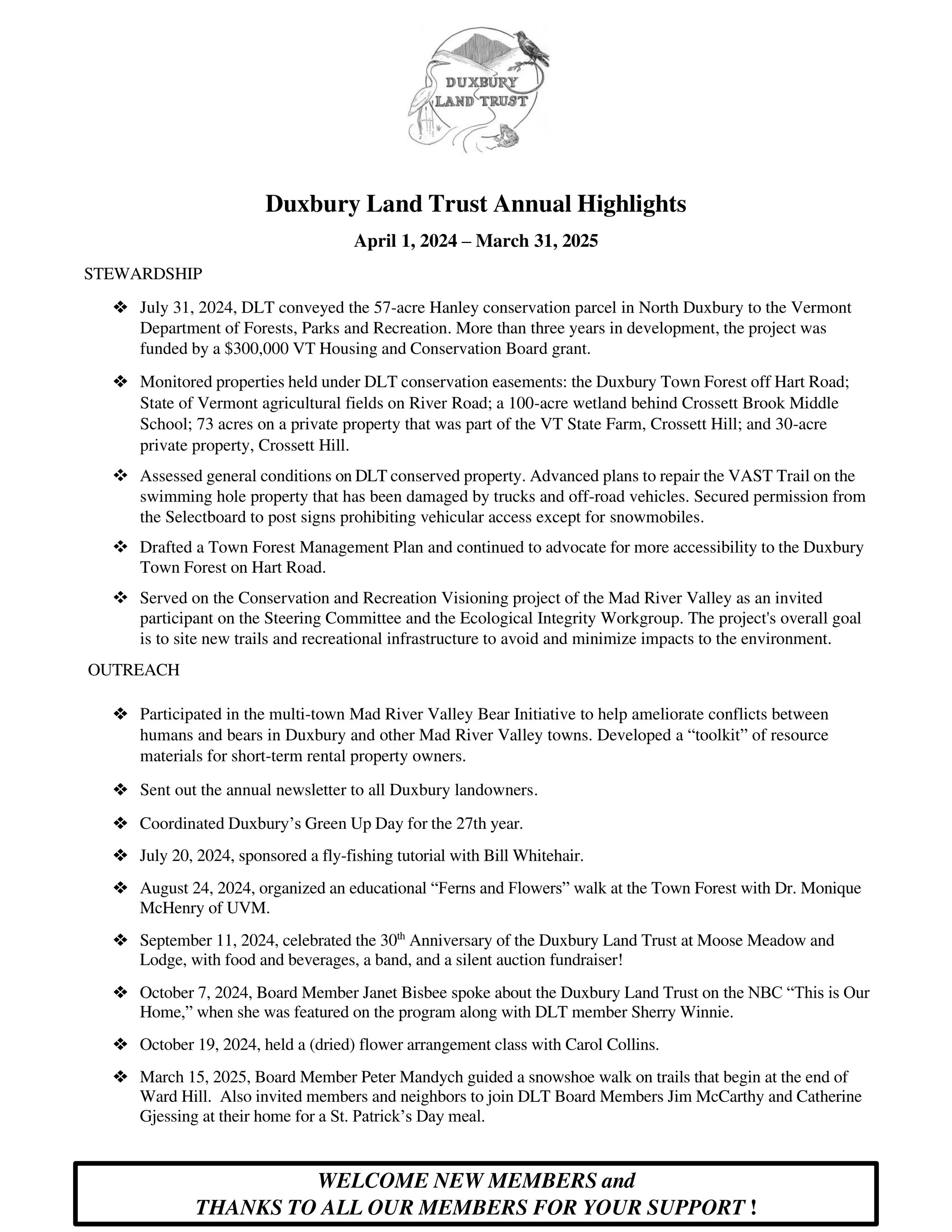
Prior to Tapper’s talk, Duxbury Land Trust held a brief business meeting of the membership in which board Chair Catherine Gjessing reported on the organization’s programs during the past year, which marked its 30th anniversary. (see the details below)
Educational and recreational programs during the year connected members and the public with several of the land trust’s conserved properties – to date the organization has conserved over 550 acres in Duxbury, according to Secretary Janet Bisbee. Its programs “aim to provide education around the unique environment in which we live,” she said.
The board also voted to add two new trustees, Halie Cousineau and Rose Wilson of North Duxbury. Learn more online at duxburylandtrust.org.
Duxbury Land Trust highlights from the past year