
Board seeks more community input on Stanley-Wasson housing
February 3, 2026 | By Lisa Scagliotti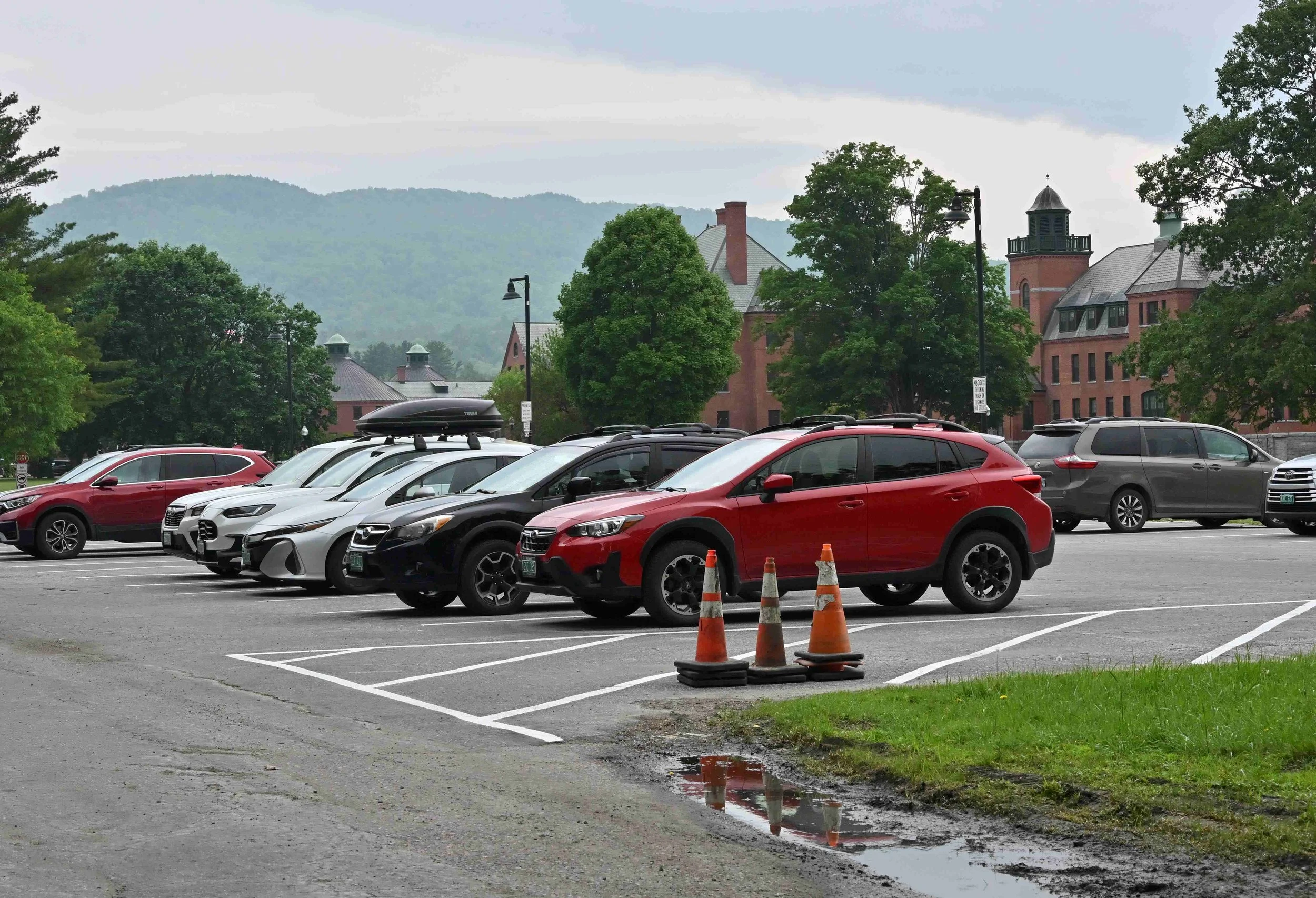
The former site of Stanley-Wasson Halls at the State Office Complex is now a vacant lot, used last summer for commuter parking during reconstruction of the Stowe Street bridge and closure of the Lincoln Street Park and Ride lot. Photo by Gordon Miller
The Waterbury Select Board would like more community input before moving forward to work with a developer on plans for a 90-unit downtown housing project on the site of two former state government buildings.
That was the board decision at its Monday meeting when it took up the topic to review progress on a draft agreement to work with a developer.
“I think there are a number of members of the community that have viewpoints on this, and I think it's incumbent upon us to get those viewpoints out and make a decision as to whether we want to move forward with this exclusivity proposal,” said board member Roger Clapp.
After some discussion about timing, the board agreed that it would like to hear from the public on the topic before Town Meeting Day which is March 3. They scheduled a special meeting for next Wednesday, Feb. 11, at 7 p.m. The meeting will be held at the Main Street fire station.
The decision was unanimous among the board members with the exception of member Mike Bard, who was absent Monday night.
The decision to reopen the community discussion comes as the board has yet to commit to working with DEW Construction from Williston. The company was the only developer to submit a proposal in September when the town put out a call seeking firms interested in coming up with a plan to build housing on what’s referred to as the Stanley-Wasson property.
For the past several months, Town Manager Tom Leitz said he had been working with the town attorney and representatives from DEW to draft an agreement for the select board to review, promising DEW the exclusive first opportunity to put together a development plan for the property.
Leitz, who stepped down from his position as municipal manager on Monday, said on Friday that the agreement was not yet ready to present to the select board.

Demolition of Stanley and Wasson Halls at the State Office Complex takes place in April 2021. Photo by Gordon Miller
History
The approximately 2-acre Stanley-Wasson parcel is part of the State Office Complex situated near the intersection of Randall Street and Park Row. The paved site is now vacant and has been used for parking. It previously was the location of two three-story brick buildings, originally built in 1901 and 1948 as dormitories for the Vermont State Hospital, and that later housed state government offices, including the headquarters for the Vermont state college system.
The buildings were damaged by flooding from Tropical Storm Irene and afterward, the state decided to no longer use them. Waterbury officials briefly considered them a possible site for new municipal offices post-Irene when the flood-damaged town offices on South Main Street needed to be replaced. Voters rejected a bond for that project, and ultimately the new municipal complex was built at 28 North Main Street, adding onto what was the former Waterbury Public Library at the Dr. Henry Janes House.
In 2023, the state of Vermont agreed it would be willing to sell the property to the town of Waterbury for $400,000 for the town to pursue a developer to construct housing on the site. That sale has not yet taken place. Town officials have said the land cost would be included in whatever development arrangement it settles on with a private company.
In August 2025, the town received a preliminary environmental review of the property that found no substantial issues of contamination on the site. That was followed by a formal call for developers to express interest in preparing housing project ideas for the land. The only firm to respond was DEW Construction, a regional construction contractor with offices in Maine, New Hampshire and Williston, Vermont.
In the Sept. 26 submission, DEW Chairman Donald Wells writes: “DEW is committed to collaborating with the Town of Waterbury, our development team, and our construction manager to deliver a project that meets or exceeds the objectives and goals outlined by the town in the [request for qualifications]. We anticipate a 3-phased project with market rate, workforce, and affordable housing components. We have included multiple possible site concepts for stakeholders’ considerations.”
Those concepts, however, have not been shared publicly.
A proposal with few details
At a public meeting last fall, Leitz described DEW’s idea as an apartment complex with approximately 90 units. The company’s submission is posted on the town website with conceptual details redacted. Leitz at the time said he could not share any more information as the details might put DEW at a premature competitive disadvantage for the project contract. A section of the project proposal is left blank and stamped “confidential/proprietary information.”
Page 11 of the DEW Construction submission to Waterbury.
Wells’ letter also asked the town for the exclusivity agreement: “We request a Project-Specific Research Period during which DEW will have exclusive rights to conduct feasibility studies, market analyses, site due diligence, assess permitting requirements, and develop project plans. Our goal is to deliver a project that meets the community’s needs for multiple types of housing for The Town of Waterbury community.”
The rest of the DEW proposal contains background information about DEW itself – its staff and details about numerous housing projects it has worked on around Vermont, including developments in Burlington, Barre, Montpelier, Shelburne, Bellows Falls, Winooski, Woodstock and White River Junction.
It also outlines the partner firms it would like to work with for the Waterbury project: Wiemann-Lamphere Architects in South Burlington, Waterbury civil engineering firm Grenier Engineering, Hardy Structural Engineering in Colchester, and DEW Construction as the construction manager.
In a narrative section, it contains a few more general details: “Our goal is to ensure the development integrates seamlessly with its surroundings and leaves a lasting, positive impact. To foster a sense of connection and accessibility, DEW will link all new sidewalks and walking paths to the existing sidewalk network. Additionally, we will create a public park to provide outdoor gathering spaces that encourage community interaction and enjoyment.”
Community pushback
Vermont’s housing crunch is a top issue being debated from the Statehouse in Montpelier to town halls and online forums. Since the COVID-19 pandemic, the need has become particularly evident with widespread public interest combined with government investment into housing initiatives around the state.
Waterbury’s elected and appointed leaders have taken steps toward sparking more development, including updating zoning bylaws to ease regulations for housing projects, selling a former municipally owned property for a 26-unit affordable housing project now under construction, and creating a housing task force to work on new initiatives.
Yet for the Stanley-Wasson location, the goal of creating more housing has been met with community opposition, in large part based on worries over future flooding and the impact a large development there might have on the surrounding neighborhood.
The Stanley-Wasson site is in the flood zone and has been flooded multiple times during the floods Waterbury has experienced in 2023 and 2024. Those floods seriously impacted the adjacent Randall Street neighborhood and properties along South Main Street.
Residents and property owners near the potential building site have strongly objected to the select board’s choice of the site for a large-scale housing development, raising questions of how it might change future flood patterns.
In response, town officials in multiple instances have said they expect any development proposal to take into account the likelihood of future flooding to offer a design that would both withstand flood damage and not exacerbate impacts on the neighborhood.
Some residents have begun to enumerate and share their concerns under the title of the Stanley Wasson Community Alliance that launched a website last fall.
“A few of us came together to create the Stanley Wasson Community Alliance – to ask some really important questions about how we build, plan, and care for one another in this place we all call home,” writes Carrie MacMillan, a founding member of the group and an adjacent property owner to the Stanley-Wasson parcel.
“Waterbury has always been resilient. We’ve weathered floods, rebuilt neighborhoods, and stood together when it mattered most,” she writes. “The goal of this space is to keep that spirit alive – to talk openly, listen with respect, and make sure every voice has a place at the table. This land, like our town, holds layers of history and meaning. It deserves careful stewardship, not rushed decisions. And so do the people who live here.”
Elizabeth Brown, a former Harwood school board member and 2024 state legislative candidate, penned a commentary posted on the site that poses multiple questions about assessing the impacts of new housing development, the pace at which it comes together, and how it fits in with the town’s vision for the future as laid out in town plans past and presently under revision.
“I hear a lot of passion about our town chipping in to solve the state housing crisis. However, let’s ask the right questions first before it is too late,” Brown writes. “Let’s not be short-sighted in our long-term ambitions, pace accordingly and thoughtfully, with the appropriate analytical rigor, and truly capture ‘all costs,’ including those that are not financial. A simple question: How much, how soon?”
Amy Marshall-Carney, who chairs the town Conservation Commission, adds in a perspective, pointing out that in addition to pursuing housing at the Stanley-Wasson site, the town is looking to acquire the nearby Randall Meadow property to excavate it and lower it to create more floodplain.
“We’re buying one flood-zone property to build on and another to protect against flooding. It’s ambitious – but ambition without coordination is a risk, not a plan, especially when public funds are at stake,” she writes. “The point I assert isn’t to block development; it’s to insist that growth be matched with forethought so that benefits don’t become unexpected liabilities.”
In a recent commentary posted on the Waterbury Roundabout, Select Board Vice Chair Kane Sweeney – who is a persistent housing advocate – voiced his support for exploring housing for the Stanley-Wasson site, with several caveats.
“I recognize that there are opponents to this proposed project, and we hear you. Your concern about building in a floodplain is valid,” he writes. “If I don't feel that [a developer’s] design meets the criteria set out by the Select Board and, to an extent, the state, I will vote no to send them back to the drawing board. If their proposal does not include a multitude of affordable and senior units, I will vote no. There is no universe in which I would vote yes on something that I felt would add undue burdens to the residents of Waterbury.”
So far, DEW has not yet begun to work on a development proposal, given that the town has yet to enter an exclusive contract to move forward.
At Monday’s select board meeting, Peter Martel, who lives next to the Stanley-Wasson site, suggested that the board wait to reopen the community conversation. “This is a pretty big decision concerning a lot of people in town,” he said, pointing out that four of the five board members are stepping down as of Town Meeting Day – three have terms ending and Sweeney is resigning.
Martel suggested the board might leave the matter for their successors to take up instead.
Chair Alyssa Johnson pointed out that the main intent is to gather community input – feedback that the next board can take into consideration.
See more about the Stanley Wasson project on the town website here.
Reminder for the Feb. 11 public meeting: No parking behind or in front of the fire station.