
Final regular meeting: Select Board starts early for Randall Meadow hearing, packed agenda
February 17, 2026 | By Lisa Scagliotti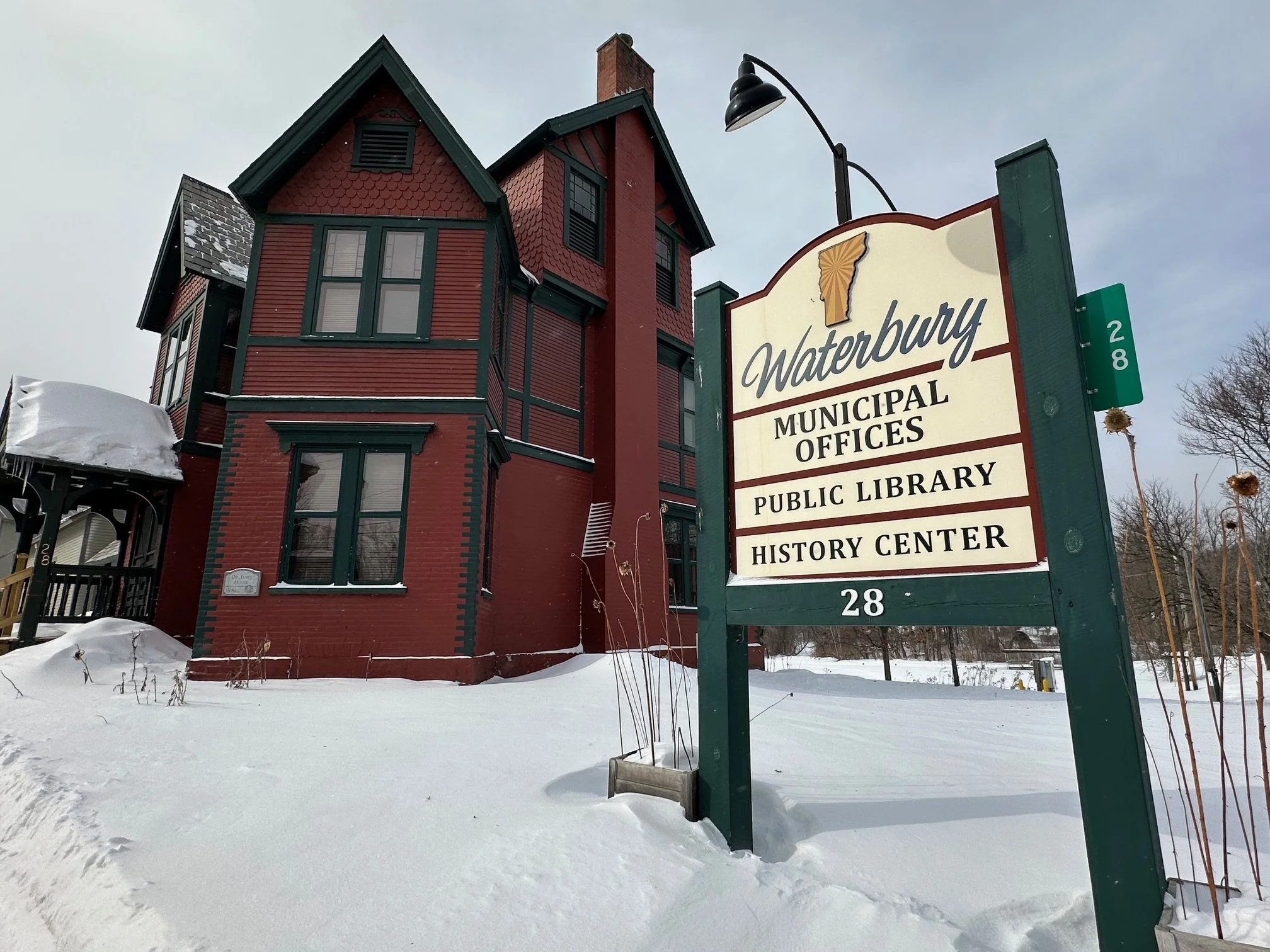
The Waterbury Select Board starts at 6 p.m. Tuesday night at the municipal office and online to hold a public hearing on the Randall Meadow bond vote and its last regular meeting as the current membership. Photo by Lisa Scagliotti
In what is likely its last regular meeting in its current membership, the Waterbury Select Board meets tonight at a slightly earlier time to accommodate a public hearing on the upcoming Randall Meadow bond vote and a lengthy to-do list on its agenda.
Tonight’s meeting in the Steele Community Room at the municipal offices begins at 6 p.m., 30 minutes earlier than usual. It is also livestreamed on Zoom with the link in the meeting agenda.
The board is meeting tonight due to Monday’s federal holiday for Presidents’ Day. The group is also likely to alter its March schedule to cancel what would typically be its first-Monday meeting of the month on March 2, due to it falling on the eve of Town Meeting Day.
That makes tonight’s gathering the final one – barring any special circumstances that might crop up in the next two weeks – for the board as it's currently configured.
Terms for three of the members – Chair Alyssa Johnson, and members Mike Bard and Tori Taravella – are ending on March 3 and none of them is seeking re-election.
Voters will choose their successors in the upcoming election. There are five candidates vying for the three openings: former board members Chris Viens and Don Schneider are running for the three-year seat that Johnson is leaving. Viens filed in January and will be on the ballot. Earlier this month, Schneider announced plans to run as a write-in candidate for the seat.
Three candidates are vying for Bard and Taravella’s one-year seats: Evan Karl Hoffman, Sandy Sabin and Martha Staskus. They all filed by the January deadline and their names will appear on the ballot. Hoffman and Sabin both ran in 2025; Staskus, who chairs the town Planning Commission, is a first-time candidate.
In addition, the board’s Vice Chair Kane Sweeney, who has two years remaining on a three-year term, recently announced plans to step down following town meeting. Sweeney’s position will not be on the ballot. It will be up to the select board after Town Meeting Day to advertise for applicants and appoint a new member to Sweeney’s seat to serve until Town Meeting Day 2027.
Big projects on the agenda
A key part of tonight’s agenda is a required public informational hearing regarding a ballot vote in the March 3 election that asks voters to authorize the select board to bond for up to $4.3 million for a major flood mitigation project in Randall Meadow.
The site is about 40 acres between the Winooski River and the Randall Street neighborhood adjacent to the State Office Complex. The town has received word that it will be awarded a $2 million disaster recovery grant from the federal Community Development Block Grant program to be put toward the project. The idea is to do a large-scale excavation of the approximately 40-acre undeveloped parcel to create more storage room for floodwaters in the future. Town officials say that preliminary work on the concept indicates that the effort could lessen the impacts of flooding along a more than 1-mile long corridor through downtown Waterbury.
The grant covers less than half the expected project costs and a requirement of the federal process is for the town government to demonstrate that it could raise the needed funding should the grant award change. Meanwhile, the town is also seeking additional grant sources for the remaining $2.3 million needed.
The idea of excavating along the Winooski River to expand flood capacity has been discussed since Tropical Storm Irene delivered devastating flooding to Waterbury in 2011. Three recent floods in 2023 and 2024 reignited the interest in moving ahead with a mitigation project.
The grant funding would pay for project analysis and planning. The state of Vermont has also agreed to transfer ownership of the Randall Meadow property to the town for a nominal fee if the project moves ahead.
Town officials will have a video presentation about the project to share, and they will take comments and answer questions. Read more here.
Another big project on tonight’s meeting agenda is for the select board to “debrief” following last week’s Feb. 11 meeting to gather public comments and questions about housing development plans for the Stanley-Wasson site at the State Office Complex near the intersection of Randall Street and Park Row and just steps away from Randall Meadow.
The board has an offer from DEW Construction to work on a proposal that could envision a housing development on that site with approximately 90 units. The company was the only firm to respond to a call from the town last fall for builders to work on construction plans that would greatly increase Waterbury’s rental housing on a site that’s situated in a location that’s been flooded multiple times in recent years.
The town currently has an option with the state of Vermont to potentially purchase the property for $400,000 to be sold to a developer to proceed with a project. The concept would create the town’s largest-scale housing development in a spot that many town residents fear may exacerbate the impacts of future floods on the existing nearby neighborhood along with raising issues such as traffic and strain on aging water and wastewater infrastructure.
About 40 people attended last week’s meeting in person at the Waterbury Main Street fire station and online to ask questions, offer comments, and hear from representatives of the development team interested in the project.
Robert Wells with DEW explained that the company is looking for an 18-month time window for “due diligence” that would encompass market research to inform the number and type of units the project would include, along with site work, engineering and design that must take into account the site’s location and potential for future flooding. “Nothing is permitted. Nothing is designed,” he said. “We want the community’s input, to hear concerns and worries in order to mitigate them.”
Local civil engineer John Grenier, part of the DEW development team, sought to assure residents that development regulations since Tropical Storm Irene in 2011 take flooding potential into account, forcing developers to design new buildings to not exacerbate the potential for flooding damage. He offered the new Waterbury Ambulance Service station completed in 2025 as an example, noting that it was built at an elevation more than 2 feet above the 100-year flood level. “The building is not designed yet,” Grenier said. “I agree there is a lot to figure out.”
Multiple residents commented on the timing of the housing development work given the major flood mitigation project being envisioned for Randall Meadow. “I’m wondering if we’ve got the cart before the horse here,” commented Chris Viens.
Dana Allen, who is working for the town to pursue more grant funding for flood mitigation and housing efforts, said both projects would be multi-year efforts to design and execute. “We are pursuing them concurrently,” he said.
Nearly all of the community members who commented both acknowledged the need for more housing to be built while expressing concerns for locating a large-scale development in a key flood-prone area.
Having lived on Randall Street for 20 years, Kathy Mackey said her family’s home went through multiple floods. She said the unpredictability of future floods should give pause to building on the Stanley-Wasson property. “We had our canoes where those buildings were,” she said, referring to the former state buildings that were torn down on the site in 2021.
Town officials say the motivation to pursue the site stems from community demand. “We’re hearing over and over — we need to address housing, the need for housing and the need for affordable housing,” said Planning Commission Chair Martha Staskus. In the commission’s ongoing work to write a new town plan, it has heard strong public concern about increasing property taxes, the need for housing that’s affordable, and the importance of addressing resiliency given changing climate trends, she said.
Carrie MacMillan, who lives along Park Row adjacent to the building site, said she doesn’t dispute the need for more housing in Waterbury. But she called designing a high-density apartment complex for the spot “a gamble with our future.” She questioned the maps planners are relying on to inform development decisions. “These maps are so outdated that if we bet on that not flooding, are we doing ourselves a disservice for our municipality, for our taxes, for the people that would probably be stranded there if it does flood again? And I think everyone should really look at that very carefully,” she said. “When we flood again —and we will, based on the climate — like is this really the right thing for our community, and is this the right place to put housing?”
Select Board members will discuss the matter tonight and may consider taking action to extend the town’s purchase option with the state for the property. Board Chair Johnson said the group is not likely to act on the predevelopment agreement with DEW, given the upcoming transition in board membership after the March 3 election.
Wells said DEW understands the timing and the company would look forward to working with whoever the town’s leadership is going forward.
Also on the agenda
In addition to the Randall Meadow hearing and the Stanley-Wasson discussions, the select board’s agenda for tonight is substantial. The agenda and a variety of meeting documents and a video presentation about Randall Meadow are online here.
Other topics for tonight include:
Reviewing details for town meeting
An update from the Housing Task Force
A presentation of Revitalizing Waterbury’s budget for 2026. The community and economic development nonprofit receives taxpayer funding from the town each year, mainly to pay for the organization’s economic development director position. The proposed town budget for 2026 appropriates $96,650, a slight increase from 2025 when $95,000 was allocated.
Discussion about zoning enforcement issues and a zoning question regarding residential property buyouts through the FEMA process.
Some adjustments to the town employee handbook