Low turnout to discuss changes to primitive camping rules
October 5, 2026 | By Katie LyfordThe state’s efforts to gauge public sentiment on upcoming changes to rules about primitive camping are off to a slow start.
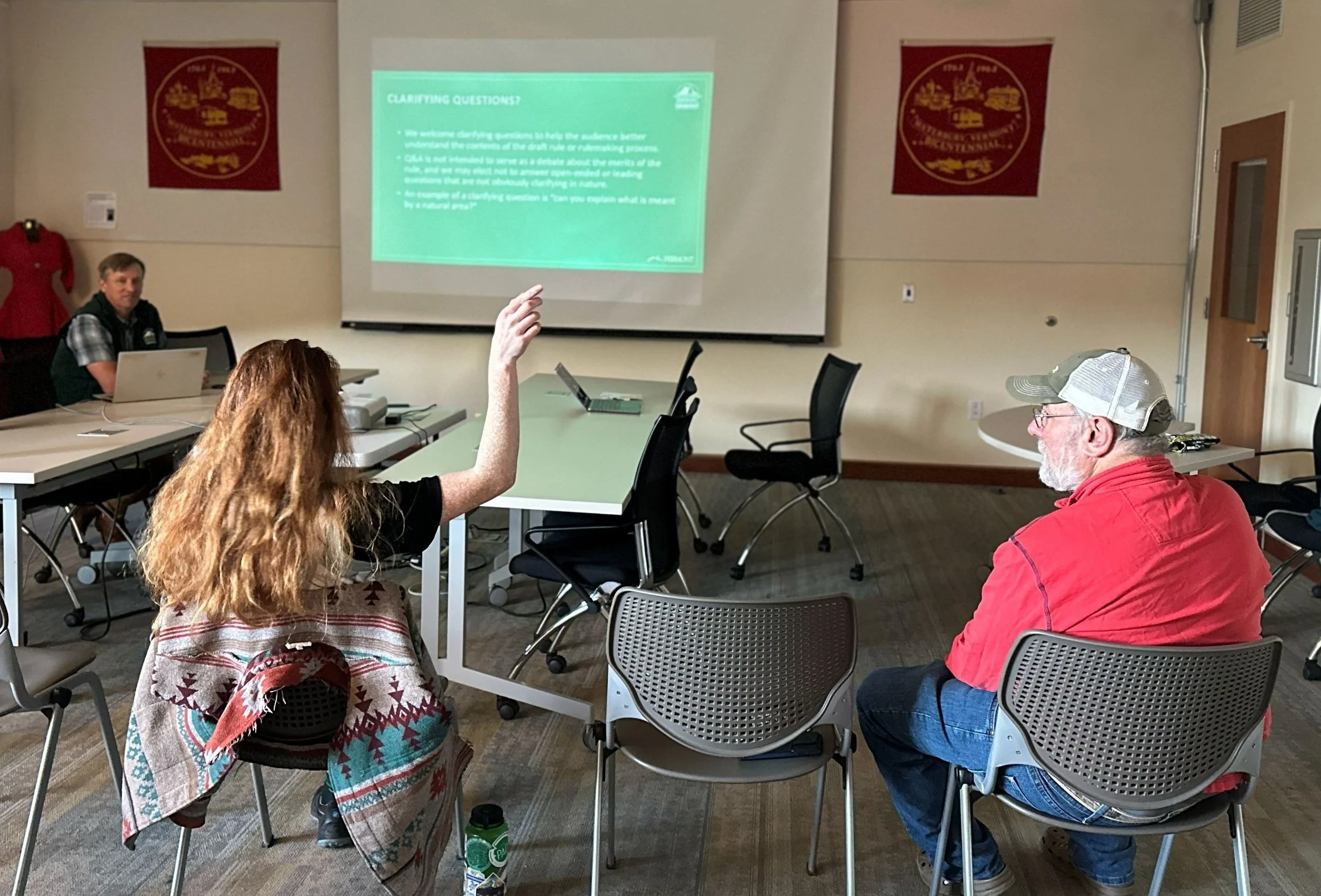
Oliver Peterson (back left) from the Vermont Department of Forests, Parks and Recreation, listens to questions from Madellyn Milsark and Mike Bard, the two attendees at a recent public meeting in Waterbury about updating primitive camping rules. Photo by Katie Lyford
Just two people turned out for a recent meeting to gather public comment in Waterbury and a previous meeting in Manchester had just one attendee.
Oliver Pierson, director of forestry at the Vermont Department of Forests, Parks and Recreation, said he expected at least a handful of people to attend the in-person meetings.
“We have been receiving comments by email and the online forum, but clearly there is not a ton of public interest in this proposed rule amendment,” Pierson said. So far, about 25 comments have come in apart from the public meetings.
Primitive camping is currently allowed in state forests and certain undeveloped state parks and wildlife management areas. It requires campers to be at least 1,000 feet from a road without a motorized vehicle. Unlike remote camping – which is popular at the state parks in Waterbury at the Waterbury Reservoir – primitive camping involves no facilities for public drinking water or toilets. There are no reservations or assigned campsites, which are typical for remote camping.
First revisions since 1993
The state hasn't changed primitive camping rules since establishing them in 1993. Increased wildfire risk and a rise in post-pandemic outdoor recreation raised the department’s concerns about preserving, protecting and reducing risks to wildlife, lands and the public.
The current rule doesn’t allow for enforcing complaints the department receives about confrontations with campers and members of the public, Pierson said, and without clear guidance or enforcement, campers are overusing and degrading many popular areas. State officials are also concerned about human and other waste contaminating water and other parts of the environment, Pierson said.
According to Pierson, the biggest concern raised by the public so far is a proposed change to the setback from water bodies from 100 to 200 feet for primitive camping. The department suggested the change due to concerns about water and soil contamination. The farther away from the water the campers are, the less likely contamination will occur. The greater proposed distance would put Vermont rules more in line with federal government standards, Pierson noted.
However, he said, this is the part of the amendments most likely to be revised based on public feedback. “We don’t need to blindly adopt this ruling just to align with the federal government,” he said. “If people show legitimate concerns, we will take them into advisement and consider altering or reconsidering the amendment.”
Two commenters
Waterbury resident Michael Bard attended the Sept. 24 Waterbury public meeting and reported opposition to the increased setback from two organizations he belongs to, the Vermont Traditions Coalition and Friends of Waterbury Reservoir.
“I don't think either organization I represent has any issues with these amendments, except for that 100-versus-200-foot part. We support the 100 feet but feel that 200 feet is a lot harder to estimate and unnecessary,” he said.
Bard asked if the proposed amendment would affect state lands around the Waterbury Reservoir. It does not because the area falls under state park remote camping rules instead. Pierson directs people to the state Forests, Parks, and Recreation Department website, which defines both types of camping and has maps showing areas in Vermont designated for primitive camping.
Bard expressed support for excluding remote camping from the rule. “I think we would have a lot more problems if it was [including remote sites], because you would probably have to redesign almost every one of those campsites to meet that standard,” he said.
Bard also expressed concern over how Vermont's Department of Fish and Wildlife would apply the new rule.
Pierson said Fish and Wildlife officials requested exclusion from the proposed changes because they maintain distinct primitive camping rules. This conversation led to a part of the amendment clarifying the jurisdiction distinction.
“I understand why Vermont Fish and Wildlife want to segregate, because a lot of their camping revolves around hunting and fishing seasons and they’re trying to get people to stop camping in parking areas and pull-offs, especially in the off-season,” he said.
Madellyn Milsark, the other Waterbury meeting attendee and also a member of Friends of Waterbury Reservoir, voiced concern about what might happen when the reservoir is lowered. Construction on a multi-year project for major maintenance on the dam is planned to begin in 2028 and it will involve lowering the water level significantly.
“When there is the drawdown, will this area then be made available for primitive camping?” Milsark asked.
Pierson said the reservoir area would not qualify for primitive camping, even when the water level is down.
Milsark also asked if the rule changes might impact the homeless and what that would look like.
“I've been in my role for four years, but I work with people who have been involved much longer. We've never, to the best of my knowledge, been made aware of a situation where someone is primitive camping as their principal residence,” Pierson said.
Pierson said he expects to post a summary of public comments and the agency’s responses by late November. The proposed changes would go before the Legislative Committee on Administrative Rules for review. If the legislative committee approves the changes, Pierson said the department hopes to have the amended rules take effect around May 2027.
The public comment period on the proposed rule change ends this Friday, Oct. 9. Individuals may comment online or send an email to anr.forests@vermont.gov with “primitive camping amendment” in the subject line.
Katie Lyford is a Community Reporting fellow with the Journalism New England Career Lab, which provides training in civic journalism for individuals in New England to report in their communities.