
Meet the candidates: Race for a 3-year Waterbury Select Board seat
February 26, 2026 | By Sarah Andrews | CorrespondentVoters have three seats to fill on the Waterbury Select Board in next week’s Town Meeting Day election, and five candidates have stepped up for the positions.
None of the contenders is a current officeholder, as all three incumbents whose terms end on March 3 have opted not to run for re-election.
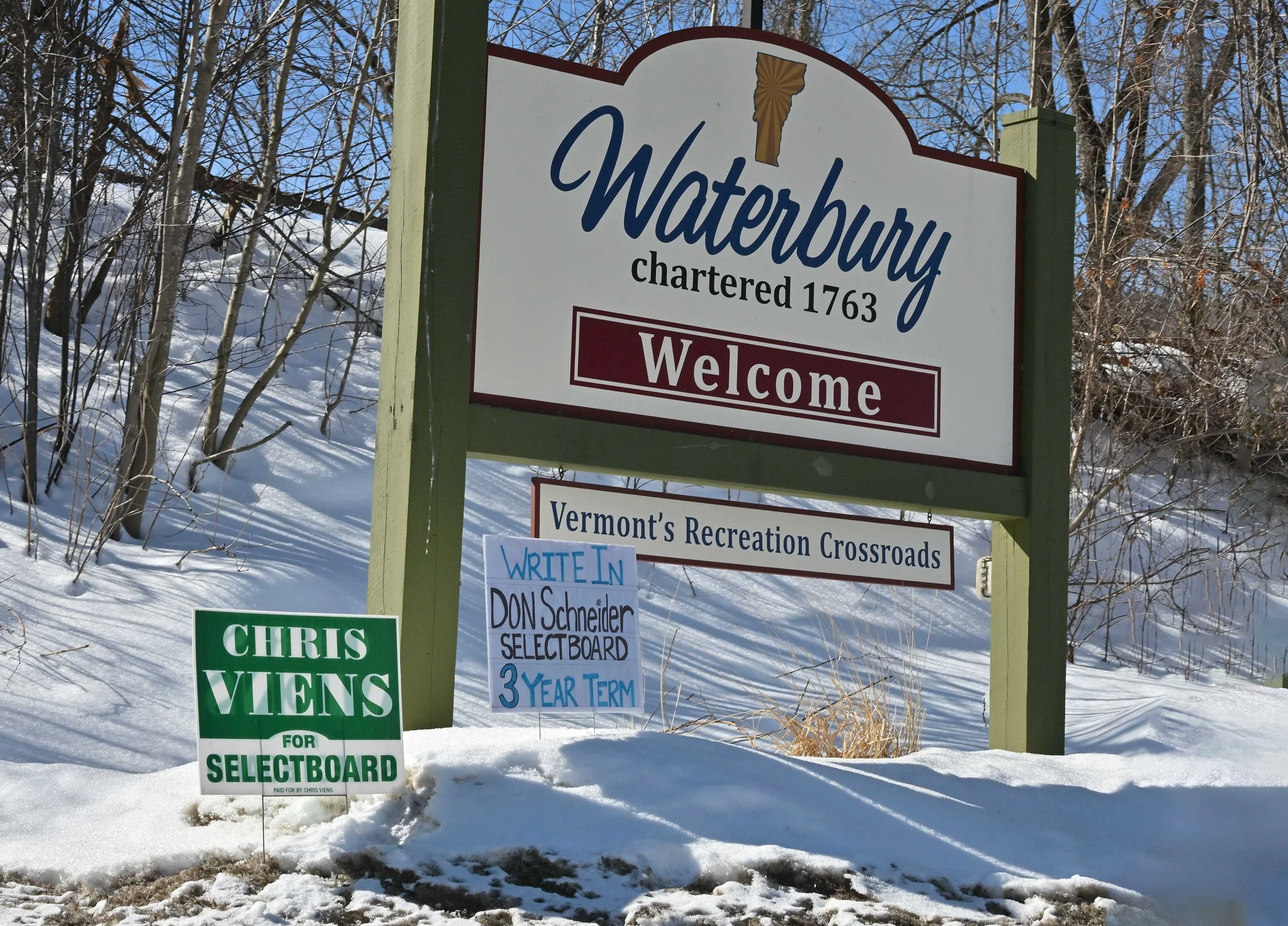
Signs for Chris Viens and Don Schneider, candidates for the three-year position on the Waterbury Select Board. Photo by Gordon Miller
This gives voters the task of filling the openings with a new slate of town leaders to add to the five-member board. Three candidates are on the ballot vying for two one-year positions. One name is on the ballot for the three-year seat, and a second candidate announced a write-in campaign after the Jan. 26 deadline to be printed on the ballot.
All five candidates have shared their views in a survey on a host of local issues that the Select Board is apt to face this year. Each of them also talked with Waterbury Roundabout about their decisions to run for local office.
Below are highlights from interviews with Chris Viens and Don Schneider, candidates for the three-year select board seat now held by board Chair Alyssa Johnson. Viens is on the ballot; Schneider is running as a write-in. Both are former select board members whose time on the board overlapped for several years. Each also served as board chair.
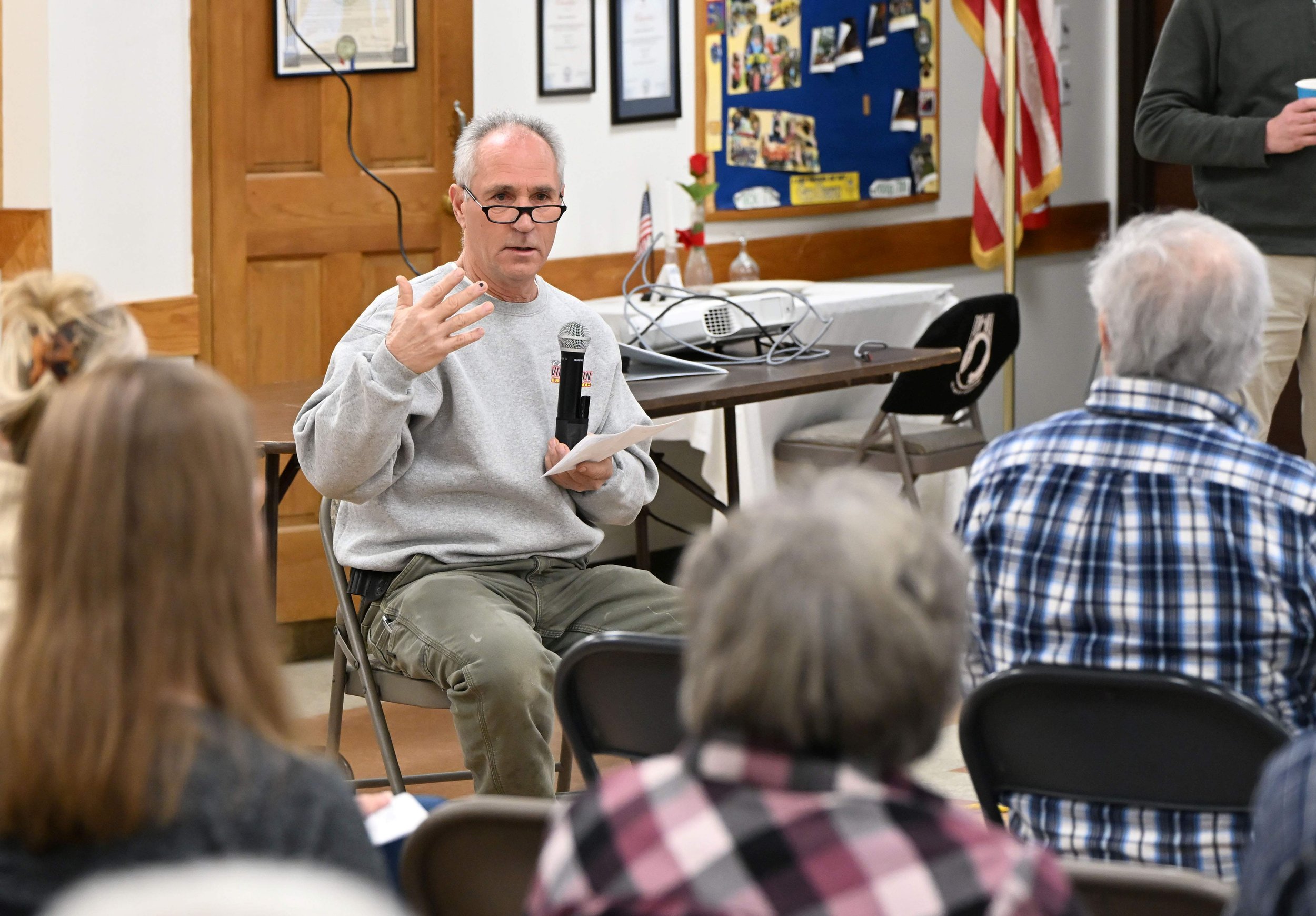
Chris Viens comments during a Waterbury town budget preview meeting in January 2025. Photo by Gordon Miller
Chris Viens
Having served on the select board from 2012 until 2023, Chris Viens says he decided to run this year because of the issues he sees facing the town, namely, concerns about affordability.
“If you can't keep a roof over your head. And it costs too much to live here, and you have to pack your bags and leave; none of that other stuff matters,” he said in a recent interview.
Viens grew up spending time in Waterbury. Today, his children and grandchildren live in Waterbury, too, members of the family’s eighth and ninth Vermont generations. When he was growing up, Viens said he remembers that life in Waterbury was not as easy as it is now.
“For people who were born in this state, it’s never been a luxury for us to live here. It’s pretty much always been a struggle,” Viens said. “You learn how to skin the cat differently, to achieve more, with a lot less money.”
Viens is the longtime owner and operator of an excavation business. He says his extensive experience in construction gives him a unique perspective when it comes to town infrastructure projects.
“I’ve built a lot of foundations in Waterbury. I’ve built bridges, I’ve built roads. Anything you can name, I’ve done it,” Viens said.
During his time on the select board, Viens boasts major improvements in paving and mowing efforts to maintain roads and sidewalks. He was also involved in the decision to amortize the municipal building, reducing the payoff period from 30 years to 20 years, a decision he says supports the town’s younger demographic.
Viens often points to the money-saving efforts he spearheaded during the planning for the construction of two new fire stations in Waterbury in 2008, before he joined the select board. Town officials first presented a plan with a $5.8 million price tag, and voters rejected the proposed bond to pay for it. Viens recounts how he got involved, recommending that the select board look closer at the development plans. Voters approved a second bond of $3.3 million bond to build the stations, more than $2 million under the original budget.
“If that isn't the right path to take when it comes to keeping people in their homes and not overtaxing them, I don’t know what is,” Viens said.
Viens' tenure on the select board included three and a half years as chair, starting in March 2017. It was during a bid for a state House seat in the fall of 2020 that comments Viens made regarding policing sparked community opposition to his role on the select board, with calls for him to resign. He stepped down as chair in November that year and continued to serve on the board until March 2023.
Looking back at his resignation from the chair position, Viens said, “People have the right to learn and grow in life.”
Now in 2026, Viens says the key issue is affordability for the town’s residents and something elected leaders need to bear in mind in all of their decision-making.
Viens says he’s reluctant to support proposals for development on the Stanley-Wasson parcel at the State Office Complex, concerned over high costs and tax increases that may come with addressing the impacts of a large-scale development there. His motto: Don’t get out over your skis.
“If you don’t create a strong underpinning for your community, it's going to collapse under its own weight. If you create a community that is solid, financially solid, structurally solid, and community-oriented, people are going to want to move here and be a part of this,” Viens said.
Concerned about overspending, Viens says that if elected, he would work with the board to create a 10-year budget plan.
Asked about the recent addition of local option taxes in Waterbury, Viens called it a valuable addition to the town's finances, but said he believes it needs to be used carefully. Begun in mid-2024, local option taxes on sales, rooms, meals and alcohol are expected to bring in over $900,000 in 2026. Viens said he wants to contribute some of the new revenue to the town’s tax stabilization fund, setting aside $200,000 a year for the fund.
“If I get elected, I’ll put guardrails on town spending until we can get our current needs up to par,” Viens said.
Beyond looking at the town's finances, Viens worries about the period of transition currently facing the town, following the exodus of multiple town staff and turnover in select board positions. Viens wants to prioritize more stability and transparency within town government going forward. He says that allowing for greater communication and support between the select board and the town staff would be a good way to maintain a stable and effective government.
“That's what I'd like to see, a policy in place that allows for more transparency or clarity between staff,” Viens said.
Viens's last election in 2023 ended in a narrow defeat in a three-way race for two seats on the select board. Viens came in third by just 17 votes behind then-newcomer Kane Sweeney and Roger Clapp, both of whom are still on the select board today. That didn’t end Viens’ involvement, however. Over the past three years, he has been a regular attendee at select board meetings, frequently commenting as a member of the public, sharing his opinions on current issues and recalling past history on many topics as well.
Viens said he’s now looking to return to office to harness his experience as a former board member, a keen observer, and a business owner to keep his friends and neighbors from being priced out of Waterbury.
“I would appreciate the opportunity to put my experience to work for the public again,” Viens said.
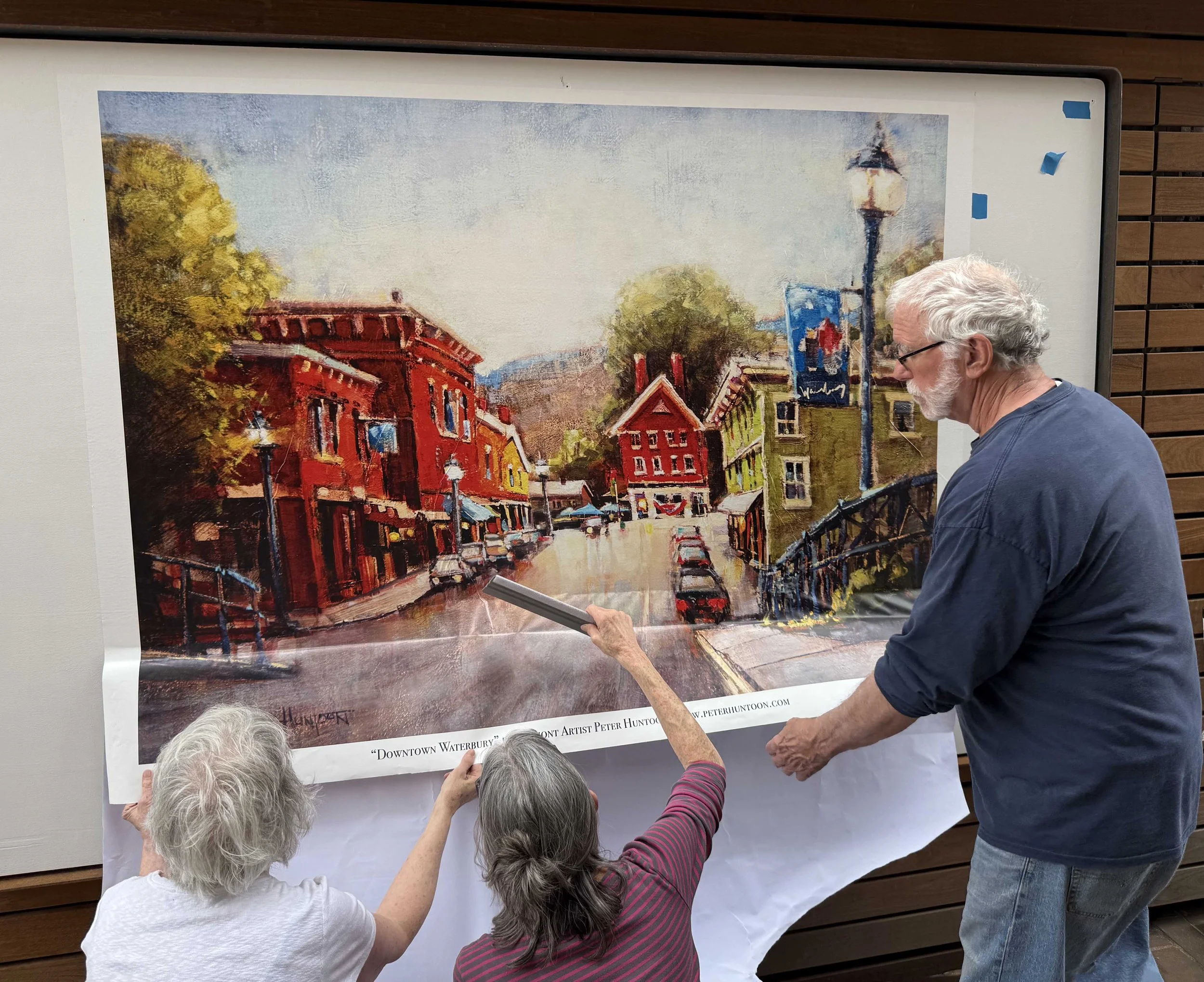
Don Schneider (right) helps install Peter Huntoon’s ‘Downtown Waterbury’ print in Jack’s Alley last spring with MK Monley and Sarah-Lee Terrat. Photo by Gordon Miller
Don Schneider
Don Schneider has lived in town since 1988 and was principal of the then-Thatcher Brook Primary School for 13 years. The school was renamed in 2021 to Brookside Primary School.
In the community, Schneider has been involved with the Waterbury Rotary Club for a decade and was part of the group that founded the nonprofit creative organization MakerSphere in 2018. He also served on the Waterbury Select Board from 2014 to 2018 and was chair for a year, 2016-17.
Schneider said that he was motivated to be a candidate again this year after people in town asked him to run as a write-in. That encouragement makes him think the town can benefit from having options for its select board.
“I just decided I've got to step up and do this. Just so there's a choice on the ballot, and an ideological choice,” Schneider said.
Schneider and Viens served on the select board together. Schneider said major efforts during his time on the board were post-Tropical Storm Irene projects, including the completion of the new municipal building after the previous town hall was destroyed by flooding, and finalizing the Hazard Flood Mitigation program through FEMA.
For Schneider, there are three main issues facing the town today that he said he hopes to address: Affordability, flood mitigation and stability within town government.
To address the town's housing shortage, Schneider supports the proposal for potential housing development on the Stanley-Wasson site downtown, but he says he’s hesitant to see the town move too quickly to support a large-scale project. The town has an option to purchase the site from the state of Vermont, and the select board has a request from one developer to spend up to 18 months to design an apartment complex for the site, which lies in flood-prone downtown Waterbury. Concern is high among local residents about the many risks that building in that location might present.
“The trouble with building new is that it's so costly, Schneider said. “It's being smart with that, going slow on some of that.”
Schneider spoke about his support of the town’s Accessory Dwelling Unit initiative, called the Waterbury Home Improvement Program. He said he hopes town officials will further promote and encourage residents to participate in that. He worries about overdeveloping on agricultural land, and thinks ADUs are a good solution to allow for more housing inventory in locations where housing already exists.
Schneider said a priority for the select board is to move the Randall Meadow flood mitigation project forward. On Town Meeting Day, voters are being asked to authorize the select board to bond for up to $4.3 million for the project as part of the process to obtain a $2 million federal grant for work that would create more room for future flood waters in the field between the Winooski River and downtown Waterbury. He said he is hoping to work with the board to keep that momentum and look beyond Randall Meadow for additional flood mitigation ideas.
The meadow project is a key start, “But what else can we do?” Schneider asked. “People think this is over, but it's not.”
Schneider has concerns about the recent changes in the town staff as many town employees have resigned in recent months, including the town manager, town clerk and library director. He says he wants to return stability to those positions. Support, he says, is essential to keeping people in those key jobs.
“It’s making sure people stay, and straightening out whatever's going on with personnel in the town office,” he said.
Schneider expressed that the town already has huge accomplishments in infrastructure work to its credit, so he thinks it is time to shift focus to more pressing issues facing the community today. “We have so much infrastructure in place that [today] it's housing, and it's flood mitigation,” he said. “Let's hyperfocus on those.”
Schneider has compiled a list of more than a dozen key infrastructure achievements in Waterbury over the past 25 years made through investments by the municipality, the state of Vermont, the school district and community members’ contributions.
The full list is included in his candidate survey response. It includes the rehabilitation of the Waterbury Train Station and construction of two fire stations, the state of Vermont’s investments in the State Office Complex after Irene, along with numerous road and bridge projects at the Interstate 89 interchange, Route 100, the roundabout, Main Street reconstruction and the Stowe Street bridge; the new town offices and library post-Irene; renovations to the primary school and a new ambulance station.
As the Select Board soon will undergo a major transition with four new members, Schneider says it’s important for those who serve next to keep the big picture in focus.
“I’m hoping I can bring a balance to the select board, in my experience and in all aspects. Waterbury is an amazing community,” Schneider said. “I'm happy to be here, and I'm happy to keep that going.”