
Waterbury lands $2.3 million in grants for flood mitigation, housing projects
December 10, 2025 | By Lisa ScagliottiNote: This post was updated on Dec. 12 with comments from Vermont’s Congressional delegation members and state Rep. Theresa Wood.
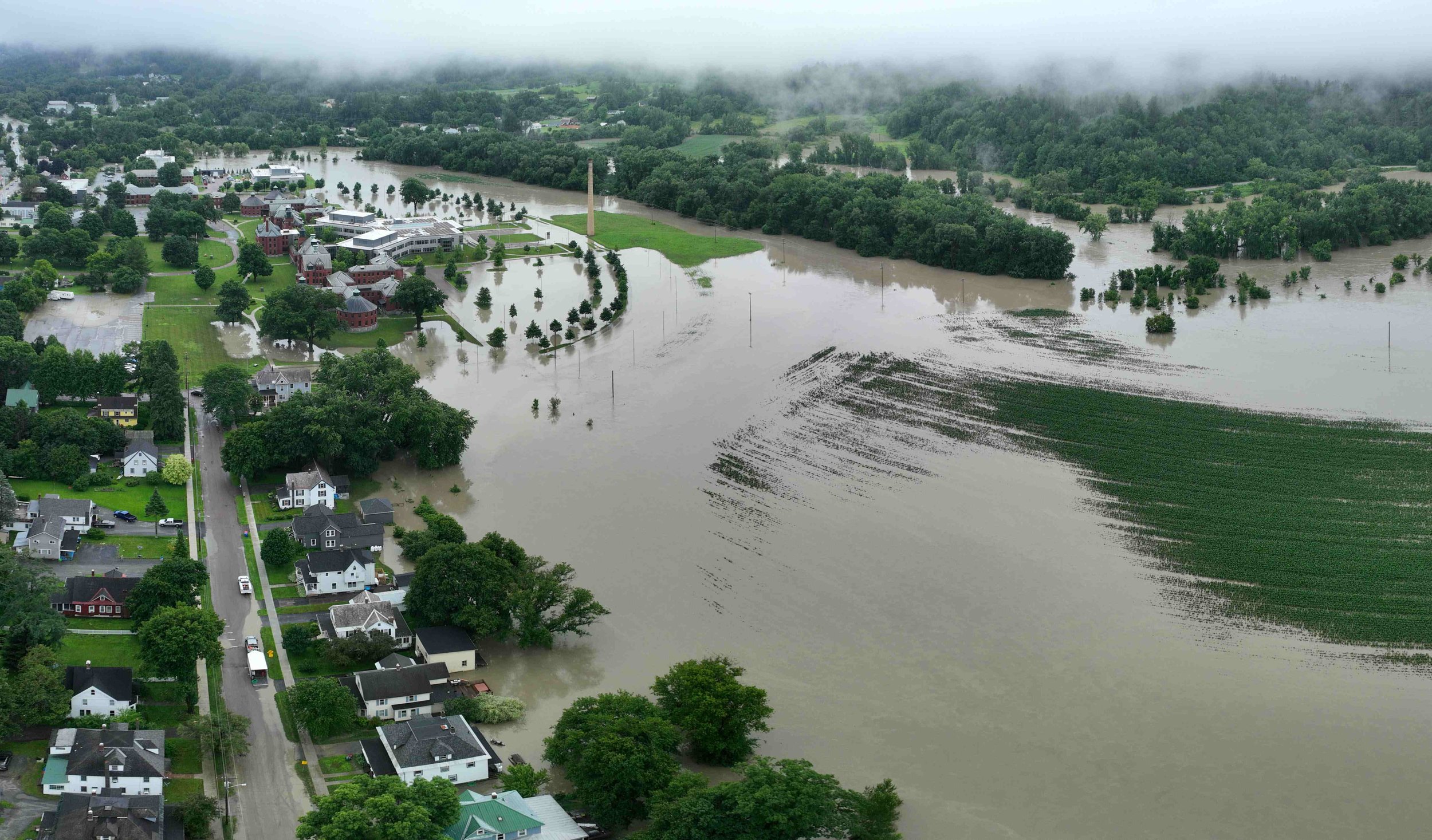
The view above Randall Street and Randall Meadow during the July 2024 flood. Photo by Gordon Miller
Woody Avenue? Armory Avenue gets a new name and a project
By Lisa ScagliottiAlthough the street signs have yet to be swapped out, the street behind Brookside Primary School, long known as Armory Avenue, was renamed in 2024 to Woody Avenue.
The change was made by former town Zoning Administrator Mike Bishop, whose position included being the E-911 coordinator for the municipality. That role involves ensuring that properties are designated with proper addresses and all streets are named. In the case of Armory Avenue, Bishop explained at the time that state officials contacted him to point out that Waterbury had both an Armory Drive – where the former Vermont National Guard armory is located – and an Armory Avenue, behind the school connecting High Street and Hillcrest Terrace. A town garage building previously referred to as an armory gave the short street behind the school its name.
Bishop explained that he heard from state officials asking municipalities to clarify situations where multiple street names are similar and could cause confusion for emergency responders, deliveries and in other situations.
Bishop was asked to submit an alternative name for one of the streets to resolve the near-duplication. He said his answer came in a lighthearted moment as Public Works Director Bill Woodruff walked past his desk at the town offices. Woodruff’s nickname is “Woody.”
“I said, how about Woody Avenue?” Bishop recalled.
The name was not in use elsewhere in Waterbury or even in Vermont.
“So ‘Woody Avenue’ it was,” he said.
The change was recorded by the state, and a search on Google Maps will pull up the new Woody Avenue name. Town officials have begun to use the new name, particularly in referring to the potential development on the town land there. All that remains is for the street signs to be swapped for new ones.
Now in his 40th year working for the town of Waterbury, Woodruff was honored this spring by the Edward Farrar Utility District at its annual meeting and on the cover of the district’s annual report. For his part, he has taken the street re-naming exercise in his characteristic, low-key manner. “Yes, the one building on the site has seen better days - much like the public works director,” he quipped.
Meanwhile, Bishop resigned from the town staff this fall. In October, he went to work as the town manager for the town of Fairfax.
A key flood mitigation project and preparations to invite housing development on town-owned property have landed Waterbury $2.3 million in federal disaster recovery grant funding, Gov. Phil Scott and state officials announced on Wednesday.
Work to create more flood water capacity in Waterbury’s Randall Meadow along the Winooski River near the State Office Complex and the Randall Street neighborhood is to receive $2 million, according to the announcement at the governor’s weekly press conference at the State House.
The grant is less than half of the $4.25 million that the town requested for the project.
Waterbury’s other request for $300,000 to prepare the town-owned property behind Brookside Primary School as a site for future multi-unit housing development was fully funded.
Waterbury’s grants were two of more than two dozen awards totalling nearly $50 million announced by Gov. Scott and Nate Formalarie, deputy commissioner of the Department of Housing and Community Development.
Storms that struck in 2023 were the worst since Tropical Storm Irene in 2011, and Vermont secured federal Community Development Block Grant Disaster Recovery funding to direct to both recovery projects and mitigation efforts for future disasters, the governor said.
“This money will be used to help restore and build nearly 200 homes, make infrastructure improvements and mitigation investments, and a small amount of money for planning so we can determine where to build in the future,” Scott said. “In the last five years, we’ve used almost half a billion dollars in state and federal funds for housing, but that’s not anywhere near enough to fill the need.”
Formalarie explained that 80% of the grants being awarded is to be directed to projects in Washington and Lamoille counties. The remaining 20% of the funding will go to projects in Caledonia, Orleans, Rutland, Windham and Windsor counties.
“The majority of these funds are focused on housing projects that will create new units which are out of harm's way from future storms, and help replace units we have lost in recent years due to the severe weather we have faced,” Formalarie said.
Wednesday’s announcement includes $27.5 million for housing construction, rehabilitation and preservation of close to 200 units. In that sum is $14.5 million to Downstreet Housing & Community Development for projects in Washington and Lamoille counties that will create 81 new permanently affordable homes, said Angie Harbin, Downstreet’s executive director. “This is a super-exciting moment for us,” she said.
The nonprofit housing developer, owner and manager will focus its grant awards on projects in Montpelier, Barre and Johnson. “These are three communities that were hit the hardest and suffered the most profound housing losses in the July 2023 floods,” Harbin said.
The Barre project is a partnership with Evernorth and the city to create 31 new rental units downtown. The Stevens Branch project will receive a grant of $2,044,621.
In Montpelier, a grant of $5,709,345 will be directed to rehabilitating a former Washington County Mental Health office building to create 21 new rental units and four home-ownership units, she said.
With a $6.5 million grant, the Johnson project also involves Evernorth to repurpose a Vermont State University campus building and add new construction to create 25 new rental units out of the flood zone.
Harbin summed up the impact: “These efforts represent recovery and stability. They contribute to stronger, safer and more equitable neighborhoods. They preserve historic buildings. They deliver downtown infill development. They increase climate resilience and they meet urgent affordable housing needs in communities that were deeply affected by disaster.”
Downstreet owns and operates several apartment complexes in Waterbury and has a new 26-unit project under construction at 51 South Main Street to open in 2026.
Another $13.3 million in grants will fund infrastructure projects, including $3.3 million for Good Samaritan Haven in Barre to move its emergency homeless shelter out of the floodplain. Another $3.2 million will fund repairs to municipal wells in Morrisville, and Cabot will receive $1.25 million for a bridge replacement project.
Congressional delegation sends comments
On Thursday, Vermont’s Congressional delegation members shared their comments, hailing the disaster recovery grants for Vermont.
“Vermonters continue to rebuild their homes, businesses and communities in the wake of the devastating 2023 floods — the worst natural disaster in our state since 1927. The recovery process is expensive and this federal funding is absolutely essential for cities and towns across our state,” said Sen. Bernie Sanders, I-Vt. “By investing in essential infrastructure, economic revitalization and mitigation against future disasters, this funding will help Vermonters rebuild stronger than before. I am proud to have helped champion this funding and will continue to demand that the federal government stand with people throughout our country in their times of need — especially after natural disasters like the ones we’ve experienced in Vermont.”
Sen. Peter Welch, D-Vt., noted that the July 2023 floods “were brutal, wrecking the homes and livelihoods of thousands of Vermonters.” He said the grants offer a lifeline to many still working on recovery efforts. “From investing in much-needed housing and infrastructure projects to supporting flood mitigation efforts, these funds will support flood-impacted communities and make our state more resilient to extreme weather,” Welch said. “I’m proud to have played a part in securing these crucial resources that will make a real difference in the lives of flood-impacted communities.”
Rep. Becca Balint, D-Vt., said she’s proud to have worked with Sanders and Welch to land the funding for Vermonters. “Climate change is here, and this money will allow communities hit hard by the 2023 flooding to build back more resiliently,” Balint said. “I will not stop fighting to help Vermonters get the federal help we need to rebuild from climate disasters.”
Flood mitigation at Randall Meadow
A state map shows the location of Randall Meadow along the Winooski River in Waterbury.
Grants totaling $6.2 million will pay for flood mitigation projects aimed at resilience in future flooding events. These include proposals for dam removals and floodplain restoration or expansion that will reduce flooding in historic downtowns, Formalarie said.
That includes $2 million for Waterbury’s Randall Meadow project that seeks to remove approximately 100,000 cubic yards of silt, soil and other material from the approximate 47-acre field that sits between the Winooski River and downtown homes that have been flooded multiple times in recent years. The state is poised to transfer ownership to the town to manage this project.
Waterbury’s proposal to excavate the cornfield area between the Winooski River and the Randall Street neighborhood has been proposed as a critical flood mitigation strategy after recent floods in 2023 and 2024 inundated the downtown neighborhood. Creating more flood storage along this stretch of the Winooski was proposed after the 2011 flood from Tropical Storm Irene, but the focus then was on lowering land on the Duxbury side of the river. Property owners were not open to the idea and the strategy was not pursued by local officials.
The concept was revived after three floods struck in the summers of 2023 and 2024 and December 2023, this time with attention turned to the state-owned Randall Meadow, most of which is currently leased to the DeFreest dairy farm in Warren.
During the 2025 legislative session, town officials and Waterbury’s state representatives convinced state lawmakers to allow for the transfer of the property to the town so it could pursue an excavation project to increase water storage capacity in future floods and lessen the impact of floodwaters on the nearby residential neighborhood and more broadly in downtown Waterbury along the Main Street corridor.
State Rep. Theresa Wood, D-Waterbury, reflected on the long road to getting a flood mitigation project started along the Winooski River in Waterbury. “Given the state never followed through on increasing the floodway in Randall Meadow after Tropical Storm Irene, I’m glad they’ve recognized the need to assist with this project,” she said. “The $2 million CDBG-DR grant is welcome news as Waterbury moves forward with plans to make our community more flood-resilient.”
Town officials have been brainstorming funding options to pay for the engineering, project design, environmental and archeological review, and ultimate removal of countless truckloads of material from the land. They applied for the Community Development Block Grant Disaster Recovery funds in September. But in discussions with the Waterbury Select Board, Town Manager Tom Leitz said he was hesitant to expect the request would be funded in full, given the high interest for the disaster recovery grants. On Wednesday, Leitz said he was pleased that the project won $2 million. “It’s 40% of the total – that’s a big piece,” he said.
All along, town officials have been brainstorming other funding options to accomplish this project. Leitz noted that Waterbury has applied for a FEMA grant and has not heard back on that request. In looking at the town budget for 2026, Leitz has also proposed allocating $350,000 from local option taxes for some of the preliminary work on the project. He also has suggested that a voter-approved bond could supply additional funds, as could a grant program through the Central Vermont Regional Planning Commission.
Landing the $2 million grant is a big step in the right direction, Leitz said. “I think we can go forth,” he said, adding that he needs to learn more about the grant’s rules and requirements.
State Rep. Tom Stevens, D-Waterbury, said he was pleased the project attracted the federal funding to allow the work to move ahead. “I’m grateful for these grants—starting work on the flood remediation of Randall Meadow is a big step in the right direction, these many years after Tropical Storm Irene. It is the right thing to do for Waterbury, and I know the residents of the village area share my gratitude,” Stevens said.
The Randall Meadow flood mitigation project also is a key part of the discussions regarding a potential large housing project being explored for the former Stanley-Wasson property nearby at the State Office Complex. The town is working on a predevelopment agreement with the firm DEW Construction for a potential 90-unit housing development for the site, which is located in the floodplain.
Local residents have expressed worries over the potential impacts a large development could have in that location in the event of a future flood.
Town officials have stressed that any proposal would need to be designed to take flood risk into account. They also emphasize that having Randall Meadow excavated to create more floodwater storage could offer mitigation for both existing development in the neighborhood and future structures.
Planning for Woody Avenue housing
The smallest portion of the grants announced by Gov. Scott on Wednesday – $3 million – is targeted for planning efforts related to housing and flood mitigation. Of that $1 million is aimed at long-term flood mitigation in Lamoille County. The Central Vermont Regional Planning Commission will receive $750,000 for flood study and modeling focused on the Winooski River watershed for future mitigation projects.
The town of Waterbury will receive a second grant in this category: $300,000 for work needed to prepare a town-owned parcel behind Brookside Primary School as a site for future affordable and/or senior housing. The spot is along the former Armory Avenue, now renamed Woody Avenue.
The project will include conceptual planning, design, permitting, engineering, and related costs of tearing down and replacing the existing town public works garage on the site, with the new building closer to High Street. The parking lot would be realigned to continue to offer overflow parking for the primary school.
The grant would cover other work to prepare the property for construction of new affordable and/or senior housing. It needs water and sewer service as well as stormwater mitigation, town officials have explained. The project would also include funds to hire consultants to help guide a public information process to determine the features the town would like to ask developers to consider in the process to offer project designs.
Leitz said, unlike the Stanley-Wasson property, where the town solicited developer-generated ideas for that parcel, the Woody Avenue project would specify criteria that the community wants to see for the site.
“When the process is done, we will be fully ready to put it out to bid,” he said.
More grants to come
At Wednesday’s press conference, Formalarie thanked his team members who worked with federal Housing and Urban Development staff on details of the grant program as well as with municipalities, agencies and nonprofits who applied for funding.
“To get to this day announcing the awards less than a year from when Congress appropriated the funds was no small feat,” he said to the state staffers and grant awardees gathered at the State House midday announcement. “It’s a lot of work to apply for federal funding and abide by all the strings that come with it. Frankly, your work is just beginning – you now have six years to get this all done.”
The disaster recovery funding comes with a requirement that projects be completed within six years. The grants announced Wednesday do not use all of the $67 million that Vermont received in the disaster recovery funding. “After these awards, $14.4 million remains,” Formalarie said.
The state will open a second grant application round for additional housing project applications with a February deadline and awards being announced next spring, he said.
Details about that process, as well as the full list of the first wave of grant awards, will be posted on the Agency of Commerce and Community Development website, accd.vermont.gov. See the full list of the grants announced on the state site as well.