
Summer’s big celestial show: Perseid meteor shower
August 6, 2026 | By Michael J. Caduto | The Outside Story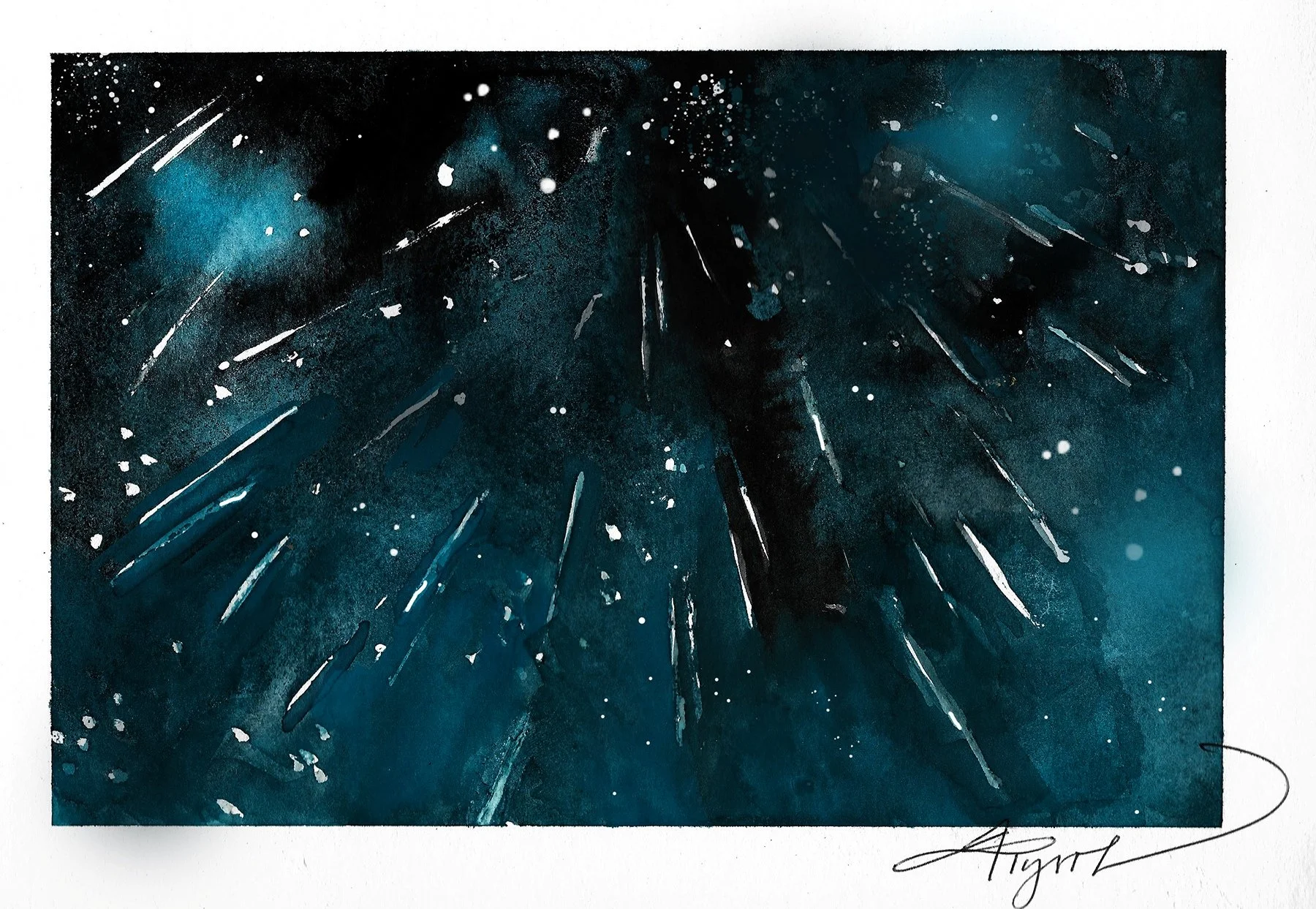
Illustration by Adelaide Murphy Tyrol
Celestial events are among the oldest and most profound human experiences of the cosmos, inspiring stories as grand as the sky is wide to explain the marvelous spectacles that arch overhead. Few natural wonders are more awesome than the blazing fireballs that streak across our night skies. And the Perseid Meteor Shower, which appears during some of the warmest nights of the year, features up to 100 meteors per hour.
Though the source of the meteors is the debris field of Comet Swift-Tuttle, the annual light show appears to come from the constellation Perseus, named for the hero in Greek mythology who is famous for beheading Medusa, whose petrifying gaze turned onlookers to stone.
Perseid meteors are not made of stone, per se; they are composed of a mélange of minerals and elements, as well as ice and cosmic dust, all of which produce subtly different colors as they blaze through the atmosphere. Iron emits a golden yellow, nitrogen and oxygen glow red, sodium appears orange, and calcium looks violet.
This summer, the Perseids will peak on August 12 and 13, but will be visible from July 17 to August 24. Sometime around midnight, look toward the constellation of Perseus, a little east of northeast, above the horizon. You will see the greatest frequency of meteors from midnight until the early hours of dawn.
“The Perseid Meteor Shower this summer is really worth making the effort to watch,” said Catherine Miller, observatory specialist at Middlebury College’s Mittelman Observatory. “The skies will be as dark as they can be with the new moon, which doesn’t happen every year. In a location with low light pollution, it should be relatively easy to see the Milky Way’s countless stars and dark, cloudy bands stretching across the sky, providing a stunning backdrop for the meteor shower.”
Each year at this time, Earth passes through the debris field of Comet Swift-Tuttle, which was discovered in 1862 by Lewis Swift and Horace Tuttle. The meteors in this shower are especially bright and often leave long trails of glowing light behind them. These “fireballs” are produced by large pieces of the comet burning up as they race through Earth’s atmosphere at more than 130,000 miles per hour.
At 16 miles across, Comet Swift-Tuttle is twice as big as the Chicxulub asteroid that crashed into the Yucatán Peninsula 66 million years ago, creating a crater about 12 miles deep and nearly 100 miles wide and causing a global winter that ended the age of non-avian dinosaurs and led to the extinction of about three-quarters of all species on Earth. But we needn’t be alarmed; most Perseid meteors are no bigger than a pebble or a grain of sand and usually burn up before impacting the ground. And Swift-Tuttle itself won’t pass close enough to Earth to be of concern until the year 4479, when there’s a nearly 100% chance it will sail safely by.
The best places for viewing meteors, or “shooting stars,” are where skies are least affected by artificial light, such as state and national parks and forests. A number of websites, such as Go Astronomy, list particularly dark places for viewing the night sky.
One such location, Stellafane Observatory in Springfield, Vermont, is recognized worldwide as a site with optimal conditions for observing the night sky. Members of Stellafane have worked for years with local businesses and governments to minimize light pollution. Educational organizations, such as the McAuliffe-Shepard Discovery Center in Concord, New Hampshire, and the Fairbanks Museum & Planetarium in St. Johnsbury, Vermont, are also great places to learn about the Perseids and related astronomical events.
“The Perseids are very special to me and are a fantastic opportunity for families to spend quality time in wonderment of our vast universe,” said Miller. “Growing up, we would find a place to lay down and stare at the sky, getting lost in the expanse of stars.”
The next few weeks are a great time to find a dark locale with a big open sky and spread out a blanket and pillow to enjoy the meteor shower. In between sightings, see how many stars and constellations you can name.
Michael J. Caduto is a writer, ecologist, and storyteller who lives in Reading, Vermont. He is the author of “Through a Naturalist’s Eyes: Exploring the Nature of New England.” The Outside Story is assigned and edited by Northern Woodlands magazine and sponsored by the Wellborn Ecology Fund of the New Hampshire Charitable Foundation.