
Shepard: Reviewing the Randall Meadow bond vote facts
February 24, 2026 | By Harry Shepard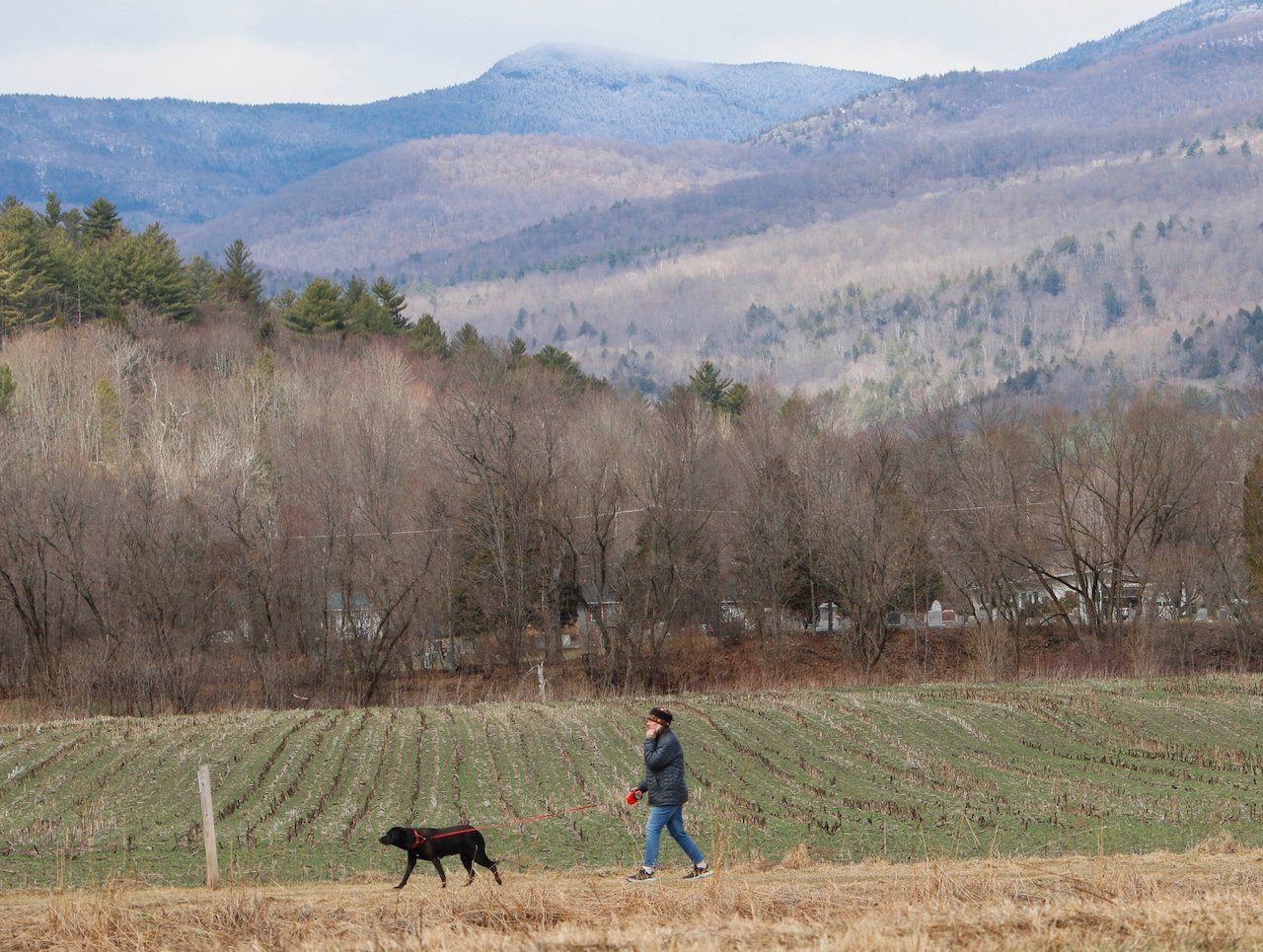
A dog and their human enjoy a spring walk on the path through Randall Meadow. File photo by Gordon Miller
After attending the Waterbury Select Board’s Feb. 17 public hearing on the proposed $4.3 million Randall Meadow bond vote, I would like to share my assessment of the merits of the project as presented to date.
With regrets, the Randall Meadow Flood Resilience Project will not provide the one-third to one foot of flood relief as purported. The Engineers Hydraulic Analysis dated June 2025 document shared for the public hearing shows results of approximately one inch in the most flood-prone areas of the village during major flood events as a result of this proposed excavation effort.
Given that we are now being asked to incur long-term bonded debt to substantially fund this project, it is both disappointing and concerning that these basic facts for flood relief are being misrepresented.
Flood level reductions are not the only misrepresentations in the project background materials. Protections will not “extend across downtown and neighborhoods.” In fact, discernible reductions in flood levels will be limited to the south side of the State Office Complex. Also, the financial analysis proclaiming a FEMA Benefit-Cost Ratio of 4.2 is primarily the result of a $15 million benefit claimed for Ecosystem Restorations. Given the limited actual flood relief, the remaining $3 million benefit claimed for 100 buildings with avoided damages has no basis in fact.
It is noteworthy that the grant funding secured is not the FEMA Hazard Mitigation Grant originally intended. It is coming from federal Community Development Block Grant-Disaster Recovery funding. Unfortunately, and maybe more importantly, many of these misrepresentations were embraced in the application for the Vermont Community Development Program grant funding awarded and these were replicated in parts of the Draft Grant Agreement included with the award notification. Aspirational misrepresentations incorporated in grant agreements can become liabilities.
For those who wonder if this project may be associated with the proposed Stanley-Wasson housing project, the references to affordable housing in the grant application and draft grant agreement are also noteworthy.
Just a few months ago, when the grant application was authorized, we were told that this project would be 100% federally funded. Now for an award of “up to $2 million,” we are being asked to authorize up to $4.3 million in long-term bonded debt, the majority of which will be repaid with interest by local property tax dollars. It is noteworthy that the Engineers Opinion of Probable Cost, based upon their Conceptual Design dated June 2025, had a Total Project Cost of $3,827,250, which includes $247,000 in Phase 1 pre-construction costs.
Maybe most importantly, is $3.8 million or $4.3 million even enough? A 100,000 cubic-yard excavation of over 40 acres in a floodplain is a major earthwork project. Key to the cost of any major earthwork project is the character of the materials to be handled and the haul length and placement requirements at the disposal site(s). With regards to character, it is noteworthy that the limited environmental test conducted to date characterized the material as “urban.”
It is also noteworthy that the Engineers Estimate includes 50,000 cubic yards for both “local” and “longer” hauls. In Vermont, fill site(s) for the disposal of large quantities of earthen materials – assuming they are not contaminated – is challenging and requires permits, usually numerous. Without knowing the character of the materials to be excavated or the haul length, placement requirements, or even the location of permitted site(s), there is no basis for estimating the costs. I believe those provided will prove to be understated.
A final point that I think is noteworthy: With regret, we have recently experienced several resignations resulting in significant staffing and capacity challenges with our town workforce. Thankfully, we have a few core staff members stepping up by adding “Interim Something” to their job titles. One needs only to look at the duty assignments contained in the grant application under “Grantee Roles and Capacity” to recognize that the Town does not have the current capacity to advance a major grant-driven capital project on a timeline. The fact that it will result in only one inch of flood relief for most of the flood-affected portions of our village – without further understanding as to what this effort might cost – is not prudent for the town.
With sympathies to all affected flooding victims, the Randall Meadow project offers no discernible flood relief, and the required bond vote for implementation is not ripe for consideration and possible acceptance. I hope you will join me in voting No to this misrepresented initiative. We should not incur long-term bonded debt “To Just Do Something.”
Waterbury resident Harry Shepard is a Licensed Professional Engineer, Stowe Public Works Director/Town Engineer and a member of the Waterbury Development Review Board.
Note: More information about the Randall Meadow project is on the town website under News and Initiatives/Flood Mitigation Projects and with the Feb. 17 Select Board public hearing meeting information that includes a video presentation and its slides, the state grant award and background from the grant application. The ballot question for Town Meeting Day is Article 4 on the town meeting warning.