
Changes on tap for 2025-26 high school athletics
August 17, 2025 fall high school sports are getting underway
By Waterbury Roundabout With the new school year starting at the end of this month, fall middle- and high-school athletics are just getting underway. Online registration for Harwood and Crossett Brook student-athletes closes on Sept. 1 and the fall sports meeting for parents and athletes was held on Aug. 6.
High school practices began this past week. Middle school teams start on Aug. 29. The school athletics calendar listing practices and games/meets is online here.
New this fall: middle school students are asked to name their first and second choices when registering for sports. That change is explained here.
Harwood’s athletic trainer position remains vacant. The athletics programs will work with VASTA physical therapy in Waterbury again this year, according to Athletic Director Ian Fraunfelder. More information will be shared by the Athletics Department and team coaches.
Below is a report from The Times Argus on school athletics updates from the Vermont Principals Association including most fall playoff dates and locations.
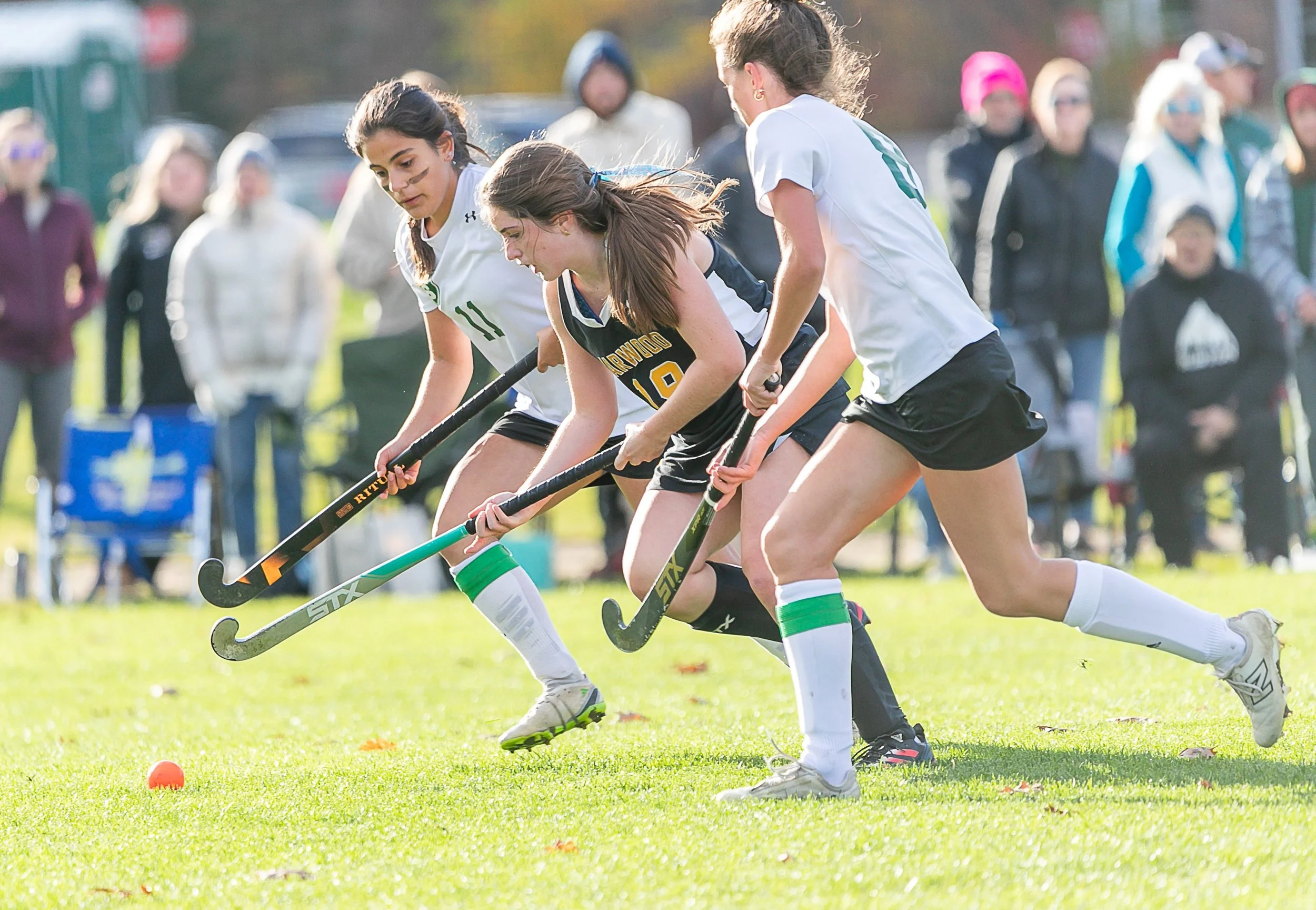
Field hockey will continue to allow 8th graders on high school rosters this year. Photo by Gordon Miller
By James Biggam | Times Argus staff writer The Vermont Principals’ Association unveiled tentative fall championship sites last week in addition to announcing that there will be a slightly shortened spring schedule and changes to the state’s out-of-season coaching policy.
Other noteworthy tidbits from the VPA’s annual Media Day on Thursday included the return of eighth-graders to varsity field hockey, reports of minor improvements with fan behavior, and the continued green light
for transgender athletes to compete in girls sports despite an active lawsuit against the VPA filed by Mid-Vermont Christian.
With 72 member high schools, the VPA also addressed a glaring gender disparity with athletic directors and a startlingly high turnover rate for that position. According to VPA Senior Executive Director Jay Nichols, the average job tenure for Vermont ADs, principals and superintendents is
roughly three years. For the second straight year, there will be 11 high schools with new athletic directors, and over the past four years there have been over 45 instances of high schools welcoming a new AD.
There are currently nine women who account for about 13% of the state’s varsity AD jobs. BFA – Fairfax’s Geri Witalec-Krupa is one of Vermont’s longest-standing female ADs and is joined by Arlington’s Kathi Bierwirth, CVU’s Renee Breault, Leland & Gray’s Tammy Claussen, Long Trail’s Steph Moberg, Peoples Academy’s Gabby Picard, Proctor’s Makenzi Bellando, Thetford’s Bri Barnes and White River’s Amy Parker.
Field hockey allows 8th graders
For the second straight year, eighth-graders can play varsity field hockey, helping to bolster some programs that have struggled with numbers. Eighth-graders are also allowed to compete on varsity for the core sports in soccer, basketball, baseball and softball if there is no JV program. One head-turning example was last winter when four eighth-graders were on the varsity roster for a Peoples Academy girls basketball squad that advanced to the Barre Aud.
Springfield field hockey will not have a team for the first time since the sport kicked off in Vermont during the early 1970s. The Division III Cosmos went a combined 0-55-1 over the past four seasons and suffered three double-digit losses last fall.
VPA Executive Director of Activities and Athletics Dr. Lauren Young said there is a chance field hockey could be consolidated to two divisions during the upcoming years if participation rates don’t improve. The past spring marked the end of D-III boys lacrosse, which had six teams in the postseason tournament. The nine teams currently in D-III field hockey are Missisquoi, Milton, Harwood, Mt. Abraham, Woodstock, Fair Haven, Stowe, defending runner-up Montpelier, and reigning champ Windsor.
Spring sports season shortened
The spring sports schedule will be reduced from 16 to 14 games for baseball and softball after decades of teams attempting to cram in late-season contests prior to playoffs. This year, snow across much of the state in late April created a logjam a month later when programs were scrambling to pencil in make-up dates.
“It’s not good for anyone,” Young said.
A major logistical problem contributing to issues with a 16-game schedule stemmed from the fact that there are separate weeks of spring break for Southern Vermont, Central Vermont and Northern Vermont. Due to scheduling limitations related to weather and field conditions, Southern Vermont League Executive Director Tim Brown reported that 70% of SVL schools did not complete 16 games this past spring.
The perpetual race to play impromptu doubleheaders in late May could be eased a bit by dropping two games from each team’s slate. The two-year policy change could also help reduce conflicts with transportation, and the VPA will collect data in order to make informed decisions about the volume of spring games in the future.
Coaching policy changes
Some guardrails are being removed for varsity coaches who want to train their athletes during months outside of the competitive season. An athlete’s in-season sport must still take precedence if they are juggling multiple activities, and no out-of-season athletic event can be mandatory or impact team selection or playing time for the regular season.
The explosion of year-round club teams has taken a toll on varsity turnouts at some schools, with many instances of athletes being forced to choose one or the other. The VPA still requires high schoolers to participate in 60% of games in order to compete in the playoffs, although there are exceptions for injuries and other extenuating circumstances.
Young described the previous set of rules limiting out-of-season coaching as a “non-enforceable policy” because it was extremely difficult for the VPA to monitor potential violations. The preliminary change allows for more skills-and-drills instruction in open gyms and will last for a year or two in a trial format.
While the summer months were already fair game for out-of-season coaching, now a soccer coach could potentially work with a student-athlete in both the winter and spring after the fall tournament ends.
The relaxed coaching restrictions in the summer allow for organized team activities, but there are some different rules during the academic year. For instance, no school uniforms, logos or branding can be used. In addition, school transportation cannot be provided, there can be no formal rosters, no scrimmages are permitted for contact sports – and there also can be no contact drills.
The VPA will allow out-of-season coaches to provide instruction to students enrolled at their school if activities are open to all eligible athletes and approved by the ADs, who are responsible for monitoring the activities. Multi-sport participation must be actively encouraged and no coach may pressure or incentivize sport specialization.
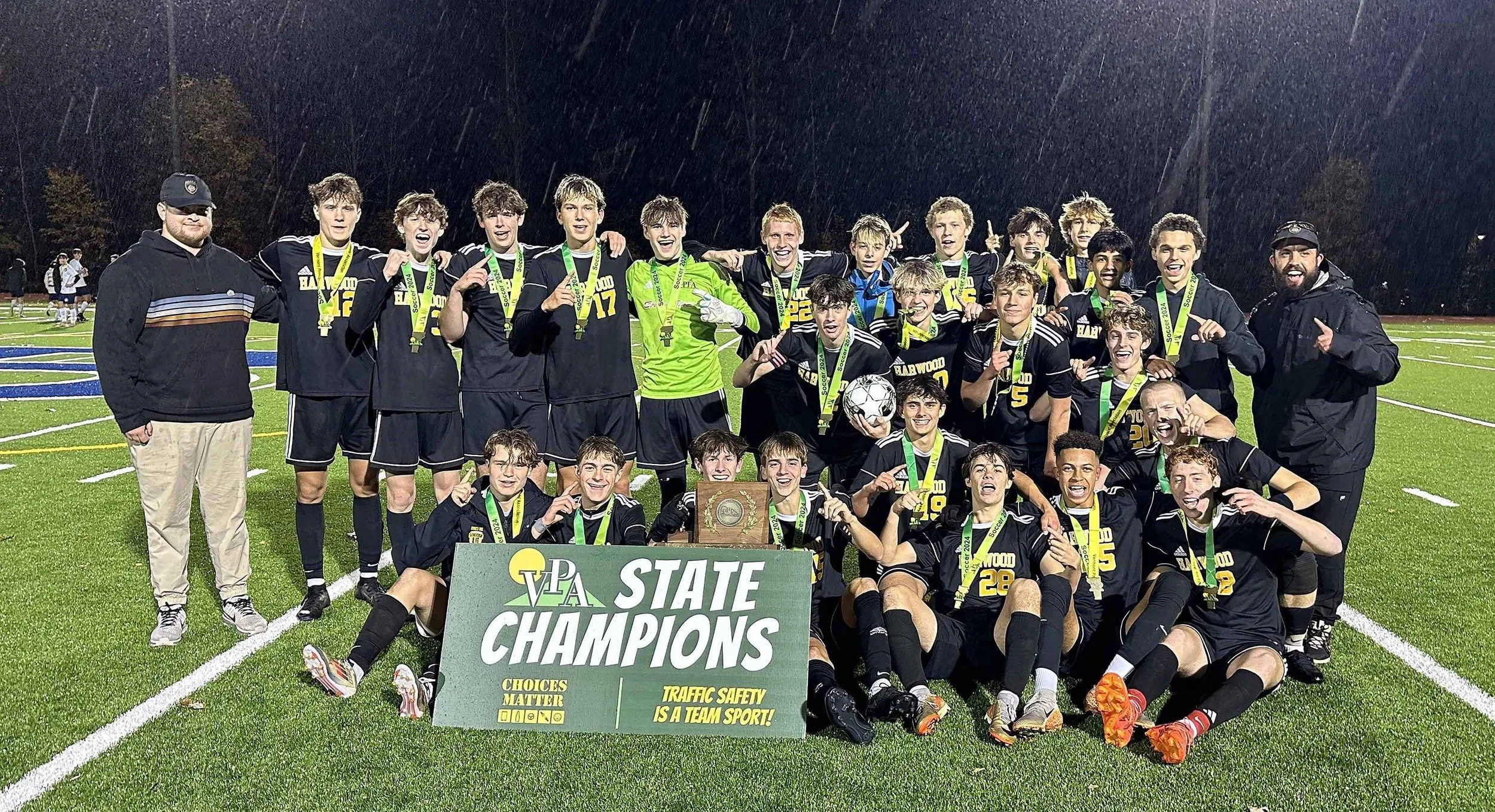
Harwood Boys Soccer wins the 2024 Division II state championship last fall. D-II boys and girls soccer title game dates and venues for the upcoming season have not been set yet. Photo by Gordon Miller
Fall championship dates
Bass fishing teams will head to South Hero for the VPA Classic on Sept. 13 prior to state championships at the same venue Oct. 4. The D-II golf qualifier will take place Sept. 30 at Champlain Country Club in Swanton, while the D-I qualifier will be held the same day at Montague Golf Club in Randolph. Dorset Field Club will host the boys golf finals Oct. 7. The girls golf champs will be crowed Oct. 10 at Lake Morey Country Club.
The tradition of Thetford hosting cross country championships will continue Oct. 25, and top runners will return to the same challenging Upper Valley trails for New England Championships a few weeks later. The field hockey title games will return to the University of Vermont, which will host the D-III game Oct. 31 at 4 p.m. The D-II and D-I finals will take place Nov. 1.
Rutland will host the D-III and D-IV soccer finals Nov. 1, while UVM will host the D-I soccer final the following day. There is currently no date or site for the D-II championships. Volleyball championships will take place Nov. 2 and South Burlington will host all three football finals Nov. 8.
Fan behavior
The VPA was in the spotlight three years ago when a rash of high-profile issues involving unruly fans and allegations of derogatory comments prevented spectators from attending some games altogether. Young is now confident that improvements have been made so that students, coaches and administrators feel empowered to stop incidents in the moment and prevent large-scale escalations.
Young estimated that roughly 95% of questionable-behavior issues at varsity competitions involve adults and she reiterated the fact that games will be stopped until a situation is addressed. One factor contributing to some incidents is that the codes for what’s permitted in a recreational-level sports environment can be very different from what constitutes inappropriate behavior at a varsity event.
Last fall, at least one soccer referee and one football official were followed to their car by unhappy fans. As a result, the VPA is seeking to have designated areas for officials to park and potentially offer post-game escorts to their vehicles.
Transgender athletes
Vermont made national headlines a few years ago after Mid-Vermont Christian refused to compete in a girls basketball playoff game vs. Long Trail, claiming that a transgender athlete compromised the fairness of the game and the safety of the players. The VPA responded by banning the Quechee school from participating in any sports, prompting a lawsuit by Mid-Vermont that rose to the federal appeals court.
“We allow students to participate as they identify,” Young said.
Last year, a federal judge in Vermont shot down Mid-Vermont’s request to rejoin the regular-season and tournament action. The polarizing issue has attracted plenty of attention, and Young stressed that it will be tough to please everyone with a clear-cut set of guidelines moving forward.
“Any policy that’s non-enforceable is a bad policy,” Young said. “If you really go down the line with genetic testing and all the testing Olympics and Paralympics do, that’s not something we have as a policy.”
This story was originally published by The Times Argus on Aug. 15.